

BRICK BY BRICK
A ROAD THROUGH BRITAIN: THE A 1 TEN YEARS AFTER BREXIT
JONATHAN MACK
July 8, 2026
What does Britain look like ten years after Brexit? Not from Parliament, but from the A1. From London to Edinburgh, Sélavy follows the road through a country still being remade. The result is a portrait of Britain in which roads, landscapes, and ordinary places prove more revealing than political slogans.
Ten years after Brexit, Britain still feels strangely unfinished. The arguments have not disappeared. They have simply become quieter. Politicians still speak of sovereignty, growth, immigration, and productivity. Yet some corners are already suggesting a return to the EU.
Meanwhile, economists continue to measure regional inequalities. Journalists search for signs of national renewal or national decline. Every few months, another report appears promising to explain what has happened to Britain since 2016. Most of them describe the country through statistics. Few describe what it actually feels like. Perhaps Britain is better understood from the road.
The A1 runs from London to Edinburgh, following much of the old Great North Road. For centuries it carried kings, merchants, soldiers, mail coaches, and travelers moving between England and Scotland. Today it carries articulated lorries, delivery vans, commuters, contractors, families, and tourists. It is neither Britain’s fastest road nor its most beautiful. Yet it may be its most revealing.
The A1 still moves through Britain rather than around it. It crosses places that have each, in different ways, defined the country: London’s financial hinterland, the logistics belt of eastern England, the coalfields of Yorkshire, the formerly industrial North, Newcastle’s cautious reinvention, the open landscapes of Northumberland, and finally Edinburgh, where another idea of Britain quietly comes into view.

The gravitational center from which the rest of the country slowly disappears.
It is tempting to imagine that countries change through dramatic events: revolutions, elections, wars, referendums. In reality, they usually change more slowly than that. One factory closes. A bypass opens. A warehouse is built. A railway line disappears. A retail park replaces a steelworks. A generation enters finance while another leaves manufacturing. Many years later, the country looks different, yet nobody can identify the precise moment when it changed. The A1 makes those gradual transformations visible.
Leaving London, the city does not really end. It dissolves. Glass towers become office parks. Office parks become retail sheds. Retail sheds become warehouses. Housing estates spread steadily northward until the distinction between city and countryside begins to blur. Somewhere just beyond the M25, London stops behaving like a capital and begins acting like an economic weather system, extending far beyond its own skyline. This may be Britain’s most important transformation of the past half-century. London no longer exists primarily in relation to Britain. It belongs to a network of global cities whose closest companions are New York, Dubai, and Tokyo. Capital flows between them with remarkable ease. The rest of the country often feels less like London’s hinterland than the landscape surrounding an international airport: connected, necessary, but no longer central to the system itself. The buildings tell the story long before the statistics do.
The office towers disappear. Their place is taken by another kind of architecture, one so ordinary that it is almost invisible: warehouses, distribution centers, fulfillment hubs. Vast rectangular buildings standing beside motorway junctions, carrying the logos of Marks & Spencer, Amazon, DHL, Tesco, or Waitrose. They rarely appear on postcards. Architects rarely discuss them. Yet they may be the defining buildings of twenty-first-century Britain. The Victorian age celebrated the factory. Chimneys became symbols of progress. Industrial buildings announced themselves with almost theatrical confidence. The warehouse does the opposite. It wants to disappear. Its purpose is not production but circulation. Goods arrive before dawn, are sorted by algorithms, and leave again practically before anyone notices they were ever there. The modern economy increasingly measures success not by what it makes, but by how efficiently it moves things from one place to another. This quiet shift from production to circulation has transformed Britain’s geography more profoundly than many political debates acknowledge.

The country’s longest argument is conducted at seventy miles an hour.
Industrial towns once existed because something specific was made there. Coal required coalfields. Shipbuilding required rivers. Steel required furnaces. Manufacturing tied knowledge, labor, and community to particular places. Logistics obeys different rules. A warehouse needs access more than geography. A motorway junction becomes more valuable than a harbor. The landscape north of London increasingly resembles a sequence of interchangeable industrial estates because efficiency has replaced locality as the organizing principle.
Britain still produces remarkable things. Its pharmaceuticals, aerospace technology, scientific research, financial services, and creative industries remain internationally significant. But the physical landscape tells another story. It reveals a country whose everyday economy increasingly depends upon movement rather than manufacture. Around Peterborough, this new Britain becomes impossible to ignore.
Peterborough rarely occupies much space in the national imagination. It lacks the mythology of Manchester, Liverpool, or Glasgow. Yet precisely because it is ordinary, it has become extraordinarily important. Peterborough produces very little that carries its own name. Instead it produces access. Roads, railways, and distribution networks intersect here with almost mathematical efficiency. The city’s true industry is connection. There is something curiously elusive about this economy. Distribution centers employ thousands of people, move millions of products, and generate enormous value, yet they leave remarkably little cultural trace. Novelists seldom write about them. Painters ignore them. Tourists drive past without noticing. Victorian Britain built railway stations like cathedrals because industry wanted to be seen. Logistics prefers invisibility. The greatest compliment a supply chain can receive is that nobody thinks about it at all.

The country’s most revealing map contains no politics.
Farther north, another landscape begins to emerge beneath the first. The fields of Yorkshire conceal one of the great geological accidents in European history. Beneath them lie the coal seams that powered the Industrial Revolution. Britain became the first industrial nation not simply because of inventiveness or entrepreneurship but because extraordinary natural resources happened to lie beneath its soil. Entire towns grew from that fact. Mines created villages. Villages became communities. Communities built schools, football clubs, brass bands, libraries, trade unions, and political movements. Coal was not merely an industry. It was an entire way of organizing society.
Driving through Yorkshire today, that world survives mostly as architecture and memory. Former railway embankments disappear into woodland. Brick warehouses stand beside retail parks. Business estates occupy reclaimed industrial land. Massive distribution facilities rise where collieries once dominated the skyline. The transition is so complete that it is almost invisible.
Britain often speaks about deindustrialization as though the country simply stopped working. The road suggests something more complicated. The economy did not disappear; it changed its function. Extraction became circulation. Railway sidings became motorway junctions. Perhaps this is why debates about decline often feel incomplete. They imply absence, whereas the A1 reveals replacement.

The closest thing Britain still has to a town square.
The most revealing place on the entire journey, however, may not be a city at all. It may be the motorway service station. Nobody visits them by choice. Nobody photographs them. They possess none of the romance once attached to the coaching inns of the Great North Road. Yet for twenty minutes, they gather together a cross-section of Britain that few other places still manage. A lorry driver queues behind a corporate lawyer. A retired couple share a table with students traveling home from university. Polish contractors, Scottish tourists, nurses, electricians, football supporters, and families returning from holiday all wait for the same coffee machine. Outside, refrigerated trucks stand beside electric SUVs. Inside, everyone complains about the price of sandwiches.
Britain remains a country deeply conscious of class, education, and accent. Yet inside a service station, those distinctions are temporarily suspended. Everybody is simply passing through. The car park offers another reminder of the country hidden behind political headlines. Britain likes to imagine itself as a nation of financiers, lawyers, and consultants. The motorway suggests something different, namely that it is also a nation of mechanics, delivery drivers, warehouse workers, engineers, nurses, tradespeople, and contractors. Without them, the invisible economy of movement would simply stop.
North of Yorkshire, the road begins to change once again.

The landscape remembers industries long after economists have forgotten them.
Newcastle appears almost unexpectedly, carrying the weight of Britain’s industrial memory while refusing to be defined by it. Coal once traveled down the Tyne. Shipyards lined its banks. Heavy engineering shaped both the city and the imagination of the nation. When those industries declined, many assumed that Newcastle would decline with them, but it never entirely did. The city suffered, certainly. Jobs disappeared. The population dropped. Neighborhoods struggled. But instead of attempting to become another London, Newcastle slowly assembled another identity. Universities expanded. Scientific research attracted investment. Digital companies occupied former industrial buildings. The quayside became a cultural district without pretending that the past had never existed.
This is not a story of miraculous recovery. Britain has produced too many simplistic narratives of decline and revival. Newcastle offers something subtler. Cities recover through institutions before they recover through investment. Universities, museums, hospitals, and public space create confidence long before economic statistics begin to improve.
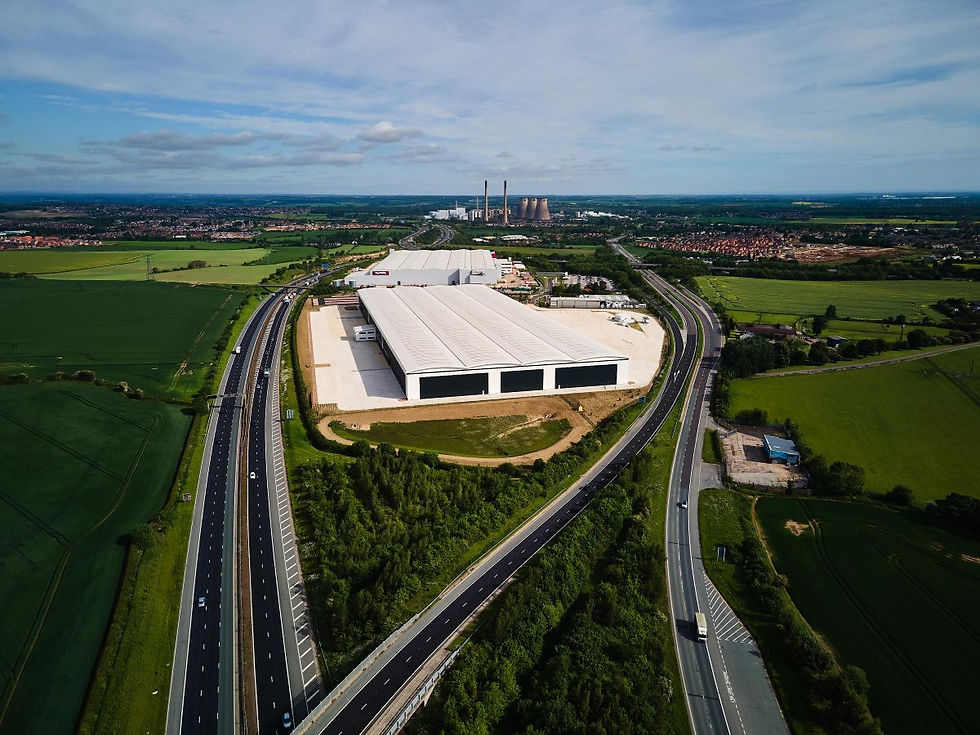
The defining architecture of twenty-first-century Britain rarely appears on postcards.
Leaving Newcastle, traffic thins. Northumberland opens out. The warehouses become less frequent. The sky seems larger. After hundreds of kilometers spent reading Britain through economics, the landscape quietly changes the subject. Then Scotland arrives without ceremony. There are no checkpoints. No dramatic frontier. Only a sign by the roadside announcing another country. Yet Edinburgh feels surprisingly different from everything that came before it. Like London, it is prosperous. Unlike London, its confidence appears rooted less in global finance than in institutions accumulated over centuries. Government, universities, law, medicine, publishing, and culture exist here in unusual density. The city feels remarkably self-assured without appearing frantic.
Looking back along the road, one begins to realize that the journey was never really about wealth. It is about the different ways wealth is created and sustained. London believes that prosperity comes from attracting global capital. The logistics belt believes that it comes from movement. Industrial Britain believed that it came from making things. Edinburgh suggests that it may also come from institutions capable of surviving successive economic revolutions. By the time the castle appears above the skyline, Brexit has almost disappeared from view.

Recovery begins long before prosperity notices.
The curious thing about driving the A1 ten years after Brexit is how little the road appears to care about politics. Prime ministers come and go with astonishing speed. Since the referendum, Britain has watched governments rise, collapse, and replace one another in ever-shorter cycles. Each arrives with a new slogan, a new plan for growth, a new promise to rebalance the country. Then another election comes, and another resignation, and another leader stands outside Number 10 insisting that this time things will be different.
From the A1, very little changes. The warehouses remain beside the same junctions. The former mining towns remain where geology placed them two centuries ago. Lorries continue to carry imported goods north and south every hour of every day. Universities continue producing graduates. Edinburgh continues to govern Scotland. London continues pulling capital toward itself like a powerful gravitational field. Politics changes governments. Geography changes countries.
That may be the quiet lesson of the road. Britain spends enormous energy arguing about Westminster while the deeper forces shaping the country lie outside Parliament altogether: where coal happened to be found, where motorways were built, where universities survived, where capital accumulated, where industries disappeared, and where institutions endured. England, after all, has nowhere left to go except north. Every mile along the A1 is a journey away from the exceptionalism of London and toward another Britain, then another, and another again. The road asks the same question over and over: What happens to a country after the center becomes wealthier than its edges? How many Britains can exist before they stop recognizing one another? No government can answer that in a single parliament. No budget can redraw a landscape built over three centuries.

At the end of the road, another idea of Britain quietly appears.
The A1 can only keep doing what it has always done. It carries the country north, one mile at a time, through the accumulated layers of its own history. Long after today’s speeches are forgotten, long after today’s prime minister has become another chapter in a political memoir, the road will still be there, connecting the same places, exposing the same inequalities, waiting for Britain to decide what kind of country lies beside it.
Jonathan Mack (born in 1962 in Birmingham) studied economics at the University of Birmingham before disappearing into the orbit of Black Sabbath as an unofficial tour assistant, driver, and occasional accountant during a chaotic British tour in the 1980s. He claims to have driven the A1 more than a hundred times between London and the North, usually at night and almost always in the rain. He also insists that conversations somewhere between Doncaster and Scotch Corner inspired the title of the “Headless Cross” album (1989), a story the surviving Black Sabbath members have consistently failed to confirm or deny.
Cover image: Every journey through Britain eventually becomes a choice between London and everywhere else.
Comments