

BRICK BY BRICK
AIRPORT HOTELS: AT THE CENTER OF THINGS, AND IN THE MIDDLE OF NOWHERE
CLARA WEISS
August 25, 2026
When a canceled flight strands hundreds of travelers in a thousand-room hotel at Frankfurt Airport, an anonymous overnight stay becomes a meditation on placelessness, interrupted journeys, and the fleeting country of the delayed.
The flight disappeared from the board at 10:47 p.m. It did not say “canceled” at first. It said “delayed,” then it gave a new time, then another, and finally there was no time at all. This was how the airline communicated the end of the evening: gradually, as if hoping we might not notice.
At the service counter, a woman in a navy uniform handed me a hotel voucher and explained that my suitcase would remain somewhere inside the airport. She said this in the reassuring tone used by people who know where neither you nor your suitcase will be sleeping. Around us, passengers held telephones to their ears and repeated the same information in different languages. The words “tomorrow morning” could be heard with unusual frequency.
The hotel was connected to Terminal 1 by a pedestrian bridge. There was no need to go outside, which meant that I entered Germany without encountering weather, pavement, darkness, or any convincing evidence of Germany. I followed signs through a sequence of illuminated passages, carrying my purse and my hotel voucher.
The voucher named the Sheraton. The building also contained a Marriott. Together, the two hotels had more than a thousand rooms. The precise number was 1,017, a figure large enough to sound less like hospitality than like urban planning. The hotels had separate names, separate reception desks, and separate ideas about carpet. They nevertheless occupied the same connected complex and shared the transient population delivered to them by the airport.
At reception, the line curved through the lobby. There were passengers from a canceled flight to Boston, passengers from a delayed flight to Mumbai, and passengers whose destinations I never learned. A family had arranged three silver suitcases around a sleeping child. Two men in suits studied their phones with the rigid concentration of surgeons. A uniformed flight attendant stood apart from the line, her small black suitcase positioned precisely beside her right foot.
No one appeared to have chosen the hotel. This distinguished us from ordinary hotel guests and gave the lobby the atmosphere of an evacuation center with better lighting. We had not come to Frankfurt. We had failed to leave it.
The receptionist asked for my passport and voucher. She typed for some time, frowned at the screen, typed again, and handed me a key card. The card carried the Sheraton logo and a room number consisting of four digits. She gestured at the elevators.
Also in my elevator were the flight attendant and a couple speaking quietly in Portuguese. Nobody pressed the button for the lobby because the lobby was the one place none of us wished to revisit. The flight attendant left first. She moved without looking for signs, turning into the corridor with the confidence of someone who had been stranded professionally.
When the elevator opened on my floor, I saw a long corridor with beige walls, patterned carpet, and evenly spaced doors. The lighting was neither bright nor dim. It had been calibrated to discourage strong feeling. Nothing in the corridor indicated the country, the hour, or the season. There were no windows. There was only the sequence of room numbers and, at the far end, an illuminated green sign promising an exit.

The view confirms that one has arrived nowhere in particular.
I found my room and placed the key card against the lock. A green light appeared. Inside were a bed, a desk, a chair, two glasses, several lamps, and a window that could not be opened. Through it I could see aircraft moving between runways and gates. Their lights crossed the darkness with purpose. From this distance, no flight appeared canceled.
The room had been designed to eliminate the need for explanation. Instructions appeared in German and English. Electrical outlets accepted the expected devices. The curtains closed completely. The bed offered several pillows of slightly different densities, as if the hotel understood that displacement required options.
In the bathroom stood small containers of shampoo and lotion. I looked for a toothbrush and found none. The airline had retained my toothbrush along with the suitcase, perhaps on the theory that neither would be required until my official journey resumed.
I called reception. The line was busy.
In the corridor, a cleaning cart stood unattended near the elevators. Its shelves contained towels, soap, coffee packets, miniature sewing kits, and other provisions for temporary emergencies. Farther down, a room service tray had been placed outside a door. A half-finished glass of white wine stood beside a covered plate. These were the only signs that the floor was inhabited.
I wandered off in search of a toothbrush. The corridor turned and became another corridor, with the same colors and proportions. The doors repeated themselves with only minor numerical adjustment. Behind them were hundreds of people from many countries, sleeping or failing to sleep in identical rooms. Some had missed weddings or meetings. Some had missed nothing that could not be postponed. Pilots waited for legal rest periods to end. Cabin crews set alarms. Children slept diagonally across beds while their parents adjusted itineraries.
The hotel concealed all of this efficiently. A thousand private disruptions produced no visible disorder. The corridors remained empty, the doors remained closed, and the carpet muffled the movements of anyone still awake.
I took the elevator to another floor. Its doors opened and I stepped out. The corridor looked exactly like mine. For several seconds I stood there with no reliable sense of having moved at all.
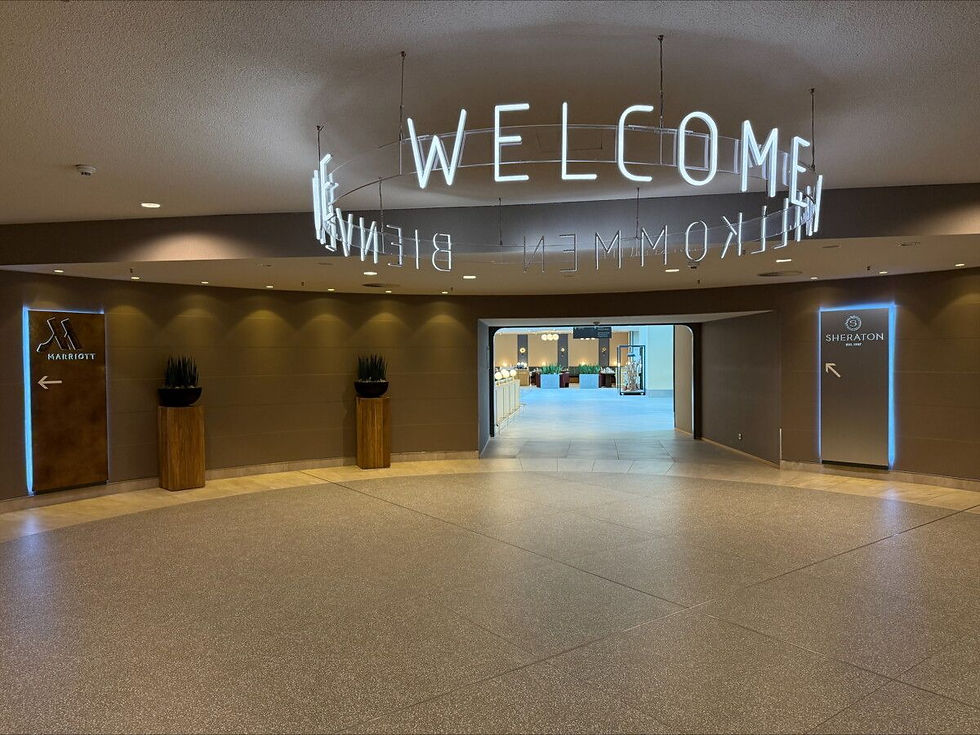
Welcome, the building insists, as if arrival had actually occurred.
I returned to my room, turned off the lights, and remained awake. My body had assigned the hour to another part of the day. At half past three I stopped attempting sleep and went downstairs.
The bar was still open. I could not determine whether this was a service, an oversight, or an acknowledgment that time inside an airport hotel had ceased to be locally enforceable. Several flight crew members occupied a table near the entrance. Their jackets hung over the backs of their chairs. At the bar sat a man drinking beer and looking at a folded boarding pass.
He told me he was from Tallinn. We did not exchange names. Tallinn seemed sufficient.
His flight had arrived late, and the aircraft meant to carry him onward had left without him. He had been given a room, a voucher, and a new departure time. The departure time had already changed twice. He explained this without complaint, as if describing the laws of a country he had not intended to visit.
“Where are we?” he asked.
I said Frankfurt.
“No,” he said. “I mean in the hotel.”
Neither of us knew. The two reception areas, several elevator banks, and repeated corridors had confused the geography. He had walked downstairs intending to find the lobby and arrived at the bar instead. Under the circumstances, he had decided to accept the correction.
The bartender polished glasses beneath lights intended to suggest evening. Behind him, bottles stood in illuminated rows. There was no window and therefore no dawn. The man from Tallinn ordered another beer. I ordered coffee, although coffee at four in the morning is less a solution than a declaration of defeat.
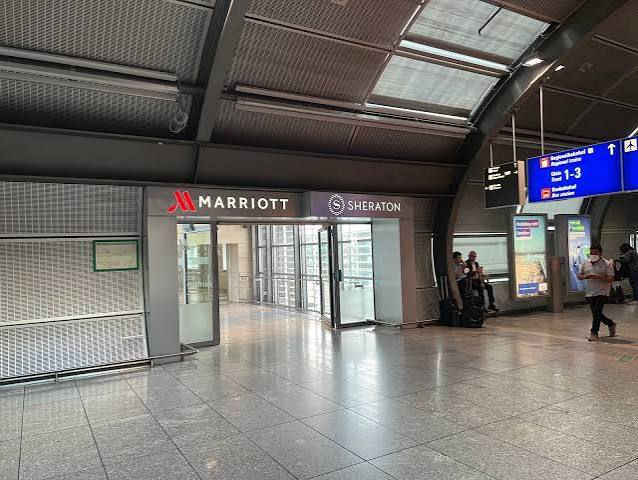
The hotel begins precisely where the airport fails to end.
We spoke about airports, but not about our lives. He named cities in which he had missed flights: Copenhagen, Istanbul, Chicago. I named cities in which my luggage had continued without me. These were the autobiographies available to us.
At a nearby table, one of the pilots laughed. The sound seemed unusually distinct in the nearly empty room. Somewhere above us, more than a thousand doors remained closed.
At half past four, the man from Tallinn looked at his telephone and said that his flight had been delayed again. This gave him three additional hours in Frankfurt, none of which he would spend in Frankfurt.
By morning he would be gone, or I would. I returned to the elevators. At some point the bartender would clear the glasses, the room would become a breakfast room, and our meeting would leave no evidence beyond two charges assigned to two room numbers.
The anthropologist Marc Augé used the term “non-place” for environments organized around circulation rather than belonging: airports, highways, motel chains, shopping centers. The term is useful, although this hotel did not feel like an absence of place. It felt like a place from which everything unnecessary had been removed. History, attachment, accident, and local obligation had been edited out. What remained were signs, procedures, and directions.
In an ordinary place, a person might be known by a name, a family, a profession, or a history. In a hotel, identity becomes logistical. A person is a passport, a room number, a reservation code, a nationality, a departure time. The receptionist does not need to know why anyone is traveling. She needs to know whether or not the airline will pay for their breakfast.

Architecture for those who are already somewhere else.
We may arrive from different countries, but the hotel makes the differences less important than our shared interruption. Accents, clothing, and passports distinguish us. The same voucher, the same key cards, and the same uncertainty make us temporarily alike. In this case, we were not citizens of Frankfurt and not quite visitors to Germany. We were passengers whose movement had stopped.
This was not cosmopolitanism in its optimistic sense. We represented many nations, but we did not form an international community. We stood beside one another without becoming known to one another. Diversity was visible everywhere and intimacy almost nowhere. The man from Tallinn and I spoke because neither of us could sleep and because the bar remained open. Had our flights departed on time, we would have passed through the terminal without noticing each other.
The hotel brought people together by preventing them from reaching the people they had intended to meet.
The flight crews occupied a different position. For passengers, the hotel was an accident. For pilots and cabin crews, it was part of an established routine. They entered with small regulation suitcases, knew which elevators to use, and understood the hours at which food could still be procured. Their familiarity did not make the building a home. It made them professionals in temporary existence.
There are also people for whom the hotel is neither accident nor interval. The receptionist, bartender, cleaners, cooks, and maintenance workers return to it repeatedly. They know which corridor leads somewhere and which only appears to. They know the rooms not as interchangeable boxes but as a daily sequence of work. The building that erases the guests’ identities depends on workers whose own lives remain largely invisible to those guests.
Calling this hotel a non-place therefore described the experience of the traveler more accurately than the nature of the building. A room used once is anonymous. A room cleaned every day is a workplace. A bar visited during one sleepless night seems detached from time. To the bartender approaching the end of a shift, five in the morning is a precise and consequential hour.

A landscape composed entirely of connections.
The hotel’s anonymity was not accidental. It was a service. The room contained nothing that required interpretation and little that might offend expectation. A traveler from Tallinn, Toronto, Tokyo, or Tunis could understand the lights, the lock, the telephone, and the evacuation map. The absence of local character allowed the building to receive almost anyone. Placelessness was one of the comforts included in the rate.
It was also a form of control. Movement followed signs. Access depended on cards. Breakfast required a room number. Elevators divided the building into authorized floors. The hotel asked few personal questions because it already possessed the information it needed. We experienced this as anonymity, but anonymity did not mean being unrecorded.
More than a thousand rooms created the population of a small town without producing its public life. There was no square, no school, no cemetery, no memory of who had lived there. The lobby resembled a public space, but everyone in it was either arriving, leaving, waiting, or being paid to remain. Nobody could quite inhabit it.
The strange achievement of the airport hotel was to gather the world without creating a world. It placed hundreds of private stories behind identical doors and preserved their separation. In the morning, when the flights began again, the population would disperse. The rooms would be cleaned, the key cards erased, and the building would prepare to forget us.
At seven, the breakfast room contained perhaps two hundred people. They appeared all at once, as if the thousand closed doors upstairs had released their occupants according to a signal I had missed.

A room designed to leave no memory of having been occupied.
The room was large, but not large enough to make two hundred people seem accidental. Tables had been pushed close together. Coffee machines flashed instructions in several languages. Guests moved between trays of eggs, bread, fruit, cold meat, and small containers of yogurt with the subdued urgency of people whose next departure had already been determined by someone else.
The stranded passengers were recognizable by their rumpled clothes. Some carried the envelopes containing their vouchers. One woman ate breakfast with her passport on the table beside her plate. Two parents consulted their telephones while their children constructed a tiny fort from packets of sugar. At another table, a man wearing a business suit without a tie conducted a video call in a low voice. Behind him, a toddler cried in another language.
Flight crews sat together. The pilots’ uniforms gave them an authority the canceled flights had made temporarily irrelevant. Cabin crew members drank coffee and checked their watches. Their suitcases stood in orderly rows beside the tables, smaller and better behaved than the luggage of ordinary passengers.
I heard German, English, French, Arabic, Spanish, and several languages I could not identify. The variety suggested an international gathering, but there was no gathering. We had not come together for a conference, a wedding, a political event, or a shared belief. Two hundred people occupied the same room because a system designed to keep them moving had stopped.
At breakfast, the hotel’s hidden population became visible. Upstairs, the identical doors had concealed nationality, age, profession, and circumstance. Here those differences returned, arranged around identical white cups. Everyone had a separate destination and a separate reason for needing to reach it. Nobody knew the name of the person at the next table.

The Sheraton: You’ll know it when you’ve passed it three times.
The room was crowded but curiously private. Conversations remained within families, crews, and traveling pairs. Those sitting alone looked at their phones. Nobody addressed the room because there was no room to address, only a temporary concentration of interrupted itineraries.
The staff moved among us, clearing plates and resetting tables with remarkable speed. A place appeared as soon as someone left, and another guest sat down before the chair even had time to cool. The table retained no other record of its previous occupant.
By eight, the departure screens on our phones had begun issuing instructions. People stood, collected passports and bags, and left without saying goodbye. The breakfast room had made us visible to one another, but visibility had not made us a community.
Within an hour, most of the tables would be empty. The cups would be washed, the crumbs removed, and the chairs returned to position. By the following morning, another two hundred people might sit in the same room, equally international, equally anonymous, and convinced that their presence there was an exception.

Frankfurt Airport: a city designed entirely around leaving it.
My flight left later that morning. I crossed the bridge to Terminal 1 carrying the same items with which I had arrived. The hotel disappeared behind me almost immediately. From the terminal, there was no indication that more than a thousand rooms stood on the other side of the wall.
The man from Tallinn had already gone, or had been delayed again. I would never know.
Nothing had happened that the hotel was designed to remember. We had arrived, been assigned numbers, slept or failed to sleep, eaten breakfast, and left. Our rooms were then made identical again.
Airports exist for people going elsewhere. For one night, however, elsewhere had become unavailable. We remained together in the strange interval between where we had been and where we believed we belonged. Then the departures resumed, and the country of the stranded dissolved without ceremony.
Clara Weiss (b. 1998 in Porto) works as a dental hygienist. A frequent traveler and close observer of everyday life, she is fascinated by how people move through the world and by the temporary communities that emerge in airports, hotels, ports, and other way stations.
Cover image: Every corridor promises departure, eventually.
Comments