
POLITICS AND POETICS
AN IRONY OF LANGUAGE: WORDS AS MORAL ARCHIVES
GEORGINA STEINER
September 22, 2026
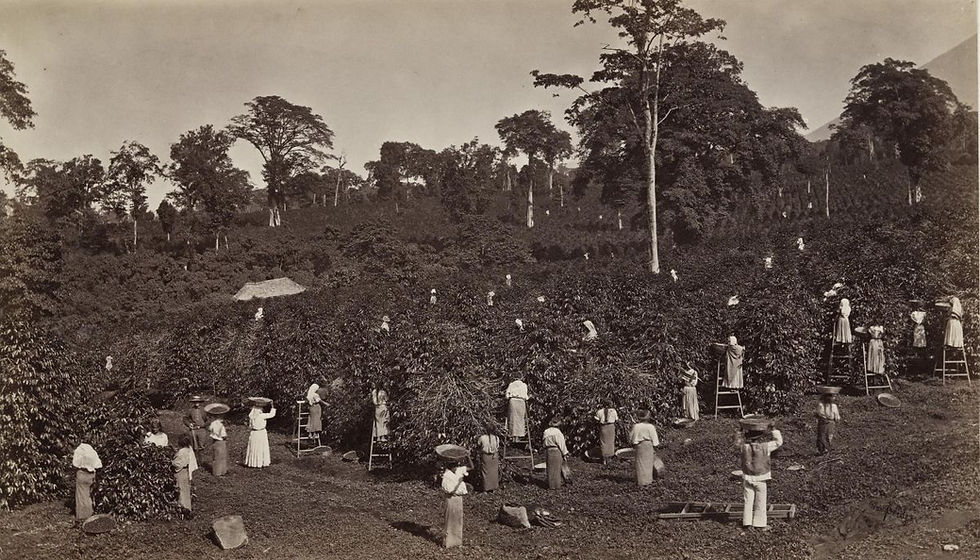
Why does a coffee plantation in Guatemala feel different from a plantation in the US South, even though the word is the same? Some language does more than describe the world; it preserves the histories that shaped it. From “plantation” and “ghetto” to “colonial” and “master,” words carry invisible archives of violence, power, and memory. Here, Georgina Steiner explores the strange moment when ordinary words become witnesses to the past.
Mention a Guatemalan coffee plantation today, and some may hesitate over the word “plantation.” Mention a plantation in the nineteenth-century US South, and no one would think of replacing it. In the latter case, the word is not merely acceptable; it is historically indispensable. The same noun can feel uncomfortable in one context and necessary in another. It is considered problematic in its most innocent use and unavoidable in its most troubling one. This is one of the ironies of language.
The hesitation is strange because it has little to do with accuracy. A plantation is still a plantation. Coffee plantations exist throughout Guatemala and across much of Latin America. Tea plantations exist in India. Rubber plantations exist in Southeast Asia. The word describes a particular form of agriculture: large-scale cultivation, usually for commercial production. Nothing in the dictionary definition has changed. And yet the word no longer arrives alone. It arrives carrying history.
We often imagine words as neutral instruments, simple labels attached to objects in the world. But language does not work like a catalogue. Words accumulate. They gather associations, memories, emotions, and judgments. They become less like entries in a dictionary and more like old cities, where different centuries exist on top of one another. Roman walls remain beneath medieval churches; medieval structures remain beneath modern buildings. Nothing disappears completely. The past survives beneath the surface. Words are built in much the same way. Every generation inherits not only a vocabulary but also the historical layers attached to it. Sometimes those layers remain invisible. Sometimes they suddenly become impossible to ignore.

A historical bird’s-eye view of the Jewish Ghetto in Venice, where the word “ghetto” originated. Before it became a metaphor for almost any form of separation, it described an actual place with actual boundaries.
The word “plantation” belongs to a larger family of words that have acquired this double existence. Consider “ghetto.” It can describe a neighborhood or district, but it also carries the memory of the Jewish quarter of Venice, the Nazi ghettos, and the Warsaw Ghetto. “Crusade” can mean a passionate campaign for a cause, yet it still echoes with the memory of religious conquest and medieval warfare. “Master” can refer to expertise, craftsmanship, or education, while also carrying the history of ownership and enslavement. “Reservation” can mean a hotel booking, but it also evokes the forced displacement of Indigenous peoples. “Settlement” can describe the founding of a community, a legal agreement, or a politically contested act of occupation. These words have not lost their original meanings. That is precisely what makes them interesting. They have acquired a second life.
They exist in a double register. One meaning belongs to ordinary description. The other belongs to historical memory. A speaker may intend one; a listener may hear both. The word functions normally, but somewhere beneath the surface, another meaning remains present. The question is why certain words become capable of carrying this additional weight.

The boundaries of the Warsaw Ghetto superimposed on a contemporary map of Warsaw. A vanished prison remains perfectly legible in the streets of the present.
After all, history is full of violence. Castles were instruments of domination. Kingdoms were created through conquest. Empires expanded through the control of other peoples. Yet these words rarely produce the same hesitation. A castle can be admired as architecture. An empire can appear in the name of a company or a hotel without immediately evoking conquest. Why? If violence alone determined which words became morally charged, almost every word inherited from the past would carry the same burden. But history does not distribute its weight evenly across language. Some words remain historical. Others become moral.
Perhaps the difference lies not simply in whether violence occurred, but in whether the consequences of that violence remain morally unresolved. Certain events do not remain only subjects for historians. They become part of the moral vocabulary through which societies understand themselves. Slavery, colonialism, genocide, racial segregation, religious persecution, forced displacement—these are not merely events that happened. They continue to shape ideas of justice, identity, and power. Because the past is not entirely past, the language associated with it cannot become entirely neutral. This is why some words seem to contain witnesses.
A word like “plantation” does not simply describe a place where coffee or sugar is grown. In certain contexts, it also recalls a system of labor, ownership, and human suffering. The word itself is not guilty. Words do not commit crimes. But words can preserve the memory of crimes. Perhaps that is their most remarkable quality.
We usually think of memory as something stored deliberately. We build archives. We create museums. We establish monuments. We write books. These are conscious acts of preservation. Language preserves differently. It preserves almost accidentally. No generation decides that a particular word will carry the weight of the past. No institution declares that a noun has become historically charged. It happens slowly, through centuries of use, through stories told and retold, through arguments, mourning, scholarship, and remembrance. A word becomes heavier because human experience has accumulated around it. The dictionary records what a word means. History records what a word has witnessed. And sometimes those two records no longer perfectly align.

A restaurant table marked Reserved. Two places politely protected from the general public. Territorial control reduced to lunch.
These words deserve a name. They are not simply historical terms. They are not merely examples of semantic change. They preserve not only a record of what happened, but a judgment about what happened. They are moral archives. An archive exists because something must be preserved after the original moment has passed. Documents are collected because memories fade. Photographs are stored because witnesses disappear. Objects are conserved because physical traces of the past are fragile.
A moral archive performs a similar function, except that it exists inside language itself. It preserves what a society has decided it must continue to remember. A dictionary tells us what a word denotes. A moral archive tells us what a civilization remembers. This is why language can never be entirely separated from history. Words do not float above time. They are shaped by the circumstances in which people use them. They carry traces of the societies that created them, the institutions that relied upon them, and the conflicts that transformed them.

Map of Native American reservations in the United States, compiled under Commissioner of Indian Affairs Thomas J. Morgan in 1890. Here, a reservation does not hold your table; it determines where you are permitted to live.
A language is therefore not simply a tool for communication. It is also a record of human relationships. It contains the vocabulary of love and violence, invention and destruction, freedom and domination. Some words celebrate achievements. Others preserve wounds. Some describe things that disappeared centuries ago but continue to influence how later generations understand themselves. The most fascinating question is not why these words have changed. It is why they have not.
Why does “plantation” still carry such force? Why does “lynching” remain almost inseparable from the history of racial terror? Why does “colonial” often arrive with a moral judgment attached? Why does “master” create discomfort in contexts where it once seemed entirely ordinary? The answer is that these words do not simply describe objects. They describe relations of power.

A 1948 receipt from S. B. Billimoria & Co. in Bombay, recording 3,000 rupees “in full settlement” of a bill. History concluded, stamped, signed, and entered into the accounts.
A plantation was not only a place where crops grew. It was also a system of labor and ownership. A ghetto was not merely a neighborhood. It was often a mechanism of separation and exclusion. A colony was not only a territory. It was a relationship between ruler and ruled. A lynching was not simply an unlawful killing. It was a public demonstration of power. The words remain charged because the structures they describe were not accidental events. They represented ways in which societies organized human relationships. Yet memory is selective. Civilizations do not remember every injustice equally. Countless cruelties disappear into history. Others remain embedded in language. No institution decides which words will carry this burden. It happens gradually, through generations of speaking, writing, teaching, arguing, and remembering. History settles unevenly upon language.

A map of “The British Colonies and Possessions,” published in 1886, with the empire colored across the globe. Before “colonial” became a furniture style, it was a claim upon much of the world.
This is also why debates about words are rarely only about words. They are often arguments about which layer of history should take precedence. One person hears the ordinary meaning. Another hears the historical memory. One person protects precision; another protects remembrance. Both are responding to something real. The challenge is that language must perform two contradictory tasks at once. It must describe the world accurately as it exists, while preserving the memory of how that world came to exist. It must be both a window and an archive. Perhaps that is the ultimate irony. The words that most clearly reveal the past are often the words we most want to use carefully. Yet if they disappeared entirely, something else would be lost. The discomfort they create is also evidence that memory has survived.
8. A John M. Smyth Company advertisement for “Colonial Bedroom Furnishings,” published in the Chicago Sunday Tribune in the early twentieth century. Colonialism, domesticated and delivered as a matching bedroom suite.
A society that forgets the history inside its words risks losing more than vocabulary. It risks losing the ability to recognize the forces that shaped it. A word like “plantation” demonstrates this complexity perfectly. To avoid it when discussing slavery would be historically absurd because it names the institution precisely. To avoid it when discussing coffee cultivation would also be unnecessary because the agricultural meaning remains valid. The word has not failed. It has succeeded in doing what language has always done: carrying more than one moment at once. A coffee plantation in Guatemala remains a plantation. A plantation in the US South remains a plantation. The word carries what something is. And it carries what happened.
That is an irony of language.
Georgina Steiner (born 1983 in Aalborg, Denmark) is a historian of linguistic ghosts. She studied comparative literature at the University of Copenhagen and completed her doctoral research at Cambridge on language, memory, and historical consciousness. Her work examines the moments when words stop simply describing the world and begin carrying its unresolved arguments, forgotten compromises, and moral histories. Her books include “The Unreliable Dictionary” (2012), “The Words We Inherit” (2018), and “A Brief History of Difficult Words” (2024).
Cover image: Coffee pickers working on a plantation in Guatemala, photographed by Eadweard Muybridge in the 1870s. Long before the plantation became a wedding venue, it was a system of labor.
Comments