
Updated: Aug 28
SILVER SCREEN
BLOW-UP: THE POLITICS OF INFINITE ZOOM
ADRIAN K. MERTENS
March 12, 2026
In 1966, the Italian filmmaker Michelangelo Antonioni made a film about a photographer who believes that if he looks closely enough, reality will confess. What seems like a thriller becomes a study in scale: how much detail the world can sustain before it collapses into abstraction. In an age of infinite replay, pixel-level scrutiny, and algorithmic certainty, Antonioni’s film feels less like a period piece and more like a warning. This essay revisits “Blow-Up” as a meditation on resolution, proportion, and the politics of seeing too much.
Blow-Up (1966) begins as a possible crime story and gradually becomes something far more unsettling: an allegory about knowledge itself.
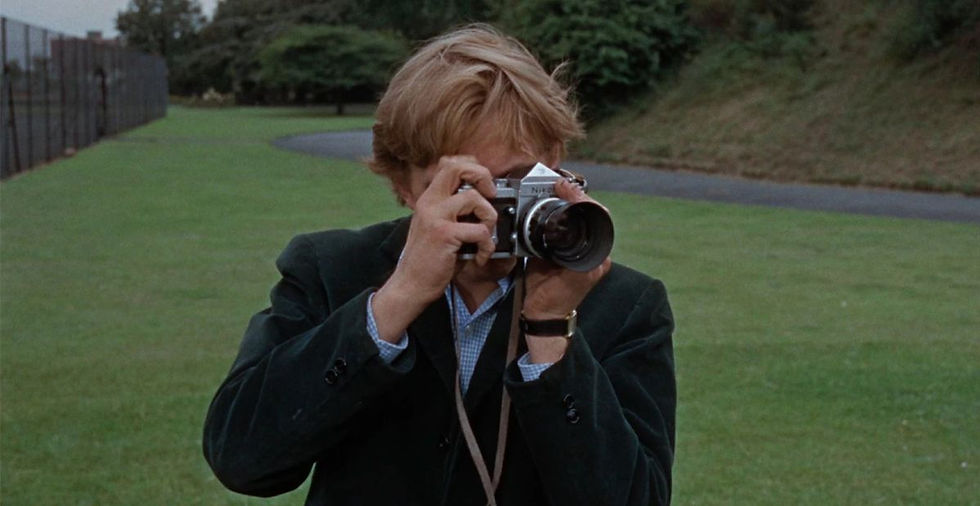
The narrative appears simple. Thomas, a fashion photographer in London, wanders into a park and casually photographs a couple. Later, in his studio, something unsettles him. He develops the negatives. A shadow in the bushes appears suspicious. He enlarges one frame. Then another. A shape begins to resemble a gun. Another enlargement suggests a body lying in the grass. He enlarges again. The image thickens into grain. Edges dissolve. Forms disintegrate into black-and-white particles. What once appeared coherent becomes surface. The closer he looks, the less certain he becomes. The blow-up reveals not hidden truth but the structural limit of representation. This gesture is the core of the film. And it is not merely cinematic. It is epistemological.
We are trained to believe that knowledge increases with magnification. To understand something, we look more closely. To verify, we isolate. To clarify, we dissect. The logic feels foundational: Proximity produces truth. Antonioni stages the collapse of that confidence, and does so calmly, almost politely.

Blow-Up II: The Frame
At normal scale, the photograph works. It depicts a scene. It allows recognition. The couple in the park appear stable within the frame. But once Thomas enlarges the image beyond its resolution, it ceases to function as a window and becomes texture. The body that seemed visible turns ambiguous. The gun dissolves into shadow. The photograph no longer refers outward to an event; it refers inward to its own material grain.
The German philosopher Hans Vaihinger (1852–1933) offers a precise vocabulary for this collapse. In The Philosophy of “As If” (1911), he argued that human knowledge operates through useful fictions. We treat concepts as if they fully correspond to reality, even though they are provisional constructions. They function effectively until we press them beyond their operative range. The photograph in Blow-Up functions as such a fiction. At a certain distance, it coheres. It presents a world. But when Thomas demands absolute verification, when he insists on stripping ambiguity away through enlargement, the fiction falters. The blow-up exposes the scaffolding of representation. Knowledge depends not only on access, but on scale.
Why return to Blow-Up now? Because we inhabit an era defined by infinite zoom. Our technologies promise total enlargement. Every image can be magnified. Every statement replayed. Every gesture is isolated and subjected to forensic scrutiny. High-resolution cameras, algorithmic parsing, endless screenshots—the contemporary condition rests on the assumption that opacity is temporary. If something remains unclear, we simply have not looked closely enough. Resolution, we assume, is endless.
Blow-Up feels prophetic not because it anticipated digital photography, but because it dramatized the instability built into magnification itself. Antonioni stages the precise moment when enlargement ceases to clarify and begins to abstract. We look at this film now because we have mistaken resolution for truth. The film proposes a counter-intuition: Beyond a certain threshold, the demand for clarity erodes coherence.

Blow-Up III: The Crop
Seen in the context of Antonioni’s broader work, Blow-Up represents not a departure but an intensification. The director had long been preoccupied with disappearance, misrecognition, and the failure of narrative resolution. In L’Avventura (1960), for example, a woman vanishes and is never found. In L’Eclisse (1962), a love story dissolves into empty urban space. What distinguishes Blow-Up is that the instability migrates from human relationships into perception itself. The uncertainty is no longer only emotional or social; it is optical and epistemological. The camera, which once merely recorded alienation, becomes the instrument that produces it. In this sense, Blow-Up is Antonioni’s most explicit meditation on modernity—not simply the loneliness of individuals, but the fragility of the frameworks through which we believe we see the world clearly. This is why we turn here not to the usual suspects of theory, but to thinkers who appear when philosophy itself is “blown up,” when its smooth surface reveals grain.
In The Obsolescence of Man (1956), the philosopher Günther Anders (1902–1992) wrote about technological disproportion. Modern technologies extend our capacities beyond human scale. We can see farther, record more, produce effects at planetary magnitude, yet our moral and interpretive frameworks remain stubbornly finite. There emerges a gap between capability and comprehension.
For Anders, this gap was existential. Our machines outpace our imagination. We can annihilate a city, but we cannot adequately picture that annihilation. We live, he suggested, in a state of “Promethean shame,” embarrassed before the precision and magnitude of our own inventions. The more our instruments amplify perception, the less proportionate our understanding becomes. Enhancement does not guarantee orientation. Often it guarantees vertigo.
Thomas’s camera embodies that disproportion. It extends perception beyond immediate experience, yet what it reveals cannot be stabilized. Amplification exceeds interpretation.

Blow-Up IV: The Enlargement
The mathematician Benoît Mandelbrot (1924–2010) demonstrated that certain forms do not become smoother when magnified. In The Fractal Geometry of Nature (1982), he showed that a coastline appears stable from afar. Zoom in, and irregularity proliferates. Zoom farther, and there is no final clean boundary, only further complication. The closer one measures, the longer the coastline becomes.
The photograph in Blow-Up behaves fractally. At a distance, it appears coherent. Under magnification, instability multiplies. Forms fragment into grain. The structure does not simplify; it disintegrates into finer uncertainty. Reality, the film suggests, may not possess infinite resolution.
Edmond Jabès (1912–1991) approached this fragility not as a psychological condition but as a linguistic one. In The Book of Questions (1963–73), he presents language itself as precarious, suspended between utterance and silence. Words do not stabilize meaning; they expose its instability. Each sentence feels like a threshold, opening onto what it cannot fully articulate. For Jabès, meaning is never secured but trembles at the edge of absence. To write, therefore, is not to preserve presence but to inscribe loss. Every word carries a trace of what has already vanished.
Excessive explanation does not secure clarity; it exposes fissures. Interrogate a word long enough and it begins to echo rather than signify. Thomas’s enlargements resemble commentary devouring its own text. Each blow-up is a footnote to the previous image. The more he interrogates the photograph, the less it speaks.
The philosopher Gilbert Simondon (1924–1989) insisted that individuals emerge from relational fields. To isolate something absolutely from its context is to distort it. A photograph already extracts a moment from its milieu. A blow-up extracts a fragment from that moment. By the final enlargement, the relational field that allowed recognition has vanished. Isolation, pursued to its limit, becomes misrepresentation.

Blow-Up V: The Grain
The thinkers above are not grand system builders. They work at the edges. They become most relevant when dominant theories are pushed to their limits, when what once appeared seamless begins to crack. When philosophy is magnified, its smooth surface reveals inconsistencies, blind spots, and unresolved tensions. It is at precisely that moment that Vaihinger, Anders, Mandelbrot, Jabès, and Simondon come into focus. Our moment does not require larger explanatory systems or ever-expanding frameworks. It requires an account of proportion, an understanding of where knowledge breaks down, where scale distorts meaning, and where the pursuit of total clarity begins to undermine itself.
As Blow-Up progresses, instability does not simply linger; it accumulates. The woman in the park urgently demands the photographs, yet never explains why. The older man remains a figure without identity or history. The body Thomas believes he sees in the grass vanishes by the time he returns. The negatives are stolen. What remains is a single blurred enlargement, so abstract that it proves nothing and, in proving nothing, proves everything about the fragility of proof itself. Antonioni removes stabilizing elements one by one, almost methodically. Each potential anchor of certainty is withdrawn. There is no confession, no recovered evidence, no final clarification. The film refuses confirmation, motive, closure. Even the possibility of crime becomes ambiguous: Was there a murder, or only the projection of one? In a conventional thriller, investigation tightens the narrative. Clues accumulate. Revelation restores order. Here, investigation produces the opposite effect. The more Thomas pursues the truth, the thinner the world becomes. The act of knowing destabilizes what is known. Inquiry does not resolve ambiguity; it intensifies it, until the search itself appears as the source of dissolution.
The final scene completes the allegory. A troupe of mimes plays tennis without a ball. When the invisible ball rolls toward Thomas, he hesitates, then picks it up and throws it back. We hear the sound of a tennis ball. Meaning appears through participation, not verification. The invisible ball works because no one attempts to enlarge it.

Blow-Up VI: The Question
Antonioni is not advocating illusion over truth. He is exposing the conditions under which meaning can exist. The politics of infinite zoom rest on the belief that sufficient magnification will reveal a stable reality. Blow-Up dismantles that belief.
Every medium has a threshold. Beyond it, magnification reveals grain rather than clarity. Knowledge requires proportion. Too much distance, and detail vanishes. Too much proximity, and structure dissolves.
At the end, Thomas fades as the camera pulls back across the park. The man who believed enlargement would secure reality dissolves into the field he tried to decode. The image thins. The world remains. We are left with a question that extends beyond cinema: How close can we look before meaning disintegrates? And perhaps more urgently: Do we still know how to stop?
Adrian K. Mertens was born in Rotterdam in 1976 during a minor optical illusion no one could later verify. He briefly enrolled in philosophy, then mathematics, then photography at universities too small to mention, abandoning each discipline at the precise moment when it began to make sense. His unpublished dissertation, “Toward a Theory of Excessive Clarity,” was rejected after he enlarged a footnote until it replaced the text.
Cover image: Blow-Up I: The Shot
Comments