

SILVER SCREEN
FEAR CHANGES ADDRESS: THE MIGRATION OF AMERICAN ANXIETY
LEONARD KESSLER
July 22, 2026
Every generation remakes “Cape Fear.” The plot barely changes, but the fear certainly does. From the criminal outsider to the guilty insider to a world where nobody agrees on the truth, one thriller has quietly documented sixty years of American anxiety. It is less a history of crime than a history of what Americans believe threatens them most.
By the time a story has been told three times across six decades, it is no longer simply a story. It becomes something closer to a diagnostic instrument. A recurring dream. A cultural symptom. Each generation returns to it not because it has run out of ideas, but because the old story continues to reveal something new about the fears of the present.

The final struggle. Fear eventually demands a confrontation.
The story of Cape Fear is deceptively simple. A convicted criminal is released from prison and begins terrorizing the lawyer he believes betrayed him. The criminal wants revenge. The lawyer wants protection. On paper, it sounds like the premise of a conventional thriller. Yet the story has proven unusually malleable—first as John D. MacDonald’s novel The Executioners in 1957, then as the 1962 film directed by J. Lee Thompson, then again as the 1991 remake directed by Martin Scorsese, and now as a television series.
The remarkable thing is not that the story endures, but that the villain remains essentially the same while the society around him changes beyond recognition. Max Cady returns from prison in every version. Yet each time he enters a different America.
The first movie version, from 1962, emerged at the edge of a world that still believed in authority. America was confident, prosperous, and institutionally stable. The postwar order appeared durable. Trust in government remained high. The family, at least as an ideal, occupied a sacred place in public life. The lawyer at the center of the story represented more than a profession. He represented legitimacy itself. In that version, fear arrives from outside. Cady is an intruder, a force entering an otherwise orderly system. The family is fundamentally healthy before his appearance. The legal system may be imperfect, but it remains recognizable and functional. The distinction between good and evil is relatively clear. Robert Mitchum’s performance is unsettling precisely because he exists beyond the boundaries of acceptable society. He threatens civilization from the outside.

Robert Mitchum’s Max Cady. No psychology. No excuses. Just menace.
This was a common fear in twentieth-century America. The criminal. The communist. The outsider. The invader. The stranger crossing an invisible boundary between order and chaos. The fear itself is almost architectural. There is an inside and an outside, and a wall between them. The drama begins when someone climbs over it. Looking back, what feels striking is not the violence but the certainty. The film never doubts where the danger originates. It knows who the villain is. It knows who deserves protection. It knows what justice looks like.
Many of the most popular American thrillers of the period operate according to similar assumptions: Evil exists. It can be identified. It can be confronted. It can ultimately be defeated. Fear functions as a temporary disruption rather than a permanent condition.

In the original Cape Fear, fear arrives not as chaos, but as calculated intimidation.
Three decades later, that confidence had largely evaporated.
When Scorsese returned to Cape Fear in 1991, he inherited the narrative structure but situated it in a very different cultural landscape. America had passed through Vietnam, Watergate, urban decline, rising inequality, media saturation, and the collapse of many postwar certainties. Distrust had become a defining feature of public life. The result is one of the most fascinating remakes in American cinema because it does not simply update the original. It interrogates it.

By 1991, villains came with trauma, theology, literature, and tattoos.
Robert De Niro’s Max Cady is no longer merely a criminal. He is a grotesque mirror. He understands the hypocrisies of the respectable world better than the respectable world understands itself. He is violent, manipulative, and monstrous, but he is also strangely perceptive. He sees weakness everywhere. Most importantly, the lawyer is no longer innocent. The revelation that Sam Bowden concealed evidence during the original trial changes everything. Suddenly the moral architecture begins to shift. The wall separating good and evil develops cracks. The distinction between victim and perpetrator becomes unstable.
Fear no longer comes exclusively from outside. Part of it already lives within the family itself. The 1991 version is obsessed with contamination. Every institution appears compromised. Marriage contains secrets. Professional ethics contain compromises. Desire contains violence. Respectability contains guilt. The family home no longer feels entirely safe because the threat is not simply approaching from beyond the property line. It already exists within the emotional structure of the household.
This transformation reflects a larger cultural shift. By the late twentieth century, Americans increasingly distrusted grand narratives of innocence. Political scandals, corporate misconduct, and media exposure had made hidden corruption seem ordinary. The suspicion that respectable people might be concealing something became almost instinctive. The hero of the story could no longer remain pure because audiences no longer believed in pure heroes. Consequently, fear changed its location.
In 1962, fear stood at the door. In 1991, fear sat at the dinner table. The difference is profound. External threats can be confronted. Internal contradictions are far more difficult to escape. This movement from external danger toward internal instability appeared across American culture during the same period. Horror films, crime novels, political discourse, and television increasingly focused on hidden dysfunction. The monster often turned out to be a neighbor, a family member, or even oneself.
Scorsese understood this intuitively. His Cape Fear feels less like a thriller than a psychological excavation. Every character appears trapped within desires and anxieties they barely understand. The violence matters less than the uncertainty. The audience no longer fears only what Max Cady might do. They fear what he reveals.
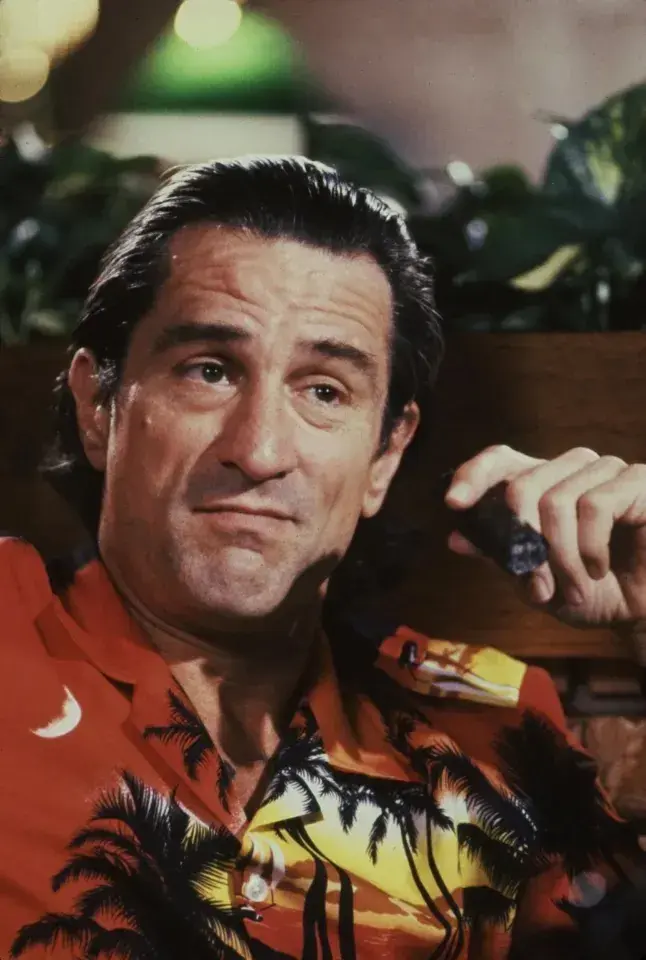
Robert De Niro's Cady knows the law almost as well as the lawyer who convicted him.
Today, however, even that framework feels strangely stable. The new television adaptation arrives in a world that differs dramatically from both 1962 and 1991. The adaptation fundamentally rearranges the moral architecture of the story. Instead of a single lawyer confronting Max Cady, the conflict now centers on a married couple, Anna and Tom Bowden, played by Amy Adams and Patrick Wilson. Anna once served as Cady's defense attorney, while Tom prosecuted the case. Their shared legal history and subsequent marriage transform what had long been a confrontation between two men into a web of divided loyalties, competing notions of justice, and unresolved questions of responsibility. The threat no longer falls upon a single representative of institutional authority but upon a family whose private life cannot be separated from the legal case that created it. Justice no longer precedes the family; it is woven into the family's very origin. The question is no longer simply who can be trusted. Increasingly, people disagree about reality itself. Social media, algorithmic feeds, fragmented information ecosystems, and political polarization have altered the nature of public experience. Millions of people inhabit entirely different versions of the same events. Consensus has become fragile. In such a world, the traditional structure of Cape Fear becomes difficult to sustain. The original depended upon certainty. The remake depended upon ambiguity. The contemporary version must confront confusion.
The most revealing aspect of the new Cape Fear is not that it revisits the story. Hollywood has always revisited stories. What is remarkable is how radically it alters the moral balance that defined the earlier versions.
In both the 1962 film and Scorsese’s remake, Max Cady is unquestionably guilty. The drama concerns the consequences of his return. The audience may sympathize with him occasionally, may admire his intelligence, may even recognize certain hypocrisies in the world he attacks, but his status as a criminal remains fundamentally secure. The tension emerges from what he might do next.
The television series begins from a different premise. It not only questions the legitimacy of Cady’s conviction but also redistributes moral responsibility across Anna and Tom Bowden, whose marriage binds together the opposing legal positions that once defined the case. Suddenly the question is no longer simply how society should defend itself against a monster. The question becomes whether society created the monster in the first place.

The outsider has become a mirror. The real question is who deserves judgment.
This reflects a broader cultural fascination. Contemporary America is obsessed with reopening settled narratives. Old court cases are reexamined. Historical reputations are revised. Forgotten scandals return to public attention. Entire industries have emerged around podcasts, documentaries, and streaming series dedicated to asking whether we’ve misunderstood the past. The modern audience is less interested in discovering who committed the crime than in determining whether the official version of events can be trusted.
In this respect, the new Cape Fear belongs less to the tradition of the thriller than to the tradition of the investigation. It assumes that certainty itself has become suspect. The change is significant because it transforms Max Cady from a figure of fear into a figure of doubt. He remains dangerous, but his danger now stems from ambiguity. If he is guilty, he is a monster seeking revenge. If he is innocent, he becomes evidence of institutional failure. If he is both victim and villain, the distinction between justice and injustice begins to blur.
The earlier films asked whether evil could penetrate the family. The new series begins from the unsettling premise that the family itself is built upon competing understandings of justice. It asks not only whether anyone still agrees on what evil looks like, but whether anyone can agree on what justice requires in the first place.
That question feels unmistakably contemporary. Public life increasingly unfolds as a conflict between competing interpretations. Politics, journalism, social media, and even personal relationships often revolve around rival narratives rather than shared facts. Every event seems to generate multiple explanations, each supported by its own evidence, its own experts, and its own audience. The original Cape Fear feared the criminal. Scorsese’s Cape Fear feared the criminal within. The new Cape Fear fears the collapse of certainty itself. This Max Cady is not merely threatening a family. He is threatening the legal and moral narrative upon which that family has built its life.
Who is telling the truth? Who deserves sympathy? Who is manipulating whom? What information can be trusted? These questions extend far beyond politics. They shape personal relationships, media consumption, professional life, and everyday perception. Modern anxiety often emerges from an inability to determine what is real. This is one reason conspiracy theories flourish. They offer narrative clarity. They restore villains, motives, and causal explanations. They transform complexity into drama.

Javier Bardem’s Cady doesn't simply threaten people. He threatens certainty itself.
The attraction is understandable. Human beings have always preferred coherent stories to unresolved ambiguity. Yet contemporary life increasingly refuses coherence. A financial crisis emerges from systems too large for any individual to comprehend. A pandemic spreads through global networks. Artificial intelligence transforms labor markets through mechanisms most people cannot explain. Climate change unfolds across timescales that exceed ordinary experience. Information arrives faster than it can be processed. The result is a peculiar form of fear that is not terror, nor panic, but disorientation. The sensation that one is living inside a plot whose structure remains hidden. Viewed from this perspective, Cape Fear becomes more than a thriller franchise. It becomes a map of evolving American anxiety.
One can observe it in politics. In journalism. In religion. In education. In family life. Institutions once relied upon inherited legitimacy. Later they faced criticism. Today many struggle simply to maintain credibility. Trust, once lost, proves remarkably difficult to rebuild. Perhaps this explains why stories such as Cape Fear continue to return. They provide a stable narrative framework through which changing fears can be examined. The plot remains constant while the emotional meaning shifts. Ancient myths performed a similar function. The stories survived because they were flexible enough to accommodate new historical circumstances. Each generation encountered its own reflection inside them. The same may be true here. Max Cady is not merely a character. He is a vessel. Every era fills him with different anxieties.

Justice has entered the marriage. Unfortunately, so has Max Cady.
The evolution of Max Cady can also be traced through the actors who inhabit him. Each version marks a particular moment in the performer’s own career, and each reveals a different understanding of menace.
Robert Mitchum was already a legend by 1962. He represented an older Hollywood masculinity: laconic, physical, self-assured. His Cady is frightening because he appears entirely comfortable with himself. There is no psychological explanation, no childhood trauma, no effort to make him understandable. Mitchum plays him as a predator. The performance belongs to an era that still believed evil could be recognized on sight.
By the time Robert De Niro took the role in 1991, American acting itself had changed. De Niro arrived carrying the legacy of Taxi Driver, Raging Bull, and Goodfellas. His generation preferred immersion to distance, psychology to archetype. His Max Cady is covered in tattoos, religious symbolism, literary quotations, and personal mythology. He is not merely a criminal. He is a damaged intellectual, a self-created monster. The performance reflects a culture increasingly fascinated with the origins of violence rather than violence itself.
Now comes Javier Bardem. Unlike the cases of Mitchum and De Niro, Bardem’s most memorable characters have occupied morally unstable territory: charismatic, terrifying, wounded, seductive, and impossible to categorize. In the new series, Max Cady is less a villain than a question mark. He has been exonerated. He may be a victim. He may be a manipulator. He may be both simultaneously. Bardem has described the contemporary version as one in which truth itself becomes subjective and audience sympathies constantly shift.
Seen together, the three performances chart more than sixty years of changing attitudes toward evil. Mitchum asks us to fear the criminal. De Niro asks us to understand him. Bardem asks us whether we can still be certain who the criminal even is.
Fear is often described as a biological response. Elevated heart rate. Adrenaline. Survival instinct. Yet cultural fears operate differently. They require narratives. They depend upon collective imagination. They tell us not merely what to fear, but why. Every society constructs its own catalog of anxieties. Sometimes they concern invasion. Sometimes corruption. Sometimes collapse. The object changes. The structure remains. Fear always points toward a perceived vulnerability. What changed between 1962 and today was not human psychology. Human beings remain remarkably consistent. What changed was the location of the vulnerability. The postwar generation feared external disruption. The late twentieth century feared internal corruption. The early twenty-first century fears systemic instability.

The newest Cape Fear is less interested in guilt than in competing versions of the truth.
The progression feels almost logical. Once external threats become manageable, attention shifts inward. Once internal contradictions become familiar, attention expands toward systems so vast they appear uncontrollable, even incomprehensible. Consequently, contemporary fear often lacks a face. This distinguishes it from earlier forms. The criminal has a face. The corrupt politician has a face. But algorithmic systems, economic networks, ecological transformations, and informational fragmentation are not identifiable villains. Their scale exceeds ordinary perception.
The absence of a visible antagonist creates a peculiar frustration. People search for individuals to blame because human beings instinctively understand stories centered on characters. Structural explanations satisfy the intellect but rarely satisfy emotion. The villain remains one of culture’s most useful inventions because villains simplify complexity. Max Cady survives because he offers a recognizable shape to fear. Yet what happens when fear itself becomes shapeless? That may be the question confronting the newest adaptation. Not who threatens the family. Not even why. But how a family experiences danger when certainty itself has become unstable.
In this sense, Cape Fear resembles many enduring cultural works. It appears to be about one thing while secretly documenting another. A thriller becomes a historical archive. A revenge story becomes a sociology of anxiety. The story survives because the fears change. Each generation returns to it and discovers a different monster waiting in the shadows. The monster remains recognizable. The shadows do not. That may be why Cape Fear continues to matter. Not because Max Cady is immortal. Because fear is. Fear simply changes its costume, waits a few decades, and returns under a familiar name.
Leonard Kessler (born in 1976 in Detroit) is an essayist and cultural historian, trained as a sociologist at the University of Chicago. In the 1990s, he worked as a court stenographer, becoming fascinated by the narratives produced by the legal system. His essays explore the intersection of popular cinema, politics, and collective fear. He is the author of “The Republic of Suspense” (1998) and “The Last Crime Story” (2014).
Cover image: Cape Fear, North Carolina. The geography never changed. The anxiety did.
Comments