

COVER TO COVER
HARRIET MARTINEAU: WHEN ECONOMICS DEVELOPED A PLOT
KARL ADAM SMITH
October 27, 2026
Before economics became a matter of graphs, Harriet Martineau gave it a cast of characters. Her workers argued, their children went hungry, and the theory of wages acquired consequences no summary could quite contain. Revisiting her 1832 tale “A Manchester Strike,” Karl Adam Smith asks what happens when a story’s people become more persuasive than the doctrine they were invented to explain.
Imagine your old economics textbook coming to life. The chapter on wages leaves the page, goes to the pub, quarrels with its employer, and returns home to discover that there is very little for dinner. Supply and demand have acquired families. Someone has decided to call a meeting. By the following morning, the people who yesterday appeared to be examples of a principle are on strike.
Harriet Martineau made something like this happen in 1832. Her Illustrations of Political Economy, published in installments between 1832 and 1834, carried economic arguments into stories populated by workers, landlords, merchants, mothers, children, and people whose understanding of their circumstances was liable to arrive considerably later than the circumstances themselves. She wanted political economy to be intelligible beyond the people who habitually read it. Fiction supplied the means: An argument could unfold through a household, a disagreement, a decision whose consequences became somebody else’s problem.
Born in Norwich in 1802, Martineau came from a family engaged in textile manufacturing. Intellectual inquiry and commerce belonged to the same household. The collapse of the family business in 1829 gave financial independence an immediate urgency, and writing became her livelihood. She lived with severe hearing loss and pursued an exceptionally public career as an author, journalist, traveler, and social observer. Her later work would include Society in America (1837), an examination of a republic whose professions of liberty were difficult to reconcile with slavery and the position of women. When the economic tales appeared, however, she was still at the beginning of the celebrity they would bring her.
These were not academic papers disguised as novels. They were deliberate literary explanations of political economy, offered to a broad readership. Martineau had a doctrine to communicate and considerable confidence in its usefulness. What makes A Manchester Strike worth opening now is what happens when that confidence encounters the people she has invented.
The tale begins on a Saturday evening in May. Workers emerge from a cotton factory beside the Medlock. The men linger to talk; many of the children hurry home as though the sunshine were something to escape. Among them is Martha, eight years old, picking her way through rubbish, mud, loose bricks, cabbage leaves, pigs, and fighting dogs. Her father, Allen, catches up with her. She is limping. Her knees have hurt all day. The mild breeze makes her shiver after the heat of the factory, and her wages have fallen to three shillings.
Before we have learned the theory of wages, we have learned what three shillings look like on their way home. They look like a child who cannot easily climb the stairs. Allen carries her to the two rooms his family occupies in a crowded building, where babies cry, neighbors quarrel, and privacy seems to be an architectural oversight. Economics enters through the legs, the lungs, the household budget. Whatever explanation eventually arrives will have to answer to this beginning.
Allen is intelligent, respected, and reluctant to become a public figure. His companions repeatedly stop him for advice, but he would prefer to get home. This preference becomes increasingly understandable as the story proceeds: Leadership means being detained by people who want your judgment until your judgment differs from theirs. Allen supports collective organization, insists on honesty, and tries to keep anger from determining strategy. None of these qualities promises him an easy life.

“Love Conquered Fear.” The machinery continued on its usual terms.
His opposite is Clack, whose name gives the reader a generous head start. Clack speaks with the assurance of someone for whom hesitation would amount to a personal defeat. He sees oppression clearly, understands himself to be indispensable, and would like to direct several operations simultaneously, preferably while everybody listens to him. Martineau observes that he is dissatisfied because his assistants cannot be out doing their work and hearing his speeches at the same time. A recognizable administrative difficulty.
The employers are hardly a harmonious assembly of wisdom. Mortimer is openly contemptuous of the workers. Rowe offers agreeable words while trying to avoid the consequences of having said them. Elliott, who pays the highest wages, strikes Clack’s hand with a riding whip when the deputation interrupts his departure. Paying well has evidently left his manners untouched. Wentworth, the comparatively reasonable manufacturer, travels on an elderly pony, talks with the men, and becomes the chief spokesman for the economics Martineau wants to explain.
The initial demand is for equal wages across the factories, at the highest existing rate. Negotiations fail, and the workers turn out. There are banners, music, speeches, and a procession whose participants have differing ideas about its purpose. Some want cheap bread; some want reform; the children understand that there is a holiday. Clack understands that there is an audience. Through this bustle, Martineau shows how a common movement can contain motives that travel together without necessarily having the same motivation or arriving at the same destination.
Children continue working after the adults strike because their earnings help sustain the households. Martha takes her turn at night work. The apothecary has recommended rest for her swollen joints, but perfect rest is unavailable. Her mother must bandage her knees and keep her lying down when she is home. In the factory, cotton dust makes her cough, the heat sickens her, and the wheels produce a dizzying sensation of unreality. She falls asleep briefly and dreams that she is still attending to her work.
The overseer is comparatively kind. He reminds Martha that she is usually industrious, but warns that other children will use her flagging as an excuse to slacken their own efforts. She responds to the praise by working harder. It is a particularly disquieting scene because cruelty does not require a cruel individual. A considerate man can help an exhausted eight-year-old resume the labor that exhausts her. The arrangements remain intact; personal kindness improves their tone.

Manchester, where the future arrived early and expected everyone else at 6 am.
When morning comes, Martha watches the sunlight move across the ceiling. She knows how far it must travel before her work will end. Meanwhile, her father has spent the night writing appeals for assistance to workers elsewhere. Nearly twenty letters, each adjusted to its recipient, emerge from the family table while his wife sleeps and the baby cries intermittently. The two scenes belong together: the child tending machinery, the father tending the precarious machinery of solidarity. Their efforts run through the same night.
Wentworth’s explanation supplies the tale’s economic framework. Wages, he argues, depend on the relationship between the capital available to employ workers and the number seeking employment. An excess of labor presses wages down. A strike consumes resources without reducing that excess, so the workers risk diminishing the fund from which their future wages must come. He distinguishes the money people receive from what it will buy—an illuminating distinction. He also attributes much of their predicament to early marriages and large families, a considerably more troubling allocation of responsibility.
In one conversation he reaches all the way back to Adam, who apparently becomes an employer soon after leaving Eden. Eve spins. The men cultivate; wages are advanced against the harvest. As more laborers appear, the available resources are divided more thinly, and a strike makes matters worse by reducing the crop. Even the expulsion from Paradise has failed to spare humanity a lesson in labor management. The biblical fable makes the reasoning memorable, while quietly giving a particular arrangement of property and employment the appearance of an almost original condition.
There is, of course, a considerable advantage in explaining economics through people whose fortunes you control. An author can arrange the available jobs, decide when subscriptions stop arriving, and make the consequences of a decision fulfill the prediction attached to it. A failed fictional strike cannot independently establish that strikes must fail. Martineau’s experiment takes place in a world whose conditions she has selected. Yet this authority has a curious limit. Giving a character enough substance to make the lesson credible also gives the reader reasons to care about matters the lesson may consider secondary. Allen’s conduct, Martha’s fatigue, and Mary’s desperation begin to generate questions of their own. The illustration remains obedient in its outcome, while becoming less obedient in what it makes us notice.
These arguments belong to Martineau’s nineteenth-century political economy. We should read their assumptions rather than adopt them as timeless explanations of wages. Her account places severe limits on what legislation and collective bargaining can accomplish, and makes restraint in family formation carry an immense burden. Yet the tale also gives Allen an explicit defense of organization: An employer can dismiss hundreds by a stroke of the pen, while the workers must bring their separate wills together to oppose him. Martineau can see unequal power. The difficulty lies in how little room her prescribed remedies leave for changing it.
Her narrative is equally attentive to the damage workers inflict on one another. Men suspected of evading the strike face intimidation. Allen himself is seized on his way to fetch Martha and threatened with being dragged through the river. Martha’s testimony saves him. Committee business dissolves into gossip, suspicion, wounded vanity, and accusations against those who disagree. Much of this is sharply comic. It also exposes the story’s class prejudice: Allen imagines that gentlemen’s committees would treat opinions as opinions, without the moral accusations produced by inadequate education. The gentlemen elsewhere in the tale provide reasons to question his optimism.

Martineau at her desk, arranging circumstances that her characters would shortly be advised to accept.
As money dwindles, the masters dismiss the children too, hoping to force a settlement. Some mothers initially welcome the release. Their children can sleep beyond the factory bell. But freedom proves unfamiliar. They wake in alarm or hurry through their meals as though time still belongs to someone else. When they play, a favorite game reproduces the cotton factory: One child becomes the master, another the overseer with a switch, and the others compete to provoke threats and scolding. The institution follows them into the yard.
Hannah, the daughter of an itinerant musician, tries to teach them other games. They cannot throw a ball properly, run well, or manage hide-and-seek. She laughs until she notices her father watching with tears in his eyes. Martineau has created something larger than an illustration of wage levels. These children have been deprived of the practice of being children. Even leisure requires capacities, habits, and an acquaintance with possibilities; release from work does not immediately supply them.
Elsewhere, one little girl makes a garden by using rusty scissors to bore a hole between two flints and planting a daisy that has somehow reached her. The detail barely occupies a sentence. It opens an entire world: a flower, an improvised tool, an unsuitable patch of ground, and the desire to cultivate something. The economic account can record a lost wage or an additional mouth to feed. Here the story records a small aspiration whose importance would be difficult to establish in those terms.
Allen’s new suit produces another complication. The workers vote to give him clothes in gratitude for his unpaid services and to make him presentable as their representative. By the following morning, rumors that he favors compromise have turned applause into hissing. He removes the coat, returns it, and sends for his working clothes. Later, his wife secretly obtains the suit and sells it to buy food. When its disappearance is discovered, suspicion falls on Allen. A gift has become evidence against the man it was intended to honor.
His wife’s decision is practical, unauthorized, and understandable. Allen experiences it as an injury to his integrity. Martineau sides firmly with his demand that the clothes be recovered or their value restored, but the scene admits an awkward question: What does an immaculate reputation cost the people dependent on its owner? The same coat means public dignity to the committee, moral independence to Allen, and bread to his wife. An object circulating through a household and an institution acquires incompatible obligations.
Martha has something to sell as well: her bullfinch, Billy. Her father explains the expense of feeding a pet when the family can barely feed itself. She agrees through tears. At the dealer’s, she makes the bird sing beautifully so that it will fetch a better price, although she has briefly considered making it seem dull. Her affection helps complete the transaction that will separate them. Afterward, she visits the shop to coax it into singing, until it is sold to someone in the country and disappears from her life.
There is a lesson in sacrifice here, carefully administered. There is also a child performing one final service for an economy that has already taken so much from her. The bird’s modest upkeep becomes indefensible; the pleasure it gives her has no comparable claim. Martineau makes the necessity persuasive without making the loss small. We can follow the calculation and still remain troubled by the world that requires it.
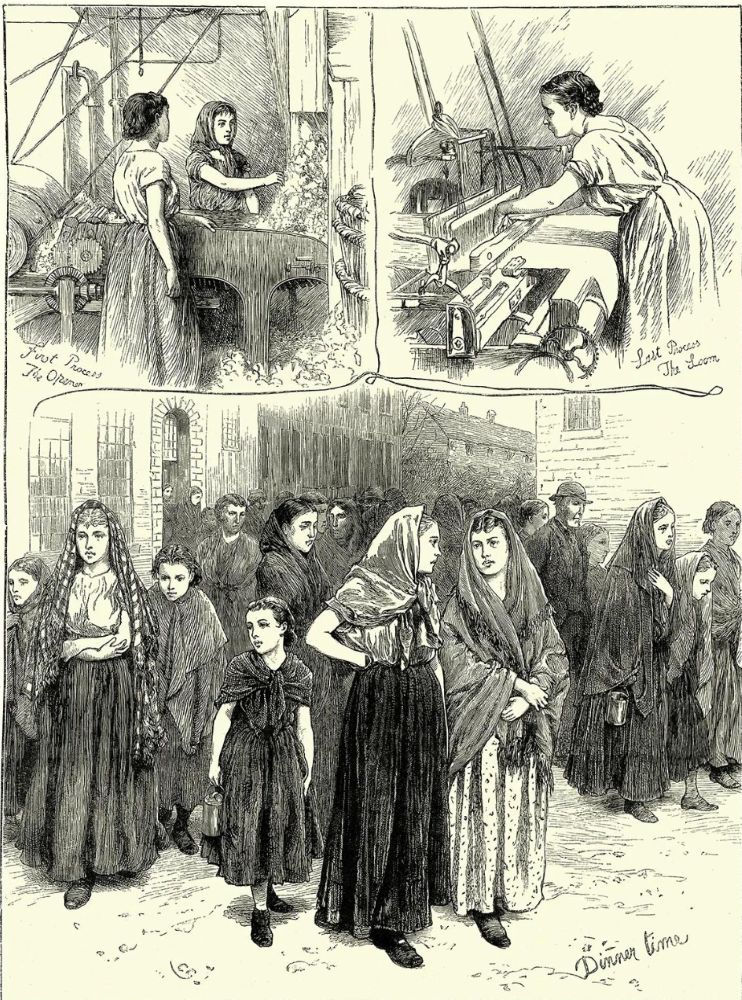
The dinner hour, during which wages briefly encounter the cost of living.
The strike ends in exhaustion and debt. A middle rate of wages is agreed, and the men retain their right to belong to the union. Allen, however, cannot return to his former life. Employers will not take him back. Even Wentworth cannot offer him a place; he has fewer jobs available and obligations to his existing workers. Allen spends the subsequent years watering streets in summer and sweeping them in winter, while his children enter the factories. The reasonable protagonist has learned, sacrificed, and behaved honorably. The reward is permanent exclusion.
In her autobiography, Martineau recalled receiving bundles of documents from Manchester operatives. She also reported that workers recognized their own leader in Allen, although she had never heard his name, and that some believed she had spent her life in a cotton mill. We need not take this retrospective account as a verdict on how all workers received her economics. It does suggest why the literary undertaking mattered to her: Research and invention had produced a life recognizable to people whose experience she did not share.

A practical lesson in authority, requiring very little explanation and a raised hand.
At the end of the tale, a summary extracts the principles. Strikes waste capital; legislation cannot settle wages; improvement depends on increasing and preserving capital and adjusting population to it. The prose tidies the room after the characters have left. But we have seen what remains outside that order: retaliation against an honorable man, kindness unable to secure a livelihood, a wife choosing between food and reputation, children carrying factory discipline into play. Calling these unfortunate circumstances does little to diminish them.
Perhaps this is where Martineau becomes most interesting. Her story can persuade us that people need to understand the arrangements governing their lives, while allowing us to question the explanations she provides. Fiction gives those arrangements duration, atmosphere, and consequences. It lets us remain beside someone after the argument considers its work finished. Having followed Martha through the street, the factory, and the bird shop, we may return to the chapter on wages with a different idea of what it ought to contain. And somewhere between two flints, with a pair of rusty scissors, a child is still trying to make a garden.
Karl Adam Smith was born in Norwich in 1978 and studied political economy in Edinburgh, where his surname opened doors that his first name occasionally closed. He later pursued economic history at the University of York, where his dissertation on unsuccessful provincial enterprises was briefly mistaken for a departmental report. He writes about Victorian literature, domestic finance, and the moral authority of people who have never checked the price of anything. He lives in Sheffield and is working on a history of minor sacrifices.
Cover image: Harriet Martineau, about to give political economy several dependents and a plot.
Comments