

COVER TO COVER
HILLBILLY WOMEN: ON THE INVENTION OF AN AMERICAN OTHER
EUDORA VANCE MERCER
May 21, 2026
Kathy Kahn’s 1973 oral history collection “Hillbilly Women” takes a startlingly simple tack: letting Appalachian women speak for themselves. What emerges is not the caricature America invented, but a far more unsettling portrait of a region that was never outside modernity, only sacrificed to it. Moving between documentary realism, oral testimony, class politics, regional identity, and the strange transformation of lived experience into stereotype, from coal towns and labor struggles to the afterlife of the “hillbilly” in contemporary media and politics, “Hillbilly Women” reveals a forgotten America whose voices now feel both historically distant and uncannily contemporary.
There are books that survive because they are masterpieces, books that survive because they were scandals, and books that survive because history accidentally circles back around to them decades later and suddenly discovers that they had been quietly waiting all along. Kathy Kahn’s Hillbilly Women, first published in 1973, belongs to the third category. It is not widely taught, rarely discussed outside Appalachian studies, and almost absent from the contemporary literary canon. Yet the moment one encounters it today, particularly in its original paperback edition with its stark black-and-white cover photograph, it feels strangely contemporary and impossibly distant at the same time. Two women stand before the camera in front of tobacco plants, unsmiling, unsentimental, neither proud nor defeated. The younger woman wears a striped dress. The older woman clasps her hands together with the exhausted stillness of someone who has spent an entire life working. The title above them, Hillbilly Women, already introduces a problem. It reads simultaneously like an insult, a sociological category, a television stereotype, and an ethnographic label. Yet the photograph resists all of these things. The women stare back too directly to become symbols.
What makes the book remarkable is not simply its subject matter, but the way it preserves a vanished relationship between voice, class, and representation in America. Hillbilly Women emerged during a peculiar moment, when oral history, documentary realism, labor activism, second-wave feminism, and anti-poverty politics briefly converged into a shared cultural project. There was a widespread belief then that listening itself could constitute a political act. The voices of miners, factory workers, domestic laborers, farmers, and poor women were recorded with an urgency usually reserved for political leaders or celebrated intellectuals. It is difficult now, in an era saturated with endless self-narration through social media and memoir culture, to recover how radical this once felt. These women were never expected to speak publicly at all.

Two women refusing to become metaphors.
The forgotten history surrounding books like Hillbilly Women is partly the history of an America that repeatedly discovers and forgets its own internal provinces. Appalachia occupies a strange position within the collective imagination. It has always been treated simultaneously as part of the nation and somehow outside it, a domestic frontier onto which fantasies of backwardness, authenticity, violence, ignorance, religiosity, and poverty could be projected. By the twentieth century, the “hillbilly” had become less a real person than a media construction. Radio shows, cartoons, television comedies, country music marketing, and Hollywood films transformed Appalachia into a national caricature. The hillbilly became one of the few remaining figures against whom open class contempt could still be directed without embarrassment.
Yet the irony is that Appalachia was never isolated from modernity. It was created by modernity. Coal extraction, railroad expansion, timber industries, labor exploitation, company towns, environmental devastation, mechanized mining, debt systems, and migration patterns tied the region directly to industrial capitalism. Appalachia is and is not a relic of the past. It is one of the sacrificial landscapes upon which modern America was built. Its supposed backwardness often masked the fact that corporations had systematically extracted enormous wealth from it while leaving behind poverty, damaged ecosystems, and unstable labor economies. The “hillbilly” stereotype functioned partly as a way to naturalize these conditions, to transform structural exploitation into cultural deficiency.
Kahn’s book quietly undermines this mythology by refusing simplification. The women who speak in the text are neither noble victims nor reactionary caricatures. They emerge instead as politically complicated, emotionally restrained, often intellectually sharp observers of their own circumstances. One woman discusses black lung disease with a matter-of-fact clarity that feels more analytically precise than much contemporary journalism. Another speaks about amphetamine use in factories to keep workers productive. Others discuss hunger, religion, domestic labor, alcoholism, childbirth, labor organizing, shame, and migration. The emotional power of these testimonies comes precisely from their lack of rhetorical performance. They do not sound like contemporary confessional writing. There is very little therapeutic vocabulary. Trauma appears indirectly, buried inside practical descriptions of work schedules, illnesses, weather, cooking, debt, and exhaustion.
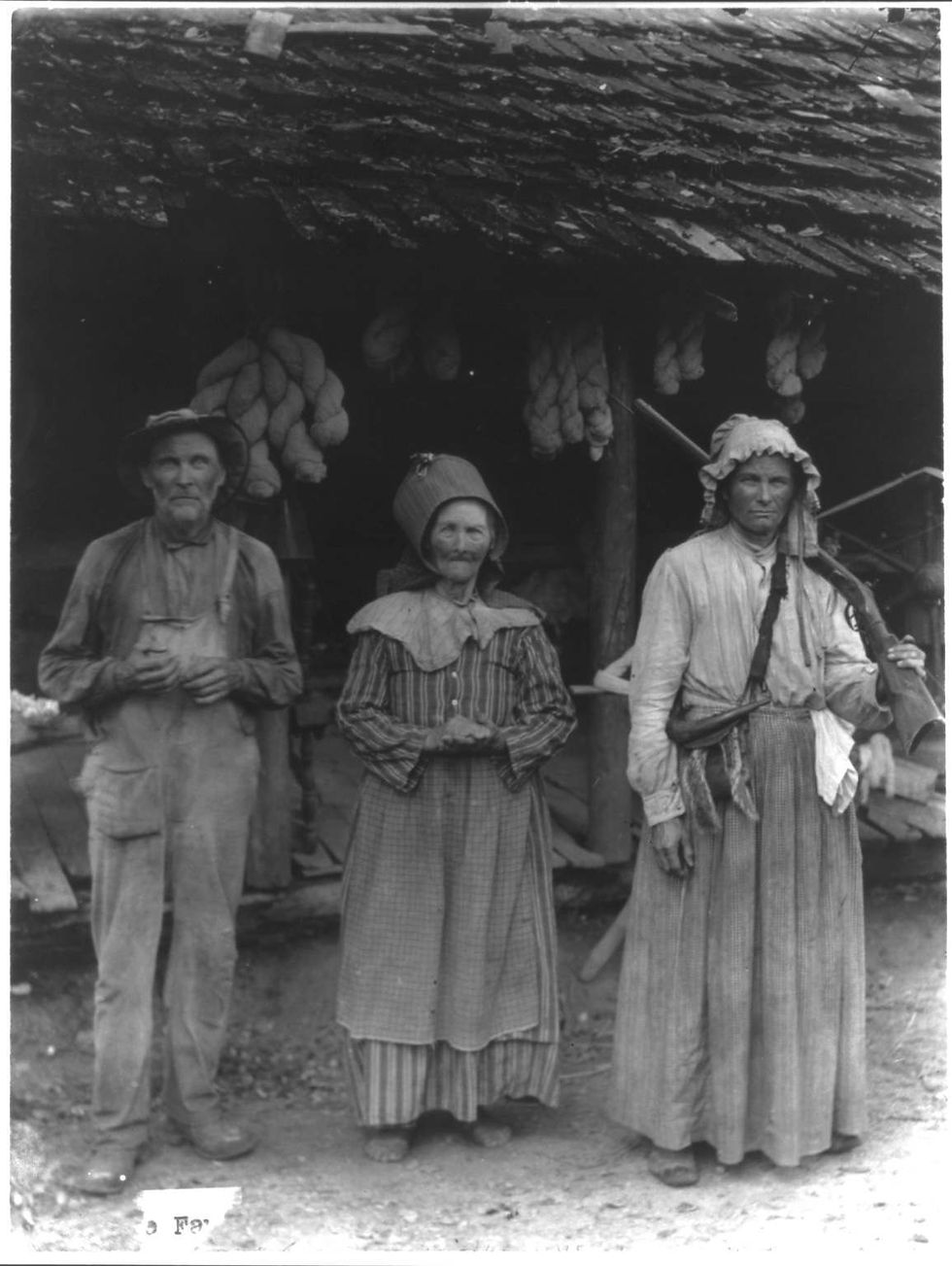
Three people patiently waiting to become stereotypes.
This distance between experience and narration is one of the book’s most fascinating qualities. Contemporary culture is dominated by highly developed languages of self-explanation. People are expected not merely to suffer but to narrate suffering fluently. Modern memoir culture often depends upon retrospective interpretation, psychological coherence, and emotional readability. The women in Hillbilly Women belong to an earlier relationship to speech. They frequently describe devastating experiences without pausing to identify themselves as devastated. A husband losing his legs in a mining accident enters the narrative with the same practical tone used to describe preserving vegetables or washing clothes. Emotional intensity appears not through dramatic emphasis but through its absence.
This gives the book an almost anti-literary quality that paradoxically becomes literary. The testimonies resist the polished architecture of contemporary nonfiction. They drift, repeat themselves, circle back, leave gaps. Yet it is precisely this roughness that creates their authority. Oral testimony has always occupied an unstable position between documentation and literature. One hears echoes here of Studs Terkel, of Svetlana Alexievich decades later, even of James Agee’s attempts in Let Us Now Praise Famous Men (1941) to confront the moral inadequacy of representing poverty aesthetically. But Hillbilly Women differs from all of them in one important respect. The women are not framed as objects of sociological fascination. Their speech is allowed to remain stubbornly local, resistant to translation into universal political language.
The politics of visibility surrounding the book are equally revealing. Appalachia has long been hyper-visible as stereotype and almost invisible as lived complexity. America possesses an extraordinary ability to convert entire populations into symbolic abstractions. The hillbilly became a repository for national anxieties about class, race, modernity, education, sexuality, and decline. Poor white Americans occupy a particularly unstable symbolic role within this structure because they disrupt simplified narratives of privilege and marginalization. They are simultaneously visible everywhere and socially unreadable. American culture alternates between mocking them, romanticizing them, fearing them, and rediscovering them with every election cycle as though encountering an unknown tribe.
The women in Kahn’s book existed before this contemporary cycle fully crystallized. Reading the book now after decades of opioid crisis documentaries, Trump country journalism, JD Vance memoir discourse, and endless think pieces about the white working class creates a strange temporal dislocation. Hillbilly Women predates the current performance of polarization. Nobody in the book appears to be speaking for an ideological audience. The women are not constructing identities for media consumption. They are not speaking in anticipation of Twitter reactions, cable news interpretations, or academic analysis. Their voices remain startlingly uncrafted, unmediated.

Poverty photographed with unsettling composure.
This may explain why the book feels emotionally contemporary while culturally foreign. One senses throughout the testimonies a mode of speech that the mass media has nearly extinguished. Regional language survives in America, but increasingly as accent rather than worldview. The flattening effects of television, higher education, internet culture, and geographic mobility have transformed speech patterns across the country. Many younger Americans now sound eerily similar regardless of where they come from. In Hillbilly Women, language still carries geography inside it. The cadence, syntax, understatement, and metaphors belong to a specific landscape and labor structure.
Regional identity itself has acquired a peculiar afterlife in contemporary culture. Regions increasingly survive as aesthetics rather than lived realities. Appalachia today exists simultaneously as tourism brand, political shorthand, folk authenticity fantasy, streaming television backdrop, and social media signifier. The actual material conditions of the region often disappear behind its symbolic usefulness. One can observe similar processes elsewhere: the US South transformed into gothic atmosphere, the Rust Belt into political allegory, the Midwest into ironic meme geography. Modern media consumes regions as emotional textures.
What Hillbilly Women preserves is the moment before Appalachia became fully aestheticized for contemporary consumption. The women speak from inside a still-functioning world, even if that world is already collapsing economically around them. This creates one of the book’s most haunting dimensions. The testimonies are filled with descriptions of labor systems, family structures, church communities, local customs, and speech rhythms that already feel historically distant. Yet the women themselves do not experience their lives as historical artifacts. They are simply describing the present tense of survival.
There is something deeply moving about this temporal asymmetry. Historical change is rarely experienced dramatically by those living through it. Entire cultures disappear gradually while still believing themselves permanent. One senses throughout the book the slow erosion of a social world without anyone fully naming it as disappearance. The coal economy is destabilizing. Younger people are leaving. Labor structures are shifting. Television is altering cultural expectations. Feminist politics are beginning to circulate unevenly through rural America. Yet these transformations appear only indirectly, through fragments and anecdotes.
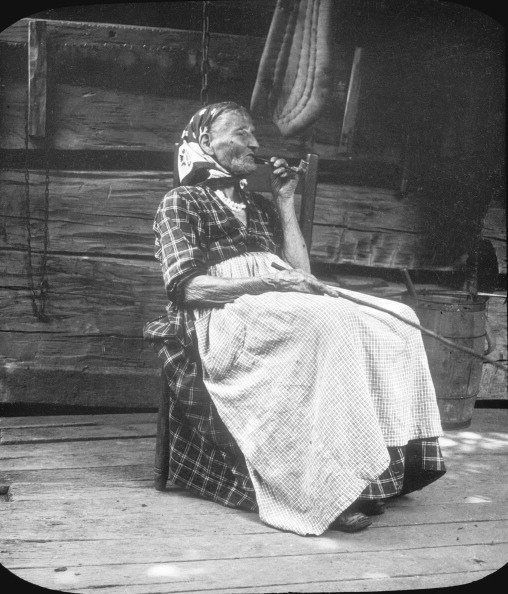
The Appalachian answer to stoicism.
The aesthetics of the book reinforce this sense of historical fragility. Documentary realism in the mid-twentieth century often operated under the belief that showing reality plainly possessed ethical force. Photography, oral testimony, cinema vérité, documentary filmmaking, and social journalism all participated in this broader faith in exposure. To reveal suffering was assumed to generate moral recognition. Today that assumption feels far less stable. Contemporary audiences consume representations of suffering continuously, often without consequence. Yet Hillbilly Women still carries traces of this earlier moral seriousness. The photographs do not aestheticize poverty, but neither do they pretend objectivity. They belong to that brief period when documentary culture still believed witnessing mattered.
This is perhaps why the cover remains so powerful. The women do not perform poverty for the camera. They simply endure its gaze. Their expressions resist interpretation. They are neither tragic nor triumphant. Contemporary visual culture tends to demand emotional legibility from photographed subjects. Documentary images are expected to announce suffering clearly enough to produce immediate moral response. The opacity of these women, the way they withhold themselves from easy consumption, feels almost radical now.
One of the most revealing aspects of the book is how frequently dignity appears disconnected from prosperity. Modern capitalist culture often assumes that material success and self-worth naturally align. The women in Hillbilly Women repeatedly undermine this assumption. Their lives contain extraordinary hardship, yet many retain strong forms of ethical and social coherence. This does not romanticize poverty. The book is unsparing about deprivation. Rather, it reveals how contemporary middle-class culture frequently misunderstands working-class life by reducing it either to misery or to resentment. The women possess forms of intelligence, humor, endurance, suspicion, and mutual obligation that remain largely invisible in dominant representations of class.
Class itself occupies a peculiar position in American culture because it is simultaneously omnipresent and systematically denied. America speaks constantly about wealth while avoiding sustained discussion of class structure. The result is a culture obsessed with economic aspiration yet uncomfortable acknowledging inherited hierarchies, regional inequalities, and structural poverty. The hillbilly stereotype has performed an important ideological function within this framework. It transformed class inequality into personal failure and cultural pathology.
Kahn’s book quietly reverses this logic by allowing structural conditions to emerge through accumulation. No grand ideological argument is imposed. Instead, one gradually understands how labor exploitation, inadequate health care, gender expectations, environmental destruction, and economic precarity shape everyday life. The political force of the book lies precisely in this refusal of abstraction. Theory appears through detail.

The century beginning to industrialize childhood.
There is also a gendered dimension that remains striking. Much of Appalachian mythology historically centers male figures: miners, moonshiners, labor organizers, musicians, outlaws. Women often appear only as secondary characters within masculine regional narratives. Hillbilly Women subtly reconstructs the region through female labor. Cooking, cleaning, childcare, textile work, emotional maintenance, nursing injured husbands, managing scarcity, preserving food, stretching budgets, surviving loneliness: These become central forms of historical experience rather than domestic background.
In retrospect, the book also reveals limitations within mainstream second-wave feminism itself. Feminist discourse of the early 1970s often centered urban professional women, sexual liberation, higher education, and middle-class autonomy. The women in Hillbilly Women inhabit an entirely different economic universe, and their relationship to labor, family, marriage, and independence cannot easily fit liberal feminist narratives of empowerment. Yet the book never treats them as politically backward. Instead, it reveals feminism as entering different social realities unevenly.
What ultimately makes Hillbilly Women endure is not nostalgia for a lost America but its resistance to simplification. The book refuses both contempt and sentimentality. That refusal feels increasingly rare. Contemporary media systems reward caricature because caricature travels quickly. Complex regional realities become flattened into instantly recognizable political identities. Appalachia becomes either reactionary wasteland or repository of folk authenticity. Both fantasies erase actual people.
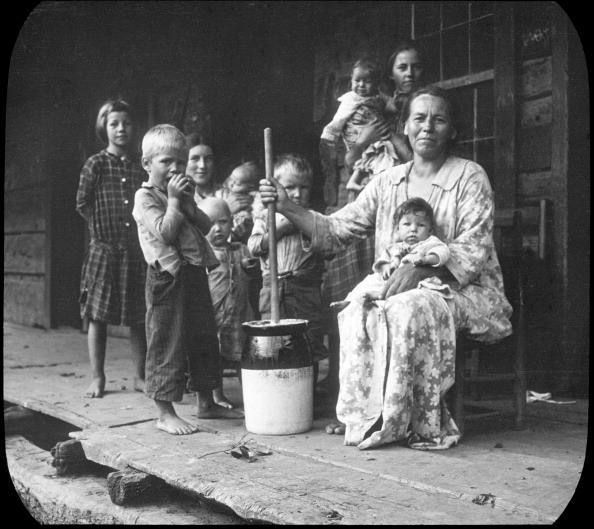
A family large enough to require its own labor policy.
The women on the cover remain unforgettable because they resist this process. They stare outward from a world already vanishing yet not fully conscious of its own disappearance. Their voices survive inside the book with extraordinary clarity, carrying the rhythms of labor, geography, class, and memory across half a century. Reading Hillbilly Women today feels less like discovering an obscure oral history than overhearing America speaking in a register it has almost entirely forgotten how to hear.
Eudora Vance Mercer was born in 1978 in Pikeville, Kentucky. A distant cousin of JD Vance, she briefly worked as a freelance copy editor on early drafts of “Hillbilly Elegy,” a fact she mentions with irritation. “I corrected the commas,” she once remarked, “but not the sociology.” After leaving a folklore studies program at the University of Kentucky, Mercer drifted through a series of occupations, including obituary writer, substitute teacher, local archivist, and ghostwriter for regional politicians. She currently lives outside Asheville, surrounded by an almost complete VHS archive of local Kentucky television commercials from the 1980s and 1990s.
Cover image: The American dream before central heating.
Comments