

COVER TO COVER
MISREAD CORRECTLY: EDGAR ALLAN POE AND THE CRADLE OF MODERNISM
MARGARET ELLER
April 16, 2026
It is possible to read Edgar Allan Poe for a long time without quite knowing where to place him. Familiar to the point of cliché, he is reduced to inventions, the detective story, and psychological horror, while his larger significance remains curiously unresolved. The author sets out to reconsider Poe not as the origin of genres, but as a figure who altered the very conditions under which literature could be understood. What emerges is a writer who does not fully belong to his own time, and whose meaning becomes clearer only when read elsewhere.
While Edgar Allan Poe has always been part of the US literary canon, his position within it has remained curiously unresolved. He appears less as the continuation of a tradition than as an interruption, an isolated figure to whom one attributes beginnings rather than belonging. He is credited with inventing forms, namely initiating the genres of detective fiction and psychological horror, yet this attribution has the effect of narrowing him. It situates him as a technician of narrative innovation rather than as a writer engaged in a larger transformation of literature itself. In the US context, Poe is thus both central and strangely peripheral, acknowledged yet not fully integrated. He is present as origin, but not as system. He is quoted, but not absorbed. The language used to describe him, particularly in criticism, often returns to the idea of invention, as though his primary contribution was to have created something new, rather than to have altered the conditions under which literature could be understood at all.
This framing has consequences. To call Poe the inventor of detective fiction, as one does with “The Murders in the Rue Morgue” (1841), is to isolate the story within the history of genre, to see it as the first instance of something that would later be developed by others. Yet what matters in that story is not merely the appearance of the detective C. Auguste Dupin, but the method that underlies his reasoning, the idea that thought itself can be dramatized, that narrative can unfold as a sequence of mental operations. The crime becomes secondary to a structure of analysis, a literary form that is less concerned with what happens than with how it is understood. This is not simply the beginning of a genre. It is a redefinition of narrative as such. Similarly, to read “The Tell-Tale Heart” or “The Black Cat” (both 1843) as early examples of psychological horror is to miss the extent to which these stories operate as closed systems, governed by rhythm, repetition, and the controlled escalation of tension. They are not expressions of madness but constructions of it, carefully calibrated to produce a specific effect. The narrators do not confess; they perform.

When Poe becomes genre: horror as spectacle, invention mistaken for containment.
What is striking is that this dimension of Poe’s work, which appears so evident when one reads him now, was not fully recognized in his own literary environment. American literature in the mid-nineteenth century was still in the process of defining itself, and it did so largely through forms that emphasized moral clarity, realism, and a certain transparency of intention. Against this backdrop, Poe’s work must have seemed excessive, even perverse, its insistence on artifice at odds with the prevailing demand for sincerity. He did not offer moral lessons; he offered structures. He did not seek to represent the world; he sought to produce effects within the mind of the reader. It is perhaps for this reason that he was received as exceptional rather than exemplary, as a writer whose peculiarities could be admired but not generalized. He was, in other words, a figure without a clear place.
The French reception of Poe began precisely at this point of displacement. When Charles Baudelaire encountered Poe in the 1840s, he did not approach him as an isolated curiosity but as a writer whose work could be understood as a system. Baudelaire’s engagement with Poe was not incidental. It coincided with his own effort to define a poetics adequate to modern life, one that would move beyond the descriptive tendencies of realism and toward a more rigorous conception of art as an autonomous domain. In Poe, Baudelaire recognized a figure who had already articulated, in practice if not always in theory, many of the principles he himself sought to establish. The encounter was therefore one of not merely admiration but identification. Baudelaire famously claimed that Poe had written for him—a statement that, if taken seriously, suggests not influence in the conventional sense but a kind of elective affinity, a recognition across distance.

The gaze without context—the cat as witness, not symbol.
Baudelaire’s translations of Poe are among the most consequential acts of literary mediation of the nineteenth century. They do not simply render Poe into French; they transform him. Baudelaire approached translation as an interpretive act, smoothing what he perceived as irregularities in Poe’s prose, emphasizing coherence, and foregrounding the conceptual dimension of the work. The result is a version of Poe that appears more unified, more deliberate, more “classical” than the original. This is not a distortion so much as a clarification, an extraction of what Baudelaire took to be the essential logic of Poe’s writing. Baudelaire supplemented these translations with essays that constructed a particular image of Poe: the misunderstood genius, isolated from his society, committed to a conception of art that places it beyond moral or utilitarian concerns. This image, while not entirely inaccurate, was nonetheless selective. It omitted certain aspects of Poe’s work, particularly its humor and its occasional excesses, in order to produce a figure that could function as a precursor.
It is here that Poe’s historical position begins to shift. In France, he was no longer merely the author of strange tales but the theorist of effect, the writer who demonstrated that literature can be organized according to principles analogous to those of music or mathematics. His famous notion of the “unity of effect,” articulated in essays such as “The Philosophy of Composition” (1846), found in the French context a resonance that it did not fully achieve in the United States. It became the basis for a conception of literature as a closed system, in which every element is subordinated to the production of a single, coherent impression. This idea, taken up and radicalized by later figures such as Stéphane Mallarmé, led toward a poetics in which the work of art is no longer a representation of reality but an autonomous object, governed by its own internal logic. The trajectory from Poe to Mallarmé is not direct, but it is unmistakable. What begins as a theory of narrative effect becomes, in the hands of the Symbolists, a theory of language itself.
The importance of this development cannot be overstated. It is through this line of reception that Poe came to occupy a position at the threshold of modernism. His insistence on construction over expression, on artifice over immediacy, anticipated a literary future that would only fully emerge at the end of the nineteenth and the beginning of the twentieth centuries. Figures such as Paul Valéry would later recognize in Poe a precursor to their own understanding of poetry as a conscious, almost mechanical operation, a making rather than a spontaneous outpouring. In this sense, Poe belonged less to his own time than to a time that had not yet arrived. He was, as it were, out of joint with the nineteenth century, and it was precisely this disjunction that allowed him to be reinterpreted in France as a figure of the future.
The contrast with other European receptions is instructive. In the United Kingdom, Poe was read and admired, but he did not occupy a central position. British literature of the mid-nineteenth century was dominated by the novel, particularly by writers such as Charles Dickens and William Makepeace Thackeray, whose work emphasized social observation and moral engagement. Against this backdrop, Poe’s tales must have seemed eccentric, their abstraction and lack of didactic purpose rendering them marginal. He was appreciated as a writer of unusual stories, but not as a figure who might redefine the principles of literature. In Germany, where Romanticism had already produced its own tradition of the uncanny in figures such as E. T. A. Hoffmann, Poe appeared less as an innovator than as a continuation, his work absorbed into an existing framework rather than generating a new one.

Baudelaire’s Poe: not invention, but transformation.
What distinguished the French reception, then, was not simply its intensity but its orientation. Poe was read not as content but as method. His stories were not merely enjoyed; they were analyzed, theorized, and integrated into a broader reflection on the nature of literature. This is why his influence in France appears so disproportionate. It is not that he was more widely read there (though he was), but that he was read differently. He became, through Baudelaire and those who followed him, a figure who helped to define what literature can be. The fact that he never set foot in France is almost irrelevant. His presence was textual, and it is through this textual presence that he exerted his influence.
One might go further and suggest that Poe became fully legible only through this French mediation. Without Baudelaire’s translations and essays, it is possible that he would have remained a fascinating but marginal figure, known for his stories but not for the principles underlying them. It is Baudelaire who extracted these principles and presented them in a form that could be recognized and developed. This does not mean that Baudelaire invented Poe, but it does mean that he completed him, or at least completed a certain version of him. The Poe that entered European modernism was not identical to the Poe who wrote in the United States. He was a constructed figure, shaped by the needs and desires of a different literary culture.
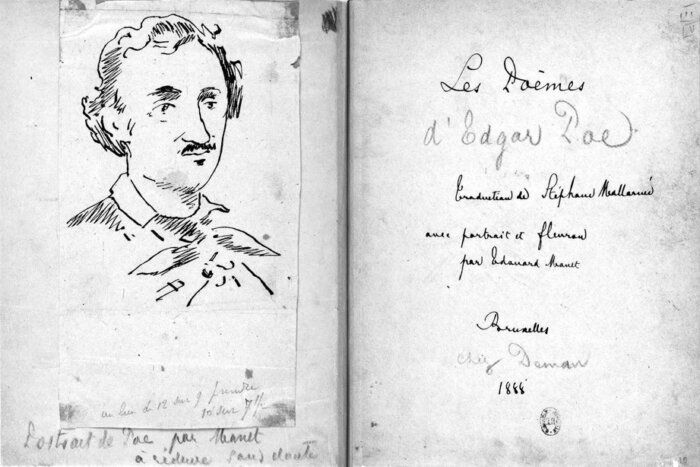
Poe in French: absorbed, translated, and finally understood as system rather than anomaly.
The consequence was a subtle but decisive repositioning. In his home country, Poe is often situated at the beginning of genres; in France, he is placed at the beginning of modernism. The difference is one of not merely emphasis but historical understanding. To read Poe as the inventor of forms is to confine him to literary history as a point of origin. To read him as the theorist of effect is to recognize him as a writer who anticipated the conditions of modern literature. It is in this latter sense that his true significance emerges. He was not simply the first of something; he was the first to understand something.
That this understanding was more clearly articulated in France than in the United States suggests that literary history is not a fixed sequence but a field of interpretations, in which the meaning of a writer can shift depending on the context in which they are read. Poe’s case is exemplary in this regard. He was the same writer, with the same texts, yet he occupies different positions in different traditions. In the United States, he remains a singular figure, difficult to place, his innovations acknowledged but his broader significance only partially grasped. In France, he is a precursor, a figure who stood at the threshold of a new conception of literature.

A grave that needed relocating, like his reputation, moved into coherence after the fact.
To say that Poe stands at the outset of modern literature is therefore not simply to assign him a place in a chronological sequence. It is to recognize that his work articulated, in advance, a set of problems and possibilities that would only later become central. That this recognition occurred more fully in France than in his home country exemplifies a curious fact of literary history. It suggests that the meaning of a writer is not given once and for all, but continually produced through acts of reading, translation, and interpretation. In this sense, Poe’s arrival in France was not an episode in his reception. It was the moment at which he became, in the fullest sense, what he had always been: a writer of modernity.
Margaret Eller (b. 1969 in Baltimore) began reading Edgar Allan Poe at age twelve, out of proximity more than interest. She has never formally studied writing or literature but has spent the past two decades reconstructing the reception of nineteenth-century writers across languages. She is currently writing a book on authors whose reputations improved after translation.
Cover image: Poe colorized and stabilized. Retrospectively made legible as a figure he never fully was.
Comments