

THE WORLD IS A STAGE
ON THE SEEMING INFINITY OF TERROR
CLAIRE ARENDT
April 21, 2026
From airport terminals and embassy sieges to livestreamed atrocities and endless digital circulation, this essay examines how political violence became increasingly entangled with the systems that display, repeat, and amplify it. Moving from the hijackings and militant iconographies of the 1970s to September 11, October 7, and today’s fractured media ecology, it offers a historically layered meditation on terror as spectacle, atmosphere, and unresolved presence.
I was born in 1969, which means that by the time I began to notice the world as something that could be followed—on television, in newspapers left open on tables—the images from Israel and the Palestinian territories were already there. They did not arrive. They appeared intermittently, as if they had always been part of this world. There were airplanes, often shown from a distance. There were rooms in which something had been suspended but not resolved. There were faces, sometimes visible, sometimes obscured, that seemed to belong to a sequence I had entered without understanding where it began.
The airport was one of the first places where this felt continuous. Not because anything had happened there, at least not that I could recall, but because it seemed already arranged around the possibility that something might. People waited in a way that suggested they had accepted a system whose logic they did not fully see. Movement was expected. Delay was anticipated. The announcements, the screens, the sense of being between places—all of this produced a kind of attention that did not need to be directed. It was already there. And when something interrupted that movement, it did not feel entirely foreign. It felt as though the structure had revealed something about itself.
The airplane carried this further. Suspended between departure and arrival, it seemed to exist in a condition that was neither here nor elsewhere. It belonged to the places it connected, but only partially. When it was diverted or held, the effect was less a break than an extension. The passengers did not choose to witness what unfolded. They were placed within it. Time stretched. The event did not conclude. It persisted, as if its duration were part of its form.
Embassies appeared differently, but with a similar clarity. They were smaller, more contained, but carried a density that exceeded their scale. A fragment of one country embedded within another, marked by symbols that announced its status, governed by protocols that distinguished it from its surroundings. When such a space was entered or occupied, the effect was not difficult to read, even if the details were unclear. Something that stood for something else had been made unstable. It did not require explanation.
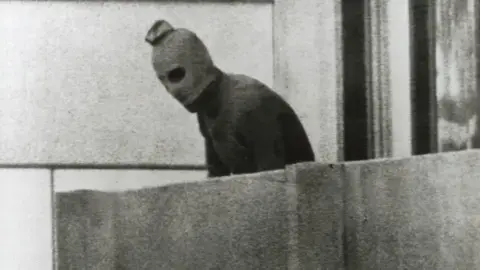
A body without identity, already aware of being seen.
In those years, the events associated with Palestinian militancy seemed to move through these spaces with a familiarity that was difficult to separate from intention. The hijackings, the prolonged situations that unfolded across days, the careful selection of sites—these did not feel arbitrary. They seemed to anticipate the way they would be seen. The act did not remain where it occurred. It extended outward, through images, through narration, through a sequence that continued after the initial moment had passed.
Around the same time, something related began to take shape within Europe. The Red Army Faction and the Red Brigades appeared to operate within similar frameworks, yet they did not feel the same. The kidnapping of Aldo Moro—a senior Italian politician and former prime minister, abducted in 1978—unfolded slowly, in fragments: letters, statements, images that seemed to prolong what had already happened. It became difficult to determine where the event ended and its narration began. It did not resolve but accumulated, even as its outcome, his murder after fifty-five days in captivity, seemed already inscribed in the structure of the situation.
The Red Army Faction, also known as the Baader–Meinhof Group, seemed to move differently. It did not wait to be described. It produced its own images, its own language, a sense of itself that remained consistent even as the actions changed. The photographs circulated with a clarity that made them difficult to read as incidental. They appeared arranged, as if the moment of capture had already considered its repetition. Andreas Baader carried a kind of charisma that resisted reduction. He appeared less as a figure shaped by events than as someone already aware of how he would appear within them. There was an element of self-mythologization, a sense that the role was being inhabited as much as it was lived. Ulrike Meinhof gave this a different form. Her writing, her articulation of the group’s position, extended the act into language, allowing it to be followed, repeated, and justified. Together, they occupied a space that was both immediate and reflective, as if the act and its explanation had begun to overlap. Terrorism as performance.
It would be possible to describe these actions in terms of what they did not achieve, to note the distance between their stated aims and their outcomes. Yet this assumes that the aim was ever defined in those terms. The imbalance was too evident to ignore. It was difficult to imagine that a sequence of kidnappings or assassinations could produce a shift in power that would resemble “victory.” Something else seemed to be at stake. The act did not resolve anything. It lingered. It introduced a disturbance that did not need to be sustained indefinitely in order to persist.

Faces arranged in advance of their repetition.
The OPEC headquarters siege in Vienna, carried out in 1975 by Carlos—a Venezuelan militant who became a transnational figure among 1970s armed networks, working with militants from the Popular Front for the Liberation of Palestine alongside a small number of European radicals—appeared to understand this in another way. The event did not remain where it occurred. It moved, in its narration, across borders, across languages. It seemed already composed for this movement. What mattered was not only what had happened, but how it could be followed from elsewhere.
It is often suggested that something changed decisively with the attacks of September 11, 2001—that a new form of violence emerged, defined by its scale, its symbolism, and its reach. This may be true, yet it risks overlooking the extent to which the elements were already present—the hijacked airplanes, the staging, and the anticipation of how the act would be seen. What seemed to shift was not the form itself, but the relationship between the act and the system in which it appeared. By that time, the conditions of attention had altered. Continuous, globally accessible news, exemplified by CNN, had established a field in which events no longer arrived at intervals but unfolded within it. There was no longer a clear separation between what happened and how it was seen. The images repeated, not as something that followed the event, but as something inseparable from it. The event did not simply occur. It occupied.
It is difficult not to recall the way those images persisted. The repetition did not feel like coverage. It felt like duration. The act extended itself through the systems it disrupted. It did not require a stage in the same way that earlier events had. It entered one that was already continuous.
In the years that followed, the figures of the 1970s returned, not as participants but as subjects of films, of narratives that reassembled their actions into something that could be followed from beginning to end, and in doing so extended their myth. Andreas Baader and Ulrike Meinhof reappeared in The Baader Meinhof Complex, directed by Uli Edel (2008). Carlos returned in Carlos, directed by Olivier Assayas (2010). In these films, what had once been fragmented became coherent. The disorder of the original events gave way to a form that seemed almost composed. It was not clear whether this clarified or obscured what had taken place.
At the same time, the structure within which such acts occurred continued to expand. The role of states became less visible, and yet more present. Iran does not appear in the same way as the groups it supports. It does not occupy airplanes or embassies. It extends influence through networks, providing support that allows these groups to act while remaining formally distinct. The act does not disappear. It disperses. What had once been tied to identifiable figures becomes part of a structure that exceeds them.

The act continues through the image, long after the moment itself.
Earlier forms suggest a different configuration, closer to nationalist or liberation movements. The Irish Republican Army, ETA in Spain, or the National Liberation Front of Corsica were tied to specific territories, their claims articulated locally even as they entered a wider field of attention. Hamas, emerging in 1987 during the first Intifada, appears close to this earlier pattern, its actions anchored in a defined geography, directed toward a conflict that remains territorial even as it is seen far beyond it. At the same time, it does not fully belong to that earlier form. Its position is less isolated. Over the decades, it has been sustained through financial, military, and logistical support from Iran, situating it within a broader network that extends beyond the territory in which it operates. The act remains local. The structure in which it persists does not.
It is not always clear what to call what is happening. “War,” “terrorism,” and “conflict” circulate as words, but without settling. They seem to arrive already in use, already worn. Jacques Derrida suggested, after 9/11, that these distinctions could no longer be relied upon, that the difference between war and terrorism, between state and non-state violence, no longer held in the way it once did. The terms persisted. Their coherence did not. It becomes difficult to determine where one form ends and another begins. The categories overlap, dissolve, and return under different names.
When the events of October 7, 2023, unfolded, they were described as unprecedented. There is something to this, but it does not entirely hold. The targeting of civilians, the production of shock, and the sense that the act anticipated its own visibility were not unfamiliar. They belonged to a sequence that had been unfolding for decades. The images appeared quickly, not with the same coherence or saturation that followed the September 11 attacks, yet they carried a similar performative quality, a comparable infusion of shock. What followed extended beyond this moment. The moment itself, however, was already sufficient.
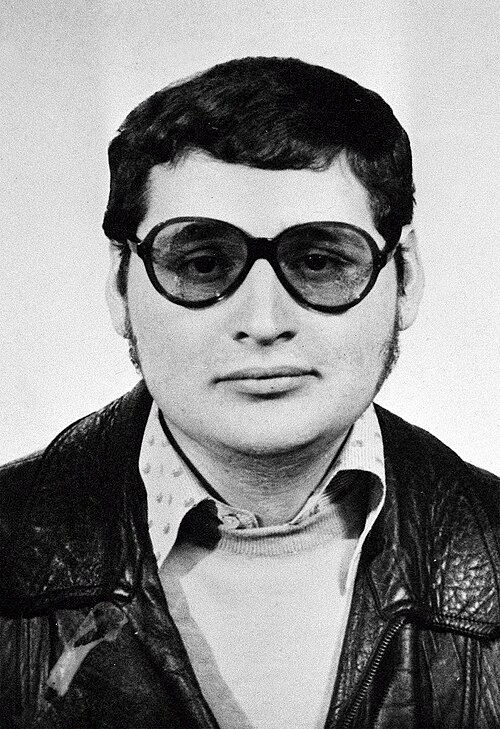
A face that understands it will circulate.
It might be expected that this logic would find its clearest form in the present, within an environment defined by social media, where images circulate without origin or endpoint, detached from the conditions that produced them and reappearing in sequences that no longer require continuity. Yet the relationship appears less settled than this would suggest. Earlier forms seemed, with a certain precision, to align themselves with the media available to them. The Red Army Faction moved within the visual language of German tabloids, its images framed, reproduced, and made legible within a print culture that could sustain them. The actions associated with Osama bin Laden appeared at a moment when continuous broadcast had established a global field of attention. Today, the stage remains, but it no longer feels singular. It has multiplied. It is not clear whether it can be occupied in the same way.

The scene does not stabilize; it multiplies.
It is difficult not to notice the timing. Jürgen Habermas, born in 1929 and one of the most influential social and political thinkers of the postwar period, died this spring, in March 2026, at a moment when the conflicts that had formed part of the background of earlier decades seemed to return in altered form. His work had been concerned, consistently and with a certain persistence, with the possibility of understanding how language, even under strain, could sustain a shared world, how disagreement could remain within a structure that did not collapse into force. Communication, in this account, was not incidental. It was foundational. Something was reassuring in this, even when it appeared abstract. It suggested that violence, however extreme, still pointed beyond itself—that it remained, in some sense, a failure rather than a condition. That which appeared as rupture could be traced back to a distortion, something that might, at least in principle, be repaired. It is not clear that this assumption still holds.
The scenes that recur, then and now, do not always appear to seek understanding, even in its most distorted form. They seem already composed for something else, oriented not toward response but toward repetition. The act does not necessarily point beyond itself. It remains, circulating, as if its persistence were sufficient. The sequence continues.
Claire Arendt (born 1969 in Luxembourg) studied political theory in Brussels before briefly teaching seminars on political violence and the limits of negotiation. She grew up in Jordan, a period she rarely discusses. She now works as a consultant specializing in scenarios involving systemic interruption, advising institutions on events they describe as unlikely but inevitable. Her father’s association with a minor militant network during the 1970s is noted in certain archives. She does not consider this biographically significant.
Cover image: The images arrive before the event has finished, and never quite leave.
Comments