
Updated: Aug 22

COVER TO COVER
READING AND RECOGNITION: ON QUANTIFYING THE UNREAD
TOMMA BERN
April 23, 2026
The author asks a simple but rarely considered question: How many of the books we call foundational are actually read, and what does that number reveal? Deconstructing the largely unexamined distinction between widely cited works and those only partially encountered, the essay attempts to quantify the unread not to diminish its importance, but to understand how influence circulates beyond completion. At the same time, it turns to another category of books, one less visible but often more decisive, whose impact is deeply personal and unevenly shared. What emerges is not a stable canon, but a fractured landscape of recognition, citation, and private transformation.
I am writing this as someone who was born in Austria and now lives in Argentina, which may account, though not entirely, for the way certain books entered my life not through intention but through accident, since I found them during a move from Vienna to Buenos Aires, in a box that had been sealed long enough to lose its original purpose, and when I opened it, I found Being and Time (1927), Ulysses (1922), and Das Kapital (1867) placed together without any visible logic except the one that only became apparent later, which is that these are the kinds of books that gather around a life rather than being deliberately acquired, books that signal a certain orientation, a certain seriousness, whether or not they have been read, and there are, of course, many more of them, accumulating across traditions and disciplines, forming a kind of dispersed canon, and it was only after I had set these aside that I opened another box and found The Tale of Genji (ca. 1008) and The Mahabharata (ca. 400 BCE–400 CE), which I confess I had not read, at least not in any sustained way, though I recognized them immediately, not from experience but from their presence in the background of things, their status as works one is expected to know, and it was in this moment, with these two boxes arranged in front of me, that the question began to take shape, not as a confession but as a structure, since the difference between the books I had read and the books I had not seemed, even then, less stable than I had assumed.
What united them was not simply their difficulty or their length, but the way they circulate as foundational, a word that suggests something fixed, something laid down in advance, and yet these books behave less like foundations than like fields—uneven, difficult to traverse, resistant to completion—and I had read Martin Heidegger, James Joyce, and Karl Marx, which is to say I had spent time with them, moved through them, returned to them, and yet I would hesitate to say that I had them, that I possessed them in any final sense, and this hesitation seemed to align me, unexpectedly, with my relation to the other two, which I had not read, and I began to wonder, not entirely rhetorically, how many of the people who cite these works, who invoke them in writing, in conversation, in passing, have in fact read them in any sustained way, or whether citation itself has come to function as a form of reading, a gesture of proximity rather than an account of experience.

The most frequently owned unread book in Western philosophy.
It occurred to me that one way to approach this, however imperfectly, would be to attempt a kind of quantification, not in order to arrive at definitive numbers but to expose the structure that such numbers, even when approximate, might reveal, and I began with Being and Time, which has maintained a continuous presence in philosophical discourse, translated, reprinted, taught, cited with a frequency that suggests a large and stable readership, and yet the material conditions of its circulation tell a different story, since works of this kind tend to sell in the range of thirty to eighty thousand copies globally over many decades, which is not insignificant but far from expansive, and if one assumes that even a majority of these copies have been owned, assigned, or purchased with the intention of reading, the number begins to contract almost immediately when one considers how such a text is actually encountered.
Among those who own the book, perhaps half do not move beyond the opening pages. Encountering its distinctive vocabulary, such as Dasein, being-in-the-world, and temporality, they recognize, not necessarily with resistance but with a certain clarity, that the text demands a form of attention that is difficult to sustain outside of a specific context, and among those who continue, a significant portion, perhaps 30 to 40 percent, read selectively, guided by courses, by secondary literature, by the need to grasp a concept rather than to traverse the work as a whole, and only a smaller group, something like 5 to 10 percent of total owners, read the book in a continuous way, and an even smaller group, perhaps 1 to 3 percent, return to it, reread it, work through its arguments with a persistence that might approximate what we mean by having actually read it, so that if one were to translate this into numbers, cautiously, one might say that out of those tens of thousands of copies, perhaps two thousand to six thousand people worldwide have engaged with substantial portions of the book, and perhaps five hundred to fifteen hundred have read it in a sustained way, and even within this group, the sense of completion remains unstable, since the work itself resists summary, resists closure, encourages return rather than resolution.

More often started than finished, and more often cited than either.
A similar, though not identical, pattern emerges with Ulysses, which occupies a different position—less confined to academic circulation, more widely owned, more visibly present and yet subject to its own form of partial reading, since the novel has sold in the hundreds of thousands, likely over a million copies across editions and decades, and exists not only as an object but as an event, a reference point, something that one is aware of even without having read it, and yet here too the numbers begin to narrow when one considers completion, since among those who own the book, a significant portion, perhaps 60 to 70 percent, do not read beyond the opening episodes, encountering its density, its shifting styles, its refusal of conventional narrative guidance, and set it aside, often with the intention of returning, and among those who continue, many proceed unevenly, reading certain episodes while skipping or skimming others, so that what emerges is not a continuous reading but a segmented one, and only a smaller group, perhaps 10 to 20 percent of owners, read the novel in full, and a still smaller group, something like 2 to 5 percent, return to it, reread it, begin to trace its internal structures, its correspondences, its deliberate excesses, so that one might estimate that perhaps fifty to one hundred and fifty thousand people worldwide have read Ulysses in its entirety, and a smaller subset, perhaps ten to thirty thousand, have engaged with it in a sustained way, and yet even here the sense of having read it remains uncertain, since its structure disperses itself across styles and references that resist total recall.
With Das Kapital, the scale expands further, with millions of copies in circulation globally over more than a century, driven not only by academic interest but by political movements, educational programs, and ideological commitments, and one might expect, from this broader distribution, a correspondingly larger readership, and yet the pattern remains consistent, since a substantial portion of readers—perhaps half or more—do not move beyond the opening chapters, encountering the analysis of commodity, value, exchange, and stopping there, while others engage selectively, often guided by summaries, commentaries, or specific political concerns, and only a smaller group read substantial portions of the work, with dramatically fewer continuing across all volumes, such that the number of readers who have engaged with the full text is likely in the tens of thousands globally, within a much larger population of those who cite, invoke, or align themselves with it, and here the gap between readership and influence becomes most visible, since the work’s impact depends less on completion than on circulation.

The most influential book most people only know through someone else’s explanation.
What these estimates begin to suggest, once placed side by side, is not simply that these books are difficult or demanding, but that they produce a particular distribution of reading, in which full engagement is concentrated among a relatively small group, while broader recognition extends across a much larger population, and it was with this in mind that I returned to the other two books I had found in the second box, The Tale of Genji and The Mahabharata, where the same structure appears in a more pronounced form.
With The Tale of Genji, modern editions and translations circulate in the tens of thousands, and its presence in education ensures that many encounter it in some form, and yet full readings remain comparatively rare, even among those who know it well, such that one might cautiously estimate that several thousand readers globally have engaged with substantial portions of the text, and a smaller number, perhaps in the low thousands or even hundreds, have read it in full in a sustained way, while a much larger group operate through excerpts, adaptations, references, and a general awareness of its importance, and here again the work’s influence extends far beyond its direct readership.
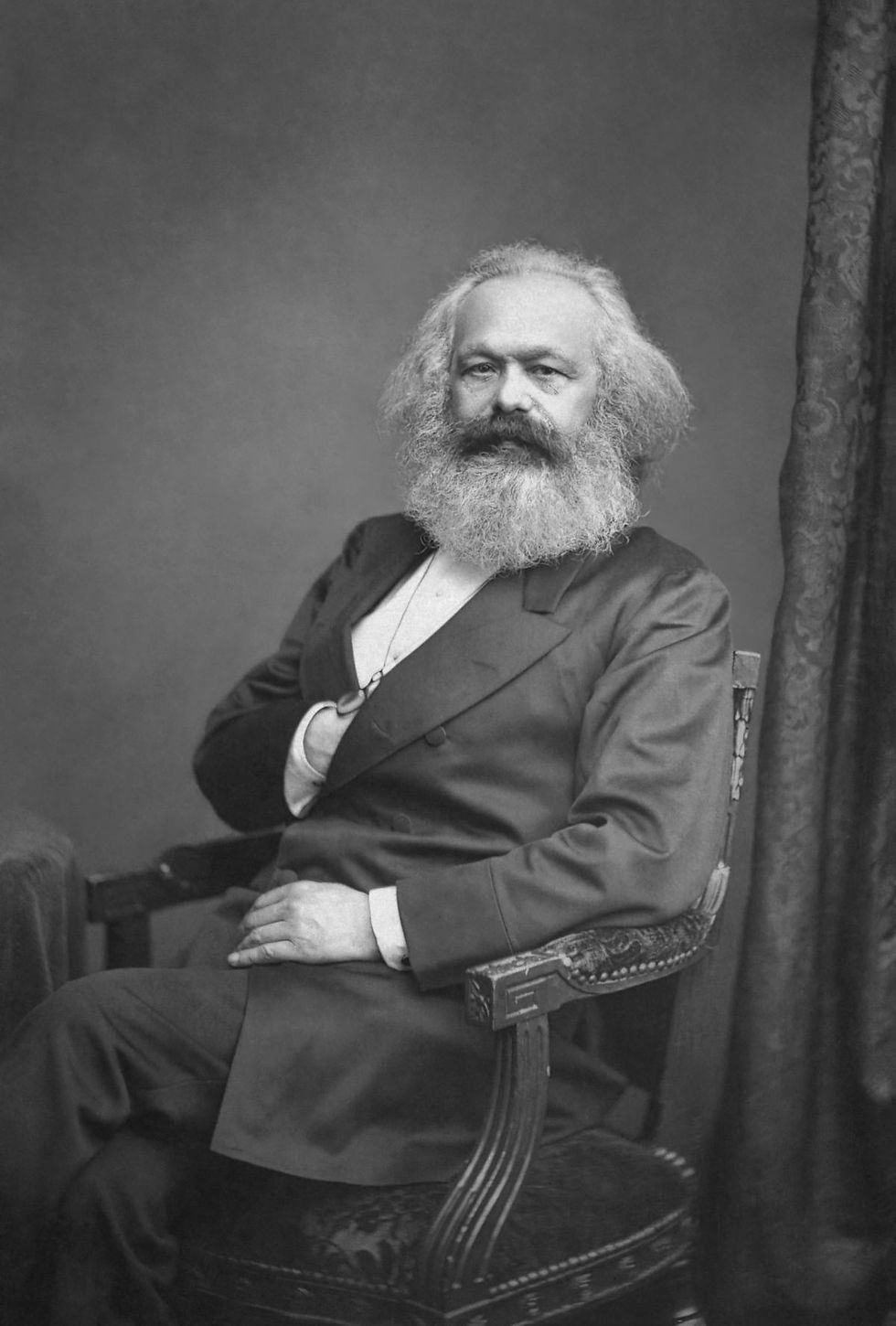


A canon in grayscale: authority stabilized as portrait, before it fractures into text.
With The Mahabharata, the structure becomes even more pronounced, since its scale places it almost beyond the category of a book to be read from beginning to end, and although its stories are known by tens or hundreds of millions, transmitted through oral tradition, performance, education, and media, the number of readers who have engaged with the full text is almost certainly extremely small, likely in the thousands globally, if that, and here the idea of completion becomes almost irrelevant, since the work exists as a field of narratives rather than a bounded object.
And it was at this point, standing between these two boxes, that the distinction between the books I had read and the books I had not began to dissolve—not entirely, but enough to make the difference feel less decisive, since even in the cases of those I had read, the experience remained partial, subject to return, dependent on context, while those I had not read in full nonetheless occupied a similar position in my thinking, present through fragments, through reputation, through the knowledge that they existed at a scale that exceeded any single encounter, and I began to suspect that these works do not persist because they are fully read, but because they remain available to be entered without ever being exhausted, and that what we call foundational may refer less to what has been collectively completed than to what continues, quietly and persistently, to resist completion.
It seemed to me, looking back at this exercise, that the attempt to quantify these books—tentative, approximate, necessarily imprecise—was less about arriving at reliable numbers than about exposing a structure that is usually concealed by habit, since we tend to speak of these works as if their authority derives from being widely read, when in fact their authority appears to rest on something more diffuse, something that circulates through recognition, citation, partial encounters, and returns, and the numbers, even when speculative, have the effect of narrowing the distance between what we assume and what is likely the case, not in order to diminish these books, but to place them more accurately within the conditions of their existence, as works that do not require completion in order to function, that do not depend on being fully absorbed in order to shape thought, and that may, in some sense, achieve their foundational status precisely because they remain, for most readers, unfinished, open, and available to be entered again.

Less a book than a civilization. Impossible to finish.
Stepping back from this attempt at quantification, I am left with another category of books, less visible but no less decisive, books that are not the ones everyone is expected to know but the ones that altered something fundamental for me, sometimes quietly, sometimes with a force that felt entirely disproportionate to their scale, books not always widely read, not always assigned, often encountered by accident and yet shaping the way I think, what I notice, even how I understand a life unfolding over time, so that it becomes difficult to imagine who I would be without them, and what becomes difficult then is not their importance but their absence elsewhere, the fact that something so formative can remain so unevenly distributed, that a book capable of such impact simply never appears in another life, not through rejection but through not being encountered at all, at which point the idea of a shared foundation begins to feel less stable and what takes its place is something more fragmented, namely a reading life composed not only of the books we are meant to recognize but also of those that, for reasons that cannot be generalized and perhaps cannot even be fully understood, arrive at the right moment and remain.
Tomma Bern (b. 1986 in Graz) trained as a restorer of rare books and manuscripts before leaving the field after concluding that damage is generally more interesting than repair. Stepping, not without hesitation, into the footsteps of Jorge Luis Borges, she now works at the Biblioteca Nacional de la República Argentina in Buenos Aires, where her responsibilities include cataloguing uncategorizable holdings, processing minor acquisitions, and navigating collections that seem less accumulated than endlessly rearranged.
Cover image: The architecture of unread intentions.
Comments