

BRICK BY BRICK
SVENSKT TENN: AN ELECTED COLLISION
USTRIT NYHOM
February 12, 2026
Svenskt Tenn does not reject modernity, nor does it fully embrace it. Instead, it absorbs it, slowly, comfortably, and without spectacle. This essay traces the unlikely encounter between Estrid Ericson’s conservative faith in domestic continuity and Josef Frank’s Viennese brand of antiauthoritarian modernism, revealing how a radical critique of order was transformed into one of Sweden’s most enduring cultural solutions.
One treat of going to Stockholm, one that everyone should allow themselves, regardless of weather, season, or mood, is spending time at the store and showroom of Svenskt Tenn, a design company founded in 1924 by Estrid Ericson. It is not an errand, and it is not shopping in any ordinary sense. It is closer to entering a parallel version of modernity, one that unfolds slowly, politely, and with remarkable confidence in its own permanence.

A glass sphere held up to the light. Reflection becomes method. The interior looks back at its creators.
You can spend hours there without buying anything, just moving from room to room, from textile book to lamp to chair, absorbing an atmosphere that feels both intensely cultivated and oddly reassuring. Nothing insists on itself. Nothing explains itself. The space does not perform contemporaneity. It does not court novelty. It assumes time, both yours and its own. Being there, even with the intention to buy, feels closer to a museum experience than to a visit to an interior design store. This is telling, since the space presents itself as a hybrid of historical continuity and contemporary life. The message is quietly ambivalent. It celebrates domesticity, a value deeply embedded in Swedish culture, while having been founded by a person who showed little interest in social arrangements ordered around prevailing family conventions.
What is striking, especially after even a short exposure to Stockholm’s more orthodox modernism, is how unembarrassed Svenskt Tenn is about density, comfort, and continuity. These interiors do not aspire to purity. They assume that life leaves traces, that objects accumulate, that taste is something one lives into rather than declares. It is modern, unmistakably so, but without the moral severity that usually accompanies modern design.
Only later does the question arise of what, exactly, this modernity is for, and who it imagines living inside it.
The answer cannot be found in objects alone. It lies instead in the biographies and historical trajectories that converge inside Svenskt Tenn, above all in the unlikely and productive encounter between its founder, Estrid Ericson, and the Austrian architect and designer Josef Frank. What appears at first as a harmonious aesthetic synthesis is, on closer inspection, a carefully managed collision between two radically different experiences of modernity.

Frank pauses over his drawings, hand to chin, as if thinking through not a room but a way of living.
Ericson was born in 1894 in the small Swedish town of Hjo and trained as a drawing teacher before founding Svenskt Tenn in Stockholm in 1924. Her entry into design was neither avant-garde nor polemical. It was pragmatic, artisanal, and incremental, shaped by the reform-minded applied-arts culture of early twentieth-century Sweden rather than by any desire for rupture. Svenskt Tenn began as a pewter workshop, closely aligned with ideals of craftsmanship, durability, and national material culture that had been circulating since the late nineteenth century through institutions such as the Swedish Arts and Crafts movement and the legacy of Ellen Key’s reformist thinking on the home.
Ericson was not working in isolation. She operated within a milieu that included figures such as Carl Malmsten, whose work likewise emphasized craftsmanship, proportion, and moral seriousness, and stood in quiet opposition to both historicist revival and emerging functionalist orthodoxy. Like Malmsten, Ericson believed that interiors were formative environments, capable of shaping character, habits, and emotional life. Design, in this view, was not expressive but educative.
What distinguishes Ericson, however, is that she chose the commercial showroom rather than the academy, the manifesto, or the exhibition hall as her primary medium. Svenskt Tenn was conceived less as a design firm than as a lived proposition, a place where objects could be encountered slowly and repeatedly, and where taste could be learned through exposure rather than instruction. Her ambition was not to invent new forms but to establish a durable interior culture that could withstand fashion, ideology, and acceleration.
From the outset, Ericson showed little interest in stylistic experimentation for its own sake. Her conservatism was literal rather than reactionary, oriented toward preservation, continuity, and the careful cultivation of taste over time. She trusted accumulation more than replacement, atmosphere more than clarity, and permanence more than progress. In this sense, Svenskt Tenn was not founded to challenge modernity but to domesticate it, to make it inhabitable without demanding conversion to a program.

Botanical forms repeat without hierarchy, signed discreetly at the edge. Nature reorganized for daily use.
That choice was strategic as much as temperamental. By the early 1920s, Swedish design culture was already polarizing between nationalist craft traditions and the coming wave of functionalism. Ericson positioned herself deliberately elsewhere. Svenskt Tenn would not compete with modernism on its own terms, nor would it retreat into revivalism. It would instead occupy a middle ground in which modern life could be absorbed gradually, without spectacle and without rupture.
It is from this position that her later collaboration with Josef Frank becomes intelligible. Frank did not introduce disorder into an otherwise orderly system. Rather, Ericson recognized in his work a means of extending her own project: an interior culture capable of accommodating complexity while remaining socially legible, comfortable, and continuous.
Yet this conservatism was never reactionary. Ericson rejected historicism and pastiche as firmly as she resisted the emerging dogmas of functionalism. What she sought instead was an interior culture capable of absorbing change without advertising it. Her rooms assume accumulation rather than replacement, inheritance rather than innovation. They are built for lives imagined as stable, extended, and legible across generations. Svenskt Tenn interiors presuppose a specific social order: a household organized around coupledom, privacy, discretion, and continuity. These are rooms designed for dinner parties, for family life, for cultivated retreat. They make no provision for rupture, precarity, or alternative domestic arrangements. Difference is permitted as atmosphere but not as structure.

Color as comfort. Geometry softened until it becomes welcoming.
Frank’s background could hardly have been more different. Born in Vienna in 1885 into an assimilated Jewish family, he came of age in a city that was less a cultural capital than a zone of permanent intellectual emergency. Fin-de-siècle and early twentieth-century Vienna was in a sense organized around fracture. The liberal bourgeois order was visibly eroding. Nationalist pressures strained the multinational empire. New disciplines emerged not to stabilize the subject but to dismantle it.
Psychoanalysis, still inseparable from its Viennese origins, questioned the very idea of a rational, self-transparent individual. At the same time, Austro-Marxism challenged bourgeois domesticity and the moral authority of private property, proposing new models of collective life that played out most visibly in housing and urban planning. Architecture was not a neutral field in this environment. It was a battleground in which competing visions of authority, discipline, and freedom were materialized in walls, plans, and interiors.
Frank was trained as an architect at the Technische Hochschule, but his intellectual formation extended well beyond technical competence. He belonged to a generation for whom architecture was inseparable from psychology, politics, and ethics. Early in his career, he became associated with the Österreichischer Werkbund, a loose but influential alliance that sought to reconcile modern production with cultural responsibility. Other prominent members included Josef Hoffmann, Koloman Moser, Oskar Strnad, and Margarete Schütte-Lihotzky.

Brass arms radiating outward, bulbs unhidden. Illumination without disguise.
Within the Werkbund, however, Frank occupied a distinctly critical position. While many of his contemporaries gravitated toward standardization, rationalization, and visual discipline, he grew increasingly suspicious of the moral claims attached to these tendencies. For Frank, the promise that order and efficiency would produce healthier or more ethical forms of life was not self-evident. He saw instead the risk that architectural clarity could become a vehicle for psychological pressure, social conformity, and, ultimately, authoritarian thinking.
Frank’s opposition to functionalist purism was not conservative, nor was it decorative. It was grounded in a deep mistrust of systems that promised harmony through control. He rejected the idea that rational planning could engineer better subjects. In his writings and interiors alike, he argued that excessive order produced anxiety rather than health, repression rather than clarity. Visual restraint, he believed, masked psychological violence. What appeared calm on the surface often concealed authoritarian impulses beneath.
His interiors therefore embraced asymmetry, visual density, and ornament not as stylistic gestures but as protective mechanisms. Pattern disrupted fixity. Complexity resisted domination. For Frank, a room that could not be fully grasped at a glance was a room that allowed its inhabitant to remain psychologically free. Disorder, in this sense, was a form of care.
These positions were sharpened by historical experience. World War I shattered any lingering faith in rational progress, while the interwar years made increasingly clear the political consequences of authoritarian thinking. By the time of the Anschluss in 1938, Frank’s critique of rigid systems had ceased to be theoretical. As a Jew and an outspoken modernist, he faced immediate danger. He and his wife Anna fled Austria, leaving behind not only a career but an entire cultural world.
Exile transformed Frank’s work. The principles remained, but their stakes intensified. Pattern, softness, and complexity became ways of defending the individual against ideological violence. Interiors were no longer simply spaces of living but shelters for subjectivity itself. Design became an ethical practice oriented toward survival.
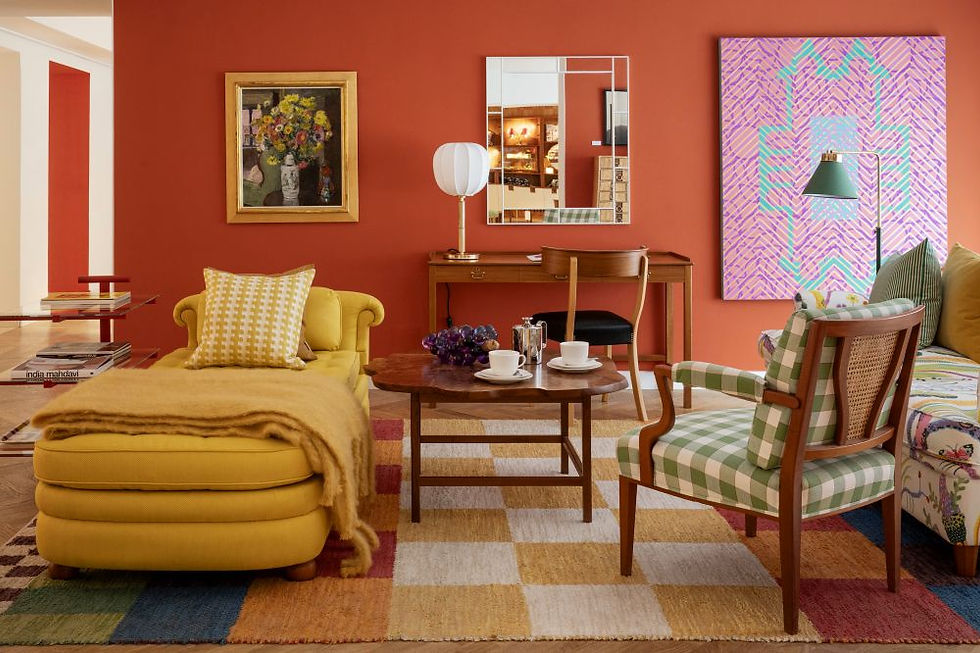
Furniture, paintings, fabrics, and light held in deliberate tension. Nothing dominates; everything speaks.
Seen from this perspective, Frank did not arrive in Sweden as a stylist offering an alternative modern look. He arrived as a thinker whose aesthetics were inseparable from political trauma and intellectual resistance. What his work would become within the Swedish context, and how much of this charge could survive translation, was the central tension that defined his collaboration with Ericson.
Frank’s contribution to Svenskt Tenn is often summarized through atmosphere, but it is anchored in a small number of objects whose persistence has quietly shaped the company’s identity. His textiles, most famously Hawaii, Manhattan, and Mille Fleurs, reject repetition, symmetry, and optical calm in favor of sprawling, almost cartographic compositions. They are patterns without centers, designed to resist containment and hierarchy. Scaled for rooms rather than surfaces, they refuse the decorative role assigned to ornament within orthodox modernism and instead behave like environments in their own right.
The same logic governs Frank’s furniture. Pieces such as his iconic asymmetrical cabinets, low upholstered armchairs, Mignon ceiling lamp, and bookcases are deliberately anti-monumental. They privilege use over display and adaptability over compositional unity. Nothing is frontal. Nothing asserts itself as a final form. These objects assume movement, rearrangement, and accumulation. They do not discipline space but loosen it. Between 1934 and his death in 1967, Frank designed nearly two thousand pieces for the company.

A freestanding cabinet of many drawers, burl veneer, and circular pulls. Utility made ceremonious.
Within Svenskt Tenn, however, these objects acquire a different valence. What Frank designed as a defense against rigidity becomes part of a stable interior grammar. The objects remain formally generous and psychologically astute, yet they now function within a framework of permanence and domestic continuity. Their radicalism survives in texture and form, even as their social implications are gently contained.
When Frank began collaborating with Ericson in the 1930s, the encounter was decisive for both. Ericson recognized in Frank a designer whose work resisted the sterility of international modernism while remaining compatible with her commitment to comfort and permanence. Frank, in turn, found in Svenskt Tenn an institutional refuge that offered continuity, protection, and economic survival. Yet the collaboration was never a simple fusion. What changed in Sweden was not the form of Frank’s work but its function. In Vienna, his interiors had been polemical, directed against the fantasy of total order. In Sweden, framed by Ericson’s worldview, those same interiors began to perform a different task. They softened modernity rather than destabilized it. They humanized progress without questioning its underlying social grammar.
This shift was subtle but profound. Svenskt Tenn interiors are formally permissive, layered in time, dense with pattern, resistant to minimalism, yet socially prescriptive. They assume stability, inheritance, and domesticity as givens. They offer refuge from modern acceleration while quietly reaffirming a conservative vision of life. And this is where the work becomes unmistakably Swedish. Sweden’s modernity has long specialized in managing contradiction rather than resolving it. Freedom is granted in atmosphere, comfort, and private feeling, while the social order remains intact. Ericson’s framing of Frank’s work exemplifies this logic with extraordinary elegance. The avant-garde is allowed to exist, but only as a tempering agent, not as a destabilizing force.

A green-shaded lamp on polished wood, surrounded by pattern and paper. Domestic calm with a pulse.
The result is a hybrid modernism that resists classification. It is radical in its refusal of functionalist austerity, conservative in its social imagination. It is intellectually generous, emotionally reassuring, and politically quiet. Frank’s Viennese antiauthoritarianism survives formally but is neutralized socially. His designs remain alive with contingency, but they no longer threaten the consensus into which they are absorbed.
Returning to Svenskt Tenn with this understanding, the experience subtly shifts. The comfort remains. The pleasure remains. But it becomes clear that what is being offered is not simply an interior style but a cultural solution: a way of living with modernity without allowing it to reorder the terms of social life. The rooms allow you to breathe, but they do not allow you to rearrange the world. The ease and reassurance persist, yet they reveal themselves as carefully bounded virtues—not an argument with modernity, but a truce with it, one that offers refuge rather than transformation.
Ustrit Nyhom does not work in design, architecture, or criticism. This is not an argument.
Cover image: Hammered silver resting on burl wood, elephants marching quietly across the wall behind it. Ornament as insistence, not excess.
Comments