

POLITICS AND POETICS
THE COMMANDMENTS: TEN RULES, NO EXPLANATIONS
CHRISTINA NAZARI
May 12, 2026
From Mount Sinai to courts, everyday speech, and now classrooms, this essay traces how the Ten Commandments moved from divine law to cultural habit. Moving through religion, law, language, desire, and the quiet persistence of moral limits, it asks what remains of these rules in a world that no longer fully believes in them, and why they continue to shape behavior even when their authority has faded. More than a history of religious instruction, it is a reflection on order, restraint, and the minimal structures that still organize how we live.
The Ten Commandments arrive in a form that feels almost suspiciously efficient. Ten short statements, delivered to Moses on Mount Sinai, written not in paragraphs but in bullet points. No introduction, no footnotes, no examples, no qualifying remarks about context or interpretation. They do not argue, they do not persuade, they do not anticipate objections. They simply appear, already complete.
It is difficult not to admire the economy of the gesture. A system of order condensed into ten lines. One could imagine worse formats, and indeed we have produced them. Entire libraries now attempt to do what these ten sentences once claimed to accomplish with a kind of confidence that, from a contemporary vantage, feels almost theatrical. The Commandments do not acknowledge complexity. They do not concede ambiguity. They do not admit that the situations to which they apply might exceed their reach. They state, and in stating, they assume their own authority.
And yet, even at the moment of their arrival, they are not quite what they later become. In Judaism, they are central, but not uniquely so. They sit within a much larger structure of law—hundreds of commandments, 613 according to the traditional count—governing everything from diet to property to ritual practice, from the preparation of food to the treatment of strangers, from agricultural cycles to contractual obligations. The Ten Commandments are prominent, certainly, but they do not function as a summary. They are part of a system, not the system itself. To extract them is already to alter them.

Moses keeping his appointment with God. No rescheduling possible.
It is in Christianity that they undergo a certain compression. Ten rules, isolated, elevated, made to stand in for a broader moral order. Portable, teachable, suitable for inscription, recitation, display. They appear on walls, in classrooms, in courtrooms, in arguments that have less to do with their content than with their symbolic weight. They become, in effect, the highlight reel of divine instruction. This is not a distortion exactly, but it is a shift. What was once embedded becomes isolated. What was part of a network becomes a list.
Lists have advantages. They are easy to remember, easy to reproduce, easy to circulate. They also invite a particular kind of reading: sequential, itemized, slightly impatient. One moves from one to the next, checking for relevance, looking for the one that applies. The format suggests clarity, even when the content resists it. There is a sense that, if one could only arrange the rules correctly, the world might follow.
At some point, however, the question presents itself, almost despite the structure that surrounds it. Why these rules? Why not others? Why this particular selection? No killing, no stealing, no false witness, no coveting, and not, for example, injunctions against indifference, or cruelty in its quieter forms, or the various ways in which people fail one another without violating any explicit prohibition.
The traditional answer is clear enough. These are divine commands, given in a specific moment, for a specific purpose. They establish order where there might otherwise be none. They define limits beyond which a community cannot sustain itself. Do not kill, because if killing becomes permissible, the group dissolves. Do not steal, because property becomes unstable. Do not lie, because trust collapses. In this reading, the rules are less about virtue than about survival.
But this explanation, while sufficient, does not entirely resolve the question. It accounts for the prohibitions that govern action, but less so for those that extend into intention. Why regulate desire? Why concern oneself with what someone wants, rather than what they do? The commandment against coveting suggests a deeper unease: that behavior alone is not enough to secure order. That comparison, resentment, and the perception of lack can be as destabilizing as any visible act.

Even revelation, at some point, requires a place to rest.
There is also the question of scale. The rules are few. They do not attempt to cover every situation. They leave large areas unaddressed. One is told not to kill, but not how to live. Not to steal, but not how to share. Not to lie, but not what to say. The economy is striking. It suggests that what matters is not completeness, but a set of fundamental constraints within which other forms of life might develop.
One could say that the Commandments are designed less to produce goodness than to prevent collapse. They aim not at the highest form of behavior, but at the avoidance of certain forms of damage. They draw a line and leave the rest unspecified. What happens within that space is not determined in advance.
This begins to explain their durability. They are not comprehensive enough to become obsolete. They do not depend on a particular social arrangement. They identify a limited number of recurring problems and attach prohibitions to them. Violence, appropriation, misrepresentation, comparison—these do not disappear. The rules remain legible because the situations they address persist.
The first commandment—no other gods before me—does not read, in this context, as a philosophical statement. It is closer to a demand for exclusivity. Not belief in the abstract, but priority. What comes first? What occupies the central position? The problem, then as now, is not the absence of belief, but its distribution. Too many objects competing for attention. Too many claims to importance. The commandment does not eliminate this competition. It declares a winner in advance.
The second—no graven images—has not aged well, at least not on the surface. We now produce images with a kind of industrial indifference. They multiply, circulate, replace one another without ceremony. Representation is no longer a risk; it is the default condition. And yet the prohibition remains oddly intelligible. Not as a literal ban, but as a recognition of the instability of images, their tendency to replace what they represent.
The third—do not take the name in vain—belongs to a category that has shifted from the sacred to the rhetorical. The misuse of language, once tied to the invocation of divine authority, now circulates in a much broader field. Words are deployed strategically, repeated without consequence, detached from what they signify. The original prohibition has dissolved, but its concern persists. The relationship between language and meaning remains unstable, even as its regulation has largely disappeared.

Clarity, delivered with the confidence that ambiguity will sort itself out later.
The fourth—remember the Sabbath—may be the most structurally radical. It does not prohibit an action; it interrupts time. One day set apart, not for productivity, but for its suspension. In a culture of continuous activity, the idea appears less as obligation than as anomaly. The rule remains legible, even admired, but rarely followed in its original sense.
Honor thy father and mother introduces hierarchy and continuity. It establishes a line—past to present—at a moment when such lines are often questioned or reconfigured. Respect remains, but its terms are negotiated rather than assumed. The rule persists, but as a point of tension rather than agreement.
Do not kill appears to be among the most straightforward and has been fully absorbed into legal systems. The prohibition is codified, enforced, and institutionalized. And yet its clarity is complicated by its exceptions. War, self-defense, state violence. Each introduces conditions under which the rule is suspended or reinterpreted. What remains is not a simple prohibition, but a boundary that is continually negotiated.
Do not commit adultery moves from action into relation. It assumes a structure, marriage, that is itself subject to change. As that structure shifts, so too does the meaning of the prohibition. What counts as betrayal, what counts as fidelity, what counts as obligation, are no longer fixed. The commandment persists, but its application becomes contingent.
Do not steal has perhaps undergone the most direct translation into law. Property, ownership, and exchange are now regulated through systems that extend far beyond the original formulation. And yet even here, ambiguity remains. What constitutes theft in a world of digital reproduction, intellectual property, and abstract forms of value is not always clear.

Two tablets, ten rules, and still an uneasy sense that something has been left out.
Do not bear false witness returns to language, but in a different register. It concerns truth in relation to others, avoidance of acts of speaking that distort or misrepresent. In its original context, this was tied to testimony, to judgment. Today, it extends across a landscape in which statements circulate rapidly, often detached from verification.
Do not covet enters the interior. It regulates not behavior, but desire. It asks not only that one refrain from taking what belongs to another, but that one refrain from wanting it. This is perhaps the most impossible of the commands, and also the most revealing. It recognizes that social order is threatened not only by action, but also by comparison.
One begins to notice, eventually, that the structure does not remain confined to religious contexts. It reappears, often quietly, even within systems that define themselves in opposition to religion—most strikingly within Communism, where official doctrine rejected religious authority. One still encounters familiar prohibitions: Do not take what belongs to the collective, do not misrepresent the official account, do not pursue private accumulation at the expense of others. The language changes, the justification shifts, yet the underlying concerns remain recognizable.
Something similar can be observed in secular moral frameworks more broadly. The vocabulary is different—harm, fairness, responsibility—but the structure often echoes the same minimal limits. Certain actions are marked as unacceptable not because they violate a command, but because they disrupt the conditions under which people can live together.
There is, finally, a quieter continuity. Systems that reject religious authority often retain a moral orientation that resembles it. An attention to inequality, a suspicion of unchecked accumulation, a concern for those in weaker positions—these are not uniquely religious ideas, but they resonate with earlier traditions that placed similar weight on restraint and obligation.
It would be too simple to describe this as inheritance. The frameworks are different, the explanations incompatible. But the convergence is difficult to ignore. It may be that these rules identify a limited number of problems that do not go away. Different systems arrive at them through different routes, but arrive nonetheless.
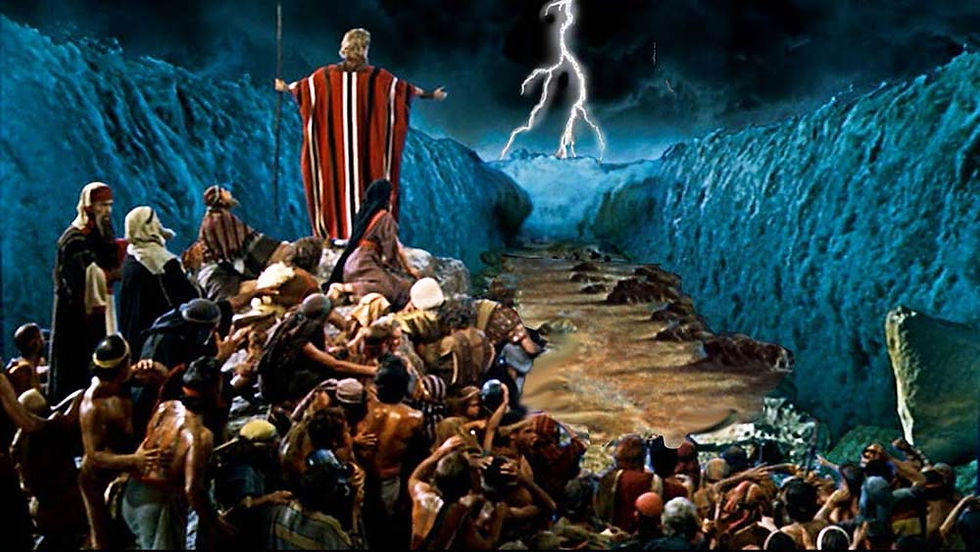
An impressive solution to a very specific problem. Not easily repeatable.
What persists, then, is not the authority of a specific set of rules, but a cluster of intuitions. That harm should be limited. That taking from others requires justification. That truth matters, even when it is contested. These intuitions appear in different vocabularies, attached to different explanations, but they do not disappear.
The Commandments survive particularly well in this state of partial amnesia. Detached from their source, they are easier to accept. They appear less as impositions than as observations. One does not need to belong to a religion to recognize their basic propositions. One knows them without necessarily thinking of them as commands.
They do not resolve the situations to which they are applied. They do not provide clarity in any comprehensive sense. But they offer something more modest: a form of orientation. Not sufficient, not complete, but present. Ten short statements, basic to the point of obviousness, still provide a minimal framework within which decisions can be recognized as such.
They are no longer decisive. But they remain. And in their persistence, stripped of certainty, they continue to offer a limited form of guidance, imperfect, uneven, and for that reason difficult to discard entirely.
Christina Nazari (b. 1955 in Chicago) studied accounting and theology and, finding neither convincing enough, became a compliance officer. She has followed the Ten Commandments for as long as she can remember and considers the outcome so far inconclusive.
Cover image: A system announced without preface. No argument, no appeal, just weather and certainty.
Comments