

THE WORLD IS A STAGE
THE CORGI AND THE QUEEN: THE POLITICAL FUNCTION OF CUTENESS
PHILIP WALTER BREW
January 29, 2026
For more than seventy years, the British monarchy stabilized its image of authority through a small, stubborn animal. This essay argues that the corgi was not a sentimental aside but a working component of power, managing contradiction at ankle height while the vertical architecture of sovereignty remained undisturbed.
The persistence of the corgi in the public life of Britain’s late Queen Elizabeth II must be understood not as anecdote but as structure. For more than seven decades, the queen appeared repeatedly alongside an animal whose physical form, scale, and temperament stood in visible tension with the symbolic architecture of monarchy. This was not merely a private preference that happened to be photographed often enough to become familiar. It was a stabilized image, endlessly reproduced, that performed a specific ideological function. The corgi did not decorate power. It mediated it.
In photographs, the disparity is immediate. The queen stands upright, framed by uniforms, palaces, motorcades, and the vertical grammar of sovereignty. At her feet, the corgi remains stubbornly horizontal: short-legged, alert, slightly comic, resistant to grace. The animal pulls against the lead, looks away from the camera, barks, interrupts. It refuses choreography. This refusal is not incidental. It is precisely what makes the image work. Authority becomes legible not through command, but through tolerance. Power appears stable because it allows itself to be disturbed.

Dynasty, succession, and inheritance, briefly reorganized around feeding schedules and attention.
Elizabeth II’s reign unfolded under historical conditions in which authority could no longer rely on transcendence alone. The British monarchy survived the twentieth century not by reasserting metaphysical sovereignty, but by submitting itself to carefully managed forms of visibility. It learned how to appear ordinary without becoming accessible, continuous without becoming intimate. Power increasingly needed to be seen enduring rather than commanding. Within this visual economy, the corgi entered as a regulating element, but also as something more elusive. It functioned not only as a mediator, but as an object saturated with affect, concealing the labor of representation by appearing natural, spontaneous, and beneath analysis.
Susan, the first corgi, entered Elizabeth’s life in 1944, before the crown and before full symbolic consolidation. This timing is decisive. Elizabeth was eighteen, Britain was still at war, and the future queen was not yet fully transformed into the figure she would become. Susan was not acquired as part of a sovereign image. She preceded it. The dog accompanied Elizabeth through a period in which private person and public function had not yet fully collapsed into one another.
This is important, because monarchy depends on the slow erasure of that distinction. What Susan did, quietly and without intention, was normalize its erosion. When Susan appeared on Elizabeth’s honeymoon in 1947, she crossed a boundary that was already weakening. The honeymoon is traditionally imagined as a suspension of public obligation, a space of privacy before the resumption of duty. Susan’s presence there collapsed that fiction. The animal moved freely between intimacy and institution, binding them together without explanation. What appeared private was already structural. It did not yet look like power, but it was already participating in its formation.
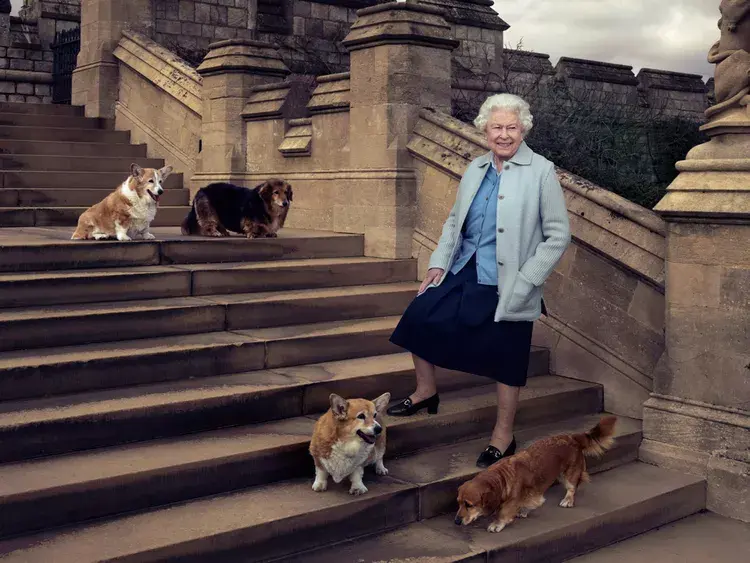
Retirement from politics does not mean retirement from symbolism.
From Susan onward, repetition replaced contingency. Elizabeth II would go on to own or breed more than thirty corgis during her reign, along with a smaller number of dorgis. The first dorgi (a cross between a corgi and a dachshund) appeared unintentionally, when Princess Margaret’s dachshund mated with one of the queen’s corgis. The hybrid is instructive. It reveals that even within an intensely managed symbolic system, meaning is often generated through accident, proximity, and domestic spillover. The monarchy does not invent all its signs. It encounters them, incorporates them, and only afterward renders them natural.
Over time, the corgi ceased to function as an individual animal and became a signifying unit. Its effectiveness depended not on uniqueness but on seriality. The same animal body, slightly altered by age or lineage, returned again and again. This repetition produced familiarity without intimacy, recognition without access. The corgi performed ordinariness while participating fully in sovereignty. It belonged simultaneously inside and outside the ritual order, and it was precisely this ambiguity that made it effective. It softened the image of authority without compromising its distance.
Read against this logic of repetition, the corgi’s role in Elizabeth II’s public life becomes clearer when considered alongside a broader history of animals circulating near political authority, not as personal companions but as instruments through which power tests its own limits. The proximity of dogs to political authority has long functioned as a diagnostic surface, revealing what a given system of power cannot comfortably articulate about itself. Animals tend to appear beside leaders not when authority is secure, but when it must be rendered believable without appearing coercive. In regimes founded on domination, the dog often becomes a displaced emblem of obedience.

Authority at rest, watched over by a creature small enough to question it without consequence.
Adolf Hitler’s German shepherd Blondi, repeatedly staged within the domestic interiors of the Berghof, did not signify tenderness or companionship. The animal condensed an ideal of loyalty purified of human unpredictability at a moment when social relations were governed by fear. Devotion that could no longer be safely enacted among people was transferred onto the animal, which could receive it without resistance or moral complication.
The invocation of Hitler in this context is not incidental. When Elizabeth received Susan in 1944, Britain was still at war with Germany, and the symbolic economies of leadership on both sides were already fully formed. The contrast is stark. In the bunker in 1945, Blondi was used as a test subject for cyanide capsules, killed to verify their effectiveness before Hitler used the same poison on himself. The animal’s loyalty was absolute, but it was also entirely expendable. This logic is consistent. In authoritarian systems, animals function not as mediators but as extensions of will, bound to images of instinct, vitality, and mastery, and ultimately subject to the same instrumental rationality as everything else. They do not soften power. They thicken it, reinforcing hierarchy through spectacle and control rather than negotiation.
The British monarchy under Elizabeth II required a different symbolic arrangement. Its problem was not how to dramatize authority, nor how to stage obedience, but how to allow sovereignty to persist without appearing either violent or sentimental. Susan and her descendants answered this problem not by symbolizing loyalty or intimacy, but by inhabiting the image of power at a low, continuous level. They were not mobilized episodically, nor deployed to redeem moments of crisis. They did not punctuate the sovereign image. They remained within it. This persistence mattered more than any particular gesture. The corgi did not interrupt authority with narrative or charisma. It settled into it, becoming part of its texture rather than its message.

A rare moment when the hierarchy dissolves entirely, and the image survives because it looks accidental.
The animal’s effectiveness lay precisely in its resistance to interpretation. It appeared ordinary, even trivial, yet carried a persistent charge. Its cuteness was neither spontaneous nor theatrical. It operated as a regulated form of affect, organizing warmth without inviting access, attachment without reciprocity. The queen did not speak through the dog, nor did the dog speak for her. There was no confessional discourse, no sentimental explanation. Instead, the animal absorbed what could not be structurally acknowledged within the institution itself: dependency, care, vulnerability. These elements were displaced downward, onto a body that could safely carry them without demanding recognition or response.
The corgi’s small acts of disorder reinforced this arrangement. Its barking, pulling, and refusal to align perfectly with ceremony introduced irrationality into the image of power without allowing it to escalate. Disorder was not excluded. It was miniaturized and contained. Authority appeared patient rather than coercive, indulgent rather than brittle. The system did not suppress its contradictions. It rendered them livable, visible only at a scale that could never threaten the structure itself.

The state presents itself formally; the animal interrupts, reminding us that power is always being observed from below.
It is against this broader field of animal symbolism, where obedience, mastery, and spectacle dominate, that the corgi’s quieter function within the British monarchy can be understood—not as charm or eccentricity, but as a form of stabilization uniquely suited to an institution surviving on endurance rather than command.
The breed itself is central to this function. Corgis are working dogs, bred to herd cattle by remaining close to the ground and exerting control through irritation rather than dominance. Their bodies resist elegance. Their proportions defy harmony. They are persistent rather than impressive. In a system saturated with vertical symbols of authority, the corgi insists on horizontality. Yet this insistence does not undermine power. It animates it. The animal introduces movement, noise, and contingency into an image that would otherwise risk stiffening into pure ceremony.
The queen’s reign coincided with the long contraction of British power. Empire dissolved. Authority became symbolic rather than material. Tradition increasingly relied on repetition rather than belief. The monarchy survived by managing its aura. The corgi contributed to this management not by reinforcing majesty but by diffusing it. It suggested continuity without triumph, endurance without domination. The image of the queen walking her dogs did not assert authority. It performed it through ritualized ordinariness.
The Welsh origin of the corgi adds another layer to this arrangement. Wales occupies a subordinate yet constitutive position within the United Kingdom. The animal mirrors this relation. It is integrated yet marginal, indispensable yet never central. The monarchy presents itself as composite without relinquishing hierarchy. The corgi participates in this presentation as a living emblem of managed difference.

Power multiplied becomes administration. Even affection requires coordination.
As Susan aged and died, she was replaced by her descendants. The lineage continued, reinforcing the appearance of continuity beyond individual bodies. Yet this continuity was never abstract. It depended on the slow accumulation of images, habits, and gestures anchored to the queen herself. The corgis were not interchangeable symbols. They were activated by duration.
In the early twenty-first century, Elizabeth II stopped breeding corgis. The reason given was that she did not wish to leave young dogs behind when she died. This decision marks a rare interruption in the logic of continuity. It acknowledges the dependency of the symbol on the body that sustains it. The object cannot outlive the ritual context that animates it.
After the queen’s death in 2022, the brief reappearance of corgis in royal contexts felt displaced. The animals remained intact, but the charge had dissipated. What remained was nostalgia, the affect that follows when belief no longer functions and only its surface survives.
Susan’s significance lies not in affection but in mediation. She did not humanize the queen in any simple sense. She allowed authority to appear grounded without becoming accessible, animated without confessing animation. She made endurance look natural.

Here, sovereignty is no longer vertical but shared laterally, eye level with the animal world.
The political function of cuteness is not reconciliation but containment. It does not resolve contradiction. It renders it livable, even comfortable. In this sense, Susan was not an ornament of monarchy but one of its instruments, a small animal through which a vast institution rehearsed its dependence on what it could never fully acknowledge.
Power does not survive through grandeur alone. It survives through objects that appear beneath it, beneath seriousness, beneath threat. Sometimes those objects are low to the ground, stubborn, difficult to control, and quietly resistant to meaning.
Philip Walter Brew (born 1998 in Cardiff) read George Orwell’s “Animal Farm” (1945) and decided to study animal behavior and sociology at the University of Cambridge. He is currently working on a book titled “Authority and Animals,” forthcoming in 2027, which explores why authority repeatedly turns to animals at precisely the moments when it claims to be most rational, modern, and in control.
Cover image: An image of reassurance: continuity rendered tactile, warm, and unmistakably domestic
Comments