

COVER TO COVER
THE EMPEROR AND THE POET: NAPOLEON’S MEETING WITH GOETHE
ADRIAN FALK
September 15, 2026
In 1808, Europe’s most powerful conqueror summoned Germany’s greatest writer—and offered him a literary critique over breakfast. Their remarkable encounter became a contest between two kinds of empire: one built with armies, the other with words.
On the morning of October 2, 1808, Johann Wolfgang von Goethe entered the imperial residence at Erfurt to meet Napoleon Bonaparte. The encounter lasted about an hour, yet it became one of history’s most celebrated meetings between political and literary power. Napoleon commanded armies and rearranged borders; Goethe rearranged the inner lives of his readers. Each man possessed something resembling an empire, although only one required artillery.
The meeting occurred during the Congress of Erfurt, a gathering of rulers, diplomats, soldiers, and courtiers held from late September to the middle of October. Its official purpose was to reinforce the alliance between Napoleon and Tsar Alexander I of Russia, established the previous year at Tilsit. Napoleon wanted Russian cooperation while he confronted resistance in Spain and prepared for another possible war with Austria. These were serious diplomatic problems, and Napoleon addressed them by assembling a remarkable collection of European royalty and surrounding them with ceremonies, banquets, uniforms, decorations, and theatrical performances. If persuasion failed, magnificence might still do some work.
Culture was part of the display. Napoleon brought prominent actors of the Comédie-Française to Erfurt to perform French tragedies before an audience of emperors, kings, and princes, many of whom were already living in one. The performances presented France not only as the strongest military power in Europe but as the heir to a great literary civilization. Inviting distinguished German writers served the same purpose. Napoleon could conquer German territory, but gaining the approval of German culture required a more delicate campaign.

Goethe in 1828, holding a manuscript and looking as though he has already found the concealed seam in your argument.
By 1808, Goethe was the obvious person to impress. The Sorrows of Young Werther, published in 1774, had made him famous throughout Europe. Its story of impossible love, emotional torment, and suicide had inspired admiration, imitation, and alarm. Young readers dressed like Werther, spoke like Werther, and occasionally worried their elders by appearing to take him rather too seriously. Goethe had since become a statesman, poet, dramatist, novelist, critic, and scientific investigator. The first part of Faust appeared in 1808, giving him the unusual distinction of meeting Napoleon during one of the most productive years of his career.
Goethe’s attitude toward the French emperor was complicated. Two years earlier, Napoleon’s forces had defeated Prussia at Jena and Auerstedt. French soldiers entered Weimar, looted houses, and threatened Goethe’s home. He had therefore encountered the empire not merely as a grand idea but as armed men at the door. Nevertheless, he did not reduce Napoleon to the role of foreign oppressor. Goethe was fascinated by exceptional energy, disciplined will, and the power of an individual to shape an age. Napoleon displayed all three qualities, along with several less attractive ones.
According to Goethe’s account, he was summoned to Napoleon at about eleven in the morning. Presented to leading French officials, including Talleyrand, he then entered the emperor’s study. Napoleon sat at a large round table eating breakfast and discussing financial contributions with Pierre Daru. Goethe stood at a respectful distance. The staging was unmistakable: Even literary immortality had to wait until the emperor had dealt with breakfast and taxes.
Napoleon examined Goethe and reportedly said, “Vous êtes un homme” (You are a man). Other accounts give the phrase as “Voilà un homme” (There is a man). The precise wording remains uncertain, as precise wording often does when history discovers that it has produced a memorable scene. Yet the remark became the symbolic center of their meeting. It suggested that Napoleon recognized Goethe as more than another official or court ornament. Before him stood a person of genuine substance, someone who possessed authority without commanding a regiment.

Napoleon at work: The clock says late, the candle says later, and Europe is still not fully reorganized.
Napoleon asked Goethe’s age. Goethe replied that he was sixty, although he was still fifty-nine. This was a pardonable act of rounding, especially in the presence of a man who had already rounded off several European states. Napoleon observed that Goethe was well preserved. The conversation then moved to literature. Daru mentioned Goethe’s dramatic works and his translation of Voltaire’s Mahomet. Napoleon criticized the play’s portrayal of a world-conquering religious leader. A world-conquering emperor naturally had professional reasons for taking an interest in how such figures appeared onstage.
Napoleon then turned to Werther. He had read the novel attentively and pointed to a feature he considered artistically flawed. Goethe did not identify the passage in his surviving account, leaving later readers to guess what the emperor disliked. The important point was that Napoleon had not summoned the author merely to offer ceremonial praise. He remembered the novel closely enough to criticize it to the man who had written it. Many writers receive comments from readers; rather fewer receive editorial notes from the ruler of continental Europe.
Napoleon controlled the room, the schedule, and the conversation. Goethe nevertheless carried another kind of power into the imperial study: the power of a book to cross borders and remain in the mind of a conqueror. They did not meet as equals in rank. They met as men who recognized in each other an unusual capacity to shape their age—one by moving armies across Europe, the other by moving readers without requiring them to leave their chairs.
Napoleon’s discussion of The Sorrows of Young Werther complicates the familiar image of the emperor as a man interested only in maps, armies, and himself. He claimed to have read the novel many times, possibly as many as eleven, and reportedly carried it during his Egyptian campaign. Whatever the exact number, his comments suggest more than ceremonial familiarity. Napoleon had not merely encountered Werther; he had argued with it, which is one of the more convincing signs that a person has read a book.
According to an account associated with Goethe’s circle, Napoleon objected to the way the novel mixed two motives in its hero: disappointed ambition and frustrated love. Werther suffers because he cannot possess Charlotte, but he is also wounded by his inferior social position and by humiliations in public life. Napoleon thought the second motive weakened the first. If love was meant to destroy Werther, then injured pride should not be allowed to share the credit. He reportedly called the mixture unnatural and asked Goethe why he had constructed it that way.

Diplomacy at Erfurt: several emperors, innumerable decorations, and not quite enough trust to go around.
Goethe seems to have taken the criticism seriously. He later compared Napoleon’s observation to the judgment of a skilled tailor who discovers a concealed seam in a sleeve that appears seamless. This was high praise from a writer who had spent decades receiving opinions about his most famous novel and had presumably learned how to survive them. Napoleon had located a structural join that most readers had missed.
The criticism also reveals something about Napoleon himself. He preferred motives to be clear, concentrated, and forceful. A hero should be driven by a dominant passion, just as a campaign should have a decisive objective. Goethe’s novel is less orderly. Werther’s destruction arises from several injuries that become inseparable: erotic disappointment, social exclusion, wounded vanity, loneliness, and a temperament unable to accommodate limits. Napoleon looked for a principal cause. Goethe had created a human being.
Their disagreement therefore concerned more than literary technique. Napoleon approached tragedy as a ruler accustomed to decision, hierarchy, and action. Goethe approached it as a writer attentive to contradiction. For Napoleon, divided motives might weaken dramatic power. For Goethe, divided motives were often the substance of character. Human beings rarely collapse for only one reason, however much an emperor—or a literary critic—might prefer a cleaner report.

The Sorrows of Young Werther, 1775. The list of printing errors was shorter than the list of emotional ones.
Napoleon’s interest extended beyond Werther. He also made observations about tragedy and rejected the fashionable idea of an obscure fate controlling human lives. In the modern world, he declared, politics was fate. Coming from a man whose decisions had altered the lives of millions, the remark possessed the advantage of being partly self-demonstrating.
Reports of conversations during the Erfurt and Weimar festivities also connect Napoleon with a proposal that Goethe write a tragedy about the death of Julius Caesar, grander than Voltaire’s treatment. The work, Napoleon suggested, should show how Caesar might have benefited humanity if he had been given enough time to complete his plans. It is difficult to miss the autobiographical convenience of this interpretation. Napoleon was offering Goethe a Roman subject with a distinctly Napoleonic moral: The great ruler is not dangerous because his power is excessive, but tragic because history may interrupt him before his benevolent designs are finished.
The emperor also invited—or instructed—Goethe to come to Paris, where immense material would supposedly nourish his poetry. The distinction between invitation and command became somewhat delicate when Napoleon said he required it. Goethe did not go. He had spent years constructing an intellectual center in Weimar and was unlikely to become an ornament at another man’s court, even when that court occupied most of the available map.
Napoleon’s attention to Goethe was probably sincere. He was an energetic reader, took drama seriously, and understood that literature could reveal the motives by which people acted. Yet sincerity and calculation were not opposites in him. Honoring Goethe also served imperial politics. Napoleon had defeated German states militarily, but military occupation did not guarantee cultural allegiance. By admiring Germany’s most celebrated writer, he could present himself not as a foreign destroyer but as a universal ruler capable of recognizing merit beyond France.

The Legion of Honor for the poet: recognition of individual greatness, conveniently issued by the empire.
The Congress of Erfurt made this cultural campaign visible. By its end, Goethe and Christoph Martin Wieland had been named knights of the Legion of Honor. The decorations acknowledged literary achievement, but they also placed that achievement within Napoleon’s system of imperial recognition. A medal can honor its recipient while advertising the authority of the person entitled to bestow it.
Literature and power therefore met at Erfurt in a state of mutual fascination. Napoleon wanted the prestige of Goethe’s genius near his empire; Goethe wanted to understand the human force reorganizing Europe. Neither man was politically innocent, and neither was merely pretending. The emperor read the poet closely, while the poet studied the emperor as if history had unexpectedly produced a character too improbable for fiction.
The meeting at Erfurt has often been remembered as an encounter between equals: the emperor of political Europe and the emperor of European literature. The comparison is attractive, although it risks flattering both men a little too efficiently. Napoleon possessed armies, laws, taxes, police, and the power to move borders. Goethe possessed books and readers. One could compel obedience; the other had to persuade. Yet Goethe’s influence could enter places where Napoleon’s soldiers would have been unwelcome, which by 1808 included a considerable portion of the continent.
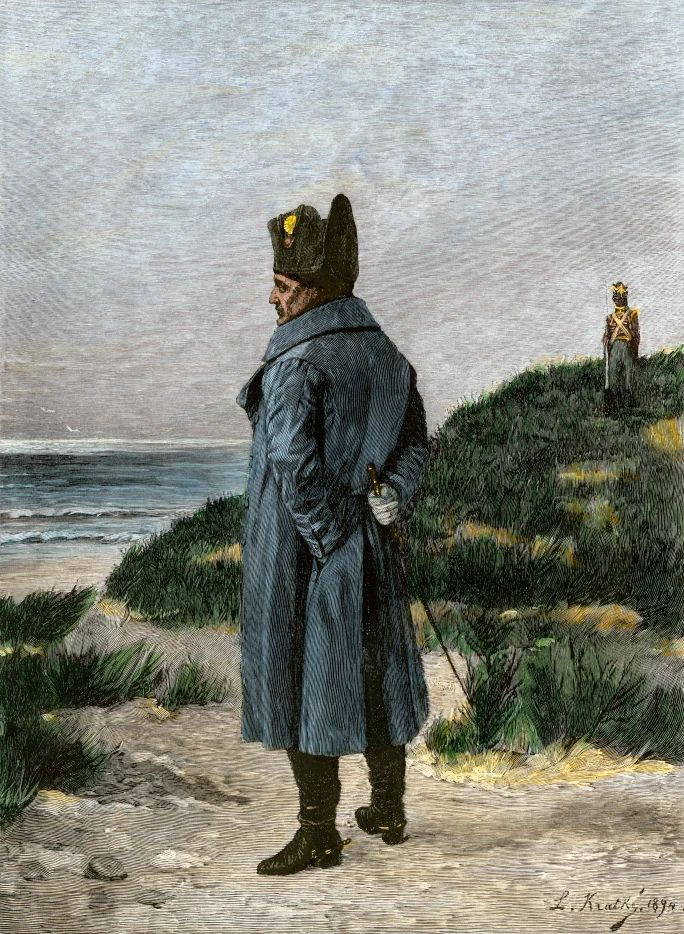
Napoleon on Saint Helena. After treating Europe as editable, he discovered that an island offered very limited revisions.
Goethe continued to speak of Napoleon with extraordinary admiration. In conversations recorded years later by Johann Peter Eckermann, he described him as one of the most productive human beings who had ever lived. Goethe used “productive” in a broad sense. A person did not need to write poems or plays to possess genius; deeds could also be creations. Napoleon produced institutions, campaigns, laws, alliances, governments, and consequences at a rate that made ordinary statesmen appear to be waiting for better weather.
For Goethe, this energy had an almost supernatural quality. He associated Napoleon with the “demonic,” by which he meant a force that could not be fully explained by ordinary reason. Such individuals seemed driven by inexhaustible activity and capable of exerting power over other people without being entirely understood by them. Goethe did not mean that Napoleon was simply evil. The demonic was larger and more ambiguous: creative, dangerous, magnetic, and resistant to moral bookkeeping.
That ambiguity is also the central difficulty in Goethe’s admiration. Napoleon’s productivity was not harmless. His achievements were inseparable from military conquest, political repression, mass conscription, and immense suffering. The same will that impressed Goethe sent armies across Europe and left hundreds of thousands dead. To describe such energy as genius may be intellectually defensible, but it is morally uncomfortable. A ruined city is a production, though its residents may not appreciate the creativity involved.
Goethe’s position cannot be reduced to simple approval. He understood that greatness could become destructive when an individual elevated one idea above every limit. Late in life, he identified Napoleon as an example of the danger of sacrificing everything to the absolute realization of a single purpose. He could therefore admire Napoleon’s clarity, energy, and intelligence while recognizing the catastrophe produced by their excess. Whether this distinction is sufficient remains open to debate. Admiring the abilities of a conqueror without endorsing conquest is possible, but it requires a careful separation between capacity and consequence—and history does not always cooperate with careful separations.

Goethe’s study in Weimar. The empire of words required fewer uniforms, but considerably more shelf space.
Goethe’s refusal to join the nationalist hostility directed at France made his attitude still more controversial. Many Germans saw Napoleon principally as an occupier. Goethe distrusted collective enthusiasm, including patriotic enthusiasm, and resisted the expectation that a writer should become a spokesman for national resentment. He preferred to judge individuals and works across political borders. This independence could appear cosmopolitan and courageous; it could also appear detached from the suffering of people who lacked the privilege of observing history from a study in Weimar.
History soon altered the balance between the emperor and the poet. In 1808 Napoleon stood near the summit of his power. Within a few years, the Russian campaign destroyed much of his army, European coalitions entered Paris, and he abdicated. His return in 1815 ended at Waterloo, after which he spent his final years on Saint Helena. The man who had treated geography as editable discovered that an island could be distressingly final.
Goethe’s authority followed a quieter course. He remained in Weimar, completed more major works, and lived until 1832. His books continued to circulate after the political order of Erfurt disappeared. It would be too simple, however, to conclude that literature defeated power. Napoleon also survived in imagination: in paintings, biographies, political myths, military studies, novels, and national memory. His territorial empire collapsed, but his symbolic empire proved remarkably difficult to evacuate.

Napoleon at Fontainebleau in 1814. Europe had finally returned the manuscript with extensive corrections.
The meeting itself contributed to that survival. Later writers and artists transformed a brief audience into a scene of mutual recognition between two great men. The uncertain greeting—“You are a man” or “There is a man”—became memorable because it condensed the entire encounter into a few words. Napoleon appears as the ruler capable of recognizing genius; Goethe appears as the genius worthy of recognition by the ruler. Each man enlarges the other. It is an exceptionally economical arrangement for posterity.
Yet the real interest of Erfurt lies not in proving that the two were equal. Their powers were fundamentally different. Napoleon could determine where Goethe stood, when he entered, and how long he remained. Goethe could determine how later generations imagined the encounter. Political power controlled the occasion; literary power helped control its memory.
At Erfurt, each man recognized a rival form of greatness: Napoleon saw a writer whose authority did not depend on imperial permission, and Goethe saw a ruler whose energy seemed to turn personality into historical force. Their admiration was genuine, their circumstances political, and their legacies morally complicated and permanently entangled. Napoleon could summon Goethe into the room. Goethe—and the writers who followed him—could ensure that the room would never become empty.
Adrian Falk (b. 1968 in Hamburg) is a writer and cultural historian based in Waterloo, Belgium. His work explores European intellectual and literary history, with a particular interest in the encounters between art and political power, the construction of historical reputation, and the ways cultural memory complicates seemingly settled judgments. He writes regularly on literature, biography, and the afterlives of historical figures.
Cover image: Napoleon receives Goethe at Erfurt. The emperor supplied the chair; the poet supplied posterity.
Comments