

THE WORLD IS A STAGE
THE IMITATION OF LIFE: HOW WE LEARNED TO BECOME ONE ANOTHER
NEIL ARDEN
May 26, 2026
We like to believe we become ourselves. This essay suggests something less comforting: that we learn ourselves by copying others, until the copy begins to feel original. From childhood imitation to social media’s readymade identities, it asks what remains of freedom when even our most private selves arrive already formatted.
What follows is not simply a theory of imitation, but a social history of how imitation has gradually migrated inward, from gesture to identity, from something one does to something one is. The contemporary unease around people “copying each other” is not new, but it has acquired a new density. What was once diffuse, slow, and partially hidden has become visible, accelerated, and, in a certain sense, finalized. We are no longer only imitating actions or tastes; we are imitating entire selves, often in forms that arrive already complete.
To understand this development, one must begin at the beginning, with the fact that imitation is not a deviation from authenticity but the precondition of any identity whatsoever. A child does not “discover” itself in isolation. It learns by copying. Not in the trivial sense of repeating words or gestures, but in a deeper, structural sense. The infant mirrors expressions, intonations, rhythms of attention. It becomes intelligible by reproducing what surrounds it. Before there is any coherent sense of self, there is a capacity to echo.
This early imitation is not yet fixed. It is exploratory, provisional, incomplete. The child tries on gestures without fully inhabiting them. It does not yet confuse imitation with identity. It is precisely this openness that makes development possible. The self, at this stage, is not a stable entity but a field of possibilities structured through interaction.
Here Donald Winnicott provides a crucial framework. Winnicott’s distinction between the “true self” and the “false self” is often misunderstood as a simple opposition between authenticity and inauthenticity. In fact, the false self emerges as a necessary adaptation. The infant learns to respond to the environment, to present what is acceptable, to align with expectations. Without this adaptation, social life would be impossible.
The danger arises not from imitation itself, but from its consolidation. When adaptation becomes rigid, when the provisional becomes permanent, the false self ceases to be a flexible interface and becomes the only available identity. It does not feel false. It feels coherent, functional, even successful. What is lost is not some hidden essence, but the capacity for spontaneity—for responses that are not entirely predetermined.

The modern self: assembled from references, playlists, and people nearby.
If imitation is the origin, then desire is its engine. René Girard radicalized the concept by arguing that we do not simply imitate actions; we imitate desires. We want things because others want them. The structure is triangular: subject, model, object. The model confers value upon the object, and the subject’s desire is mediated through that model. What becomes evident, especially in the present, is that the “object” of desire can be an identity itself. One does not merely want what another has; one wants to be what another is. The admired figure becomes a template. But increasingly, the figure is less an individual than a type. Desire attaches not to singular persons but to recognizable configurations of traits, tones, and positions.
Historically, this process was constrained. One encountered a limited number of models—family members, local figures, a handful of public personalities. The imitation was partial, often inconsistent. There was room for deviation, for misinterpretation, for the slow formation of something idiosyncratic.
The twentieth century expanded the field. Mass media introduced a proliferation of figures, styles, and attitudes. Erving Goffman captured this shift in his account of social life as performance. Individuals, he argued, present themselves in ways that are legible to others—managing impressions, maintaining roles. The self is not hidden behind the performance; it is constituted through it. Yet Goffman’s world retained a certain multiplicity. The performance was situational. One could be different in different contexts. The office self, the private self, the social self—these were not necessarily unified. The gaps between them allowed for a degree of freedom, even if that freedom was constrained.
The decisive transformation occurred with the emergence of digital platforms such as Instagram and TikTok. Here, the conditions of imitation are not merely expanded but restructured. The self is no longer performed for a limited audience in a specific context; it is continuously presented to an abstract, indefinite public. The performance must be consistent, recognizable, and repeatable.
What these platforms produce is not simply visibility but standardization. They refine individuals into types. The successful persona is one that can be quickly identified: the incisive commentator, the morally certain advocate, the detached observer, the cultivated aesthete. Each comes with a set of cues—visual, linguistic, tonal—that can be learned, replicated, and optimized.
Imitation, under these conditions, becomes granular. It extends beyond general aspiration into the microstructure of expression. One adopts not only what to think, but how to speak. The cadence of sentences, the placement of emphasis, the strategic pause before a conclusion. Even the sound of the voice begins to converge toward recognizable patterns. There is a narrowing of expressive range toward what is legible within the system.
Language reveals this most clearly. Certain phrases circulate widely, functioning as markers of alignment. Vocabulary becomes a signal of belonging. One does not simply articulate an idea; one activates a position that is already intelligible within a shared discourse. The originality of the thought is secondary to the recognizability of its form.
At this point, Girard’s mimetic framework intensifies. The model is no longer a distant figure but a distributed pattern. Desire is directed toward identities that have already been validated by visibility. One wants to inhabit a form that is known to work. The imitation is immediate and continuous, reinforced by feedback.

Everyone performing individuality with remarkable consistency.
Goffman’s dramaturgy, in turn, becomes literalized. The distinction between stage and backstage collapses. There is no longer a clear space in which the performance can be suspended. The self must be maintained across contexts. Consistency becomes a requirement, not a choice. Inconsistency threatens legibility.
Winnicott’s false self finds ideal conditions. The adaptive persona is not only necessary but rewarded. It is amplified through metrics—likes, shares, engagement. The more effectively one inhabits a role, the more it is confirmed as identity. The feedback loop stabilizes the performance.
It is here that the idea of the “readymade self” becomes particularly illuminating. Borrowing, in a loose sense, from Marcel Duchamp, one might say that identity increasingly resembles a readymade: something selected rather than formed, designated rather than discovered. A set of traits, tones, and positions—already circulating, already validated—are taken up and declared as one’s own. As with Duchamp’s objects, nothing intrinsic has changed. What changes is the framing. The act of adoption transforms the available material into identity. The readymade self is not fabricated from scratch; it is assembled from preexisting components that retain their recognizability.
This helps explain why the adoption feels like discovery. The modern injunction to “find oneself” is resolved through selection. One encounters a persona that resonates, that appears coherent, that has already been validated, and one adopts it. The ambiguity of self-formation is replaced by the clarity of identification.
But the readymade has a structural limitation. It arrives complete. It leaves little room for alteration without losing its coherence. The more precisely defined the type, the less flexible it becomes. Variation introduces friction, and friction reduces visibility.
If one returns to the child, the contrast becomes stark. Early imitation was generative because it was incomplete. It allowed for error, for misalignment, for gradual differentiation. The child did not adopt a finished identity; it experimented with fragments. In the contemporary environment, the fragments have been pre-assembled. The self is offered as a package. The process of formation is compressed into a moment of selection followed by a process of maintenance.
This does not mean that transformation is impossible. Even a readymade can be altered, recontextualized, misused. But the system does not encourage such deviations. It rewards stability, coherence, recognizability. The cost of deviation is reduced legibility, and reduced legibility often means reduced social presence.
From a social-historical perspective, one might say that the self has moved from opacity to transparency, from gradual formation to immediate presentation, from internal negotiation to external validation. The space in which identity could remain uncertain, provisional, or contradictory has narrowed.
What is lost is not authenticity in a romantic sense, but the capacity to remain unfinished. The moment of not yet knowing—how to speak, what to think, how to position oneself—has become difficult to sustain. It does not circulate. It cannot be easily coded into a recognizable form.
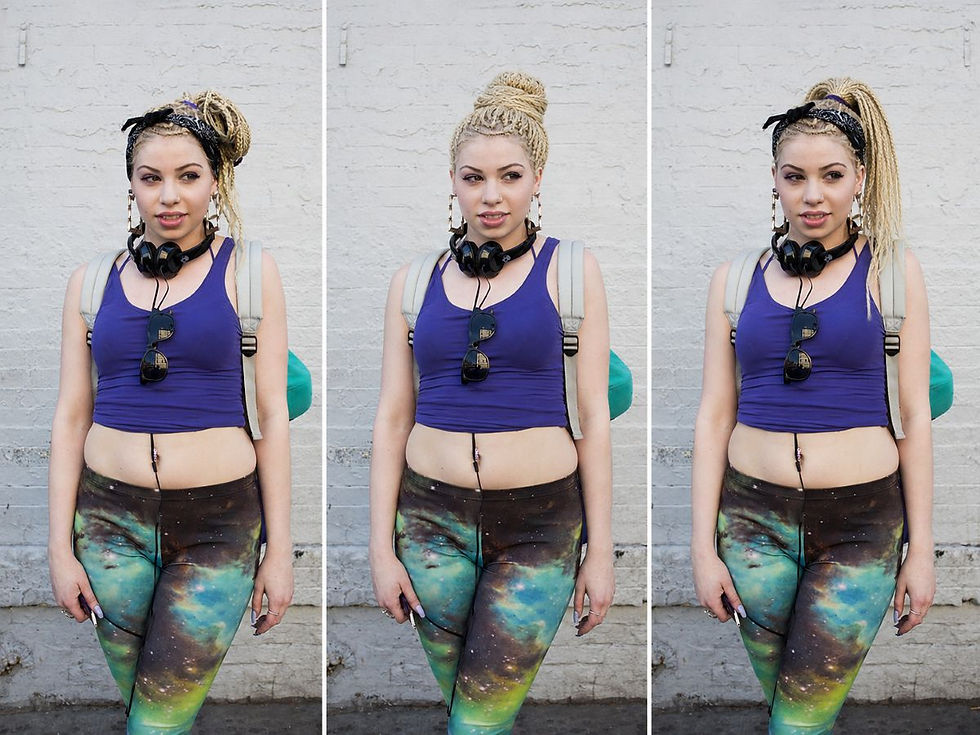
We learn who we are by rehearsing each other.
And yet, it is precisely this moment that may still hold the possibility of transformation. If imitation is unavoidable, the question is how it is processed. One can adopt a readymade self and maintain it, refining its edges, ensuring its coherence. Or one can treat it as provisional, as material to be worked through.
The difference lies in whether imitation is allowed to remain in motion.
Friedrich Nietzsche suggested that the self is not discovered but created. But creation, in this context, does not mean invention ex nihilo. It means the capacity to take what is given—models, roles, readymades—and transform them. To introduce variation, to sustain tension, to resist closure. The unsettling possibility is that many no longer experience this as a tension. The readymade self functions. It provides coherence, recognition, and reward. Under such conditions, the distinction between adoption and identity fades.
What remains, perhaps, is not a hidden, true self waiting to be uncovered, but a fragile capacity: the ability to notice the imitation, to recognize the borrowed nature of one’s voice, one’s vocabulary, one’s posture toward the world. This recognition does not dissolve the structure, but it introduces a slight distance.
In that distance, however minimal, something like freedom might still persist—not the freedom to be entirely original, which is impossible, but the freedom to alter what one has already taken on.
Neil Arden (b. 1948 in Santa Clarita, California) wrote sparse essays in the 1970s and 1980s about imitation, media behavior, and constructed personality. His cult book “The Arrangement of Selves” (1988) argued that modern identity increasingly arrived preassembled through images, advertising, and social expectation. He stopped publishing in the late 1990s. This is his first essay in twenty-seven years.
Cover image: Three versions of the same original nobody remembers meeting first.
Comments