

THE WORLD IS A STAGE
THE TYRANNY OF POLITE QUESTIONS
LARA SCHMEGEGGE
May 19, 2026
How do polite questions function less as curiosity than as classification? How do they sort, place, and reduce people into coordinates while passing for conversation? Here we trace the quiet mechanics of these social scripts—how repetition is mistaken for exchange, and how interaction becomes organized rather than alive. Following this structure to its breaking point, it shows how these rituals flatten and exhaust, and what happens when one stops cooperating via disruption, decline, or simply abandonment.
There is a moment, often at the beginning of an evening—or, if you are with children, a weekend afternoon—when the room has not yet decided what it is. People stand with drinks they neither needed nor particularly wanted, arranged in small, temporary constellations that feel less like gatherings than like rehearsals. Nothing has happened yet, which is precisely the problem. Out of that mild vacuum, language arrives, not as invention, but as retrieval. The first question is rarely chosen; it is remembered.
I was at a party with the parents of one of my younger daughter’s friends. The children were playing, which was the only reason to be there. I was there for her; the rest felt like an obligation I had quietly agreed to without quite realizing it. I intuited that I would not particularly like the other parents, but that seemed almost beside the point. The expectation was not to like, but to participate. I was introduced, then introduced again, then again, each time with the same sequence, as if the room operated on a shared template.
Where are you from?
How long have you been in New York?
What do you do for a living?
What university did you go to?
What school do your children go to?
Where do you live?
Where do you summer/winter?
They appear as questions but behave like instruments. They are not designed to discover anything unexpected; they are designed to stabilize the situation quickly. One could call them neutral, but neutrality here is a technique, not a condition. These are safe questions in the same way that a hallway is safe: It moves you along without asking you to stop anywhere in particular.

An evening dedicated to discovering where everyone summers, and absolutely nothing else.
What made it worse was the necessity of pretending. Not in any dramatic sense, but in the small, continuous way one adjusts tone, posture, interest. The more I did it, the more strained it became. There is a point at which the effort to appear at ease produces the opposite effect. One becomes aware of the performance itself, and once that awareness sets in, it does not recede.
I sometimes feel tempted to ask something entirely arbitrary. Imagine asking, “How tall are you?” Someone answers, “Five eleven.” You say, “That’s interesting. My grandfather was five eleven. Toward the end of his life, he shrank to five six. He died of a stroke. Of course, this does not mean that everyone who is five eleven will shrink and die of a stroke, although one cannot entirely rule it out.” At this point, the conversation does not so much continue as drift. It has not collapsed, but it no longer knows what it is doing. The exchange is absurd, but not entirely incoherent. It simply lacks the stabilizing function of the usual questions. It does not place the person in any meaningful social category. It does not provide a usable coordinate. It produces associations rather than orientation, digression rather than placement. And this is precisely why it fails as small talk. The standard questions persist not because they are more logical, but because they are more efficient. They reduce rather than expand. They lead quickly to a shared map, whereas the arbitrary question opens into a space that cannot be easily managed and therefore must be avoided.
At this point, it is worth stating that I do not ask these kinds of questions. In fact, I rarely ask questions at all in these moments. I do not ask in order to sustain an exchange or to fill a silence. I ask only when something genuinely arrests my attention. A book someone is carrying that I recognize. A piece of clothing that suggests a particular sensibility. A piece of jewelry that seems to have a history. The logo of a sports team I like. These are not neutral prompts. They are specific, contingent, and, most importantly, motivated. The question emerges from an observation, not from a need to maintain continuity. This changes the structure of the interaction entirely.
I remember meeting a parent once wearing a baseball cap that read, “Charlie Don’t Surf.” It was less an introduction than a signal. Within seconds, we were deep inside Apocalypse Now—not just the film, but why it refuses to age, what it does to time and narrative, how it turns war into something at once staged and uncontrollable, drifting from Robert Duvall’s hypnotic absurdity to his dark humor, and, inevitably, to surfing. The exchange lasted close to an hour. We never exchanged names. I never asked where he was from, what he did, or any of the usual coordinates. And yet, by the end, there was a sense of having understood something, if not about the person, then about the way he thinks, the way he sees.

Performing your LinkedIn profile live and in person.
This is a different kind of opening. It begins not with the person as an abstract category, but with a shared point of attention. It is less an icebreaker than an entry point, designed not to dissolve the surface, but to bypass it altogether. The usual questions try to establish context before content. This does the opposite: It lets content generate its own context.
Perhaps that is why it feels less forced. It carries its own justification. The question is not asked because one must ask something, but because something has already presented itself as worth asking about. And in that shift from obligation to attention, the conversation becomes, almost without effort, something else.
The standard questions—where are you from, what do you do—presume that a person can be approached abstractly, without reference to what is immediately present. They begin from general categories and move, if at all, toward the particular. What I am describing is the inverse. It begins with something concrete, something visible or perceptible, and moves outward from there.
If someone is holding a book I care about, the question is already anchored. It does not need to locate the person within a grid; it begins from a point of shared attention. It is less a request for information than an extension of perception. The answer, in such cases, is not merely a label but a continuation. Like the sports team, “What about that goal by Harry Kane last Saturday?”
There is also a different kind of risk involved. To ask about a specific object or detail is to reveal something of one’s own interest. It is not neutral. It exposes a preference, a curiosity, a sensibility. The safe-script questions avoid this entirely. They allow the speaker to remain unmarked, to gather information without giving anything away.
In that sense, the script is asymmetrical. It extracts without exposing. What I am describing is more reciprocal. The question carries a trace of the person asking it.
It is perhaps for this reason that such questions are less common. They require attention, and attention cannot be automated. It has to be directed, and in being directed, it reveals itself. One cannot ask about a book without, in some way, indicating that one reads, or cares about reading. One cannot ask about a piece of clothing without signaling a sensitivity to form, texture, or style.
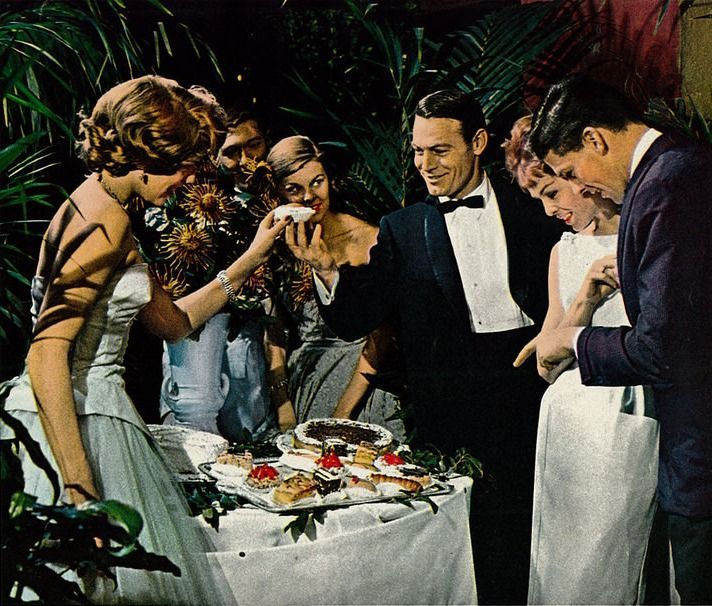
A room full of people politely extracting coordinates from one another.
This is also why these questions tend to produce different responses. They do not ask the other person to summarize themselves; they invite them to elaborate on something specific. The conversation, if it develops, does so around a shared point rather than along parallel lines of self-description.
It would be easy to idealize this as a superior form of interaction, but that would miss its limitations. It is selective. It depends on the presence of something that genuinely engages attention. In its absence, one remains silent or withdraws. It does not offer a general solution to the problem of social exchange; it offers a different criterion for participation.
What it does provide is a way of distinguishing between questions that are asked to maintain a structure and questions that are asked because they are necessary—not in any objective sense, but in the sense that they arise from a moment that cannot be ignored. In this light, the refusal of the script is not merely negative. It is not simply a rejection of certain questions, but an affirmation of a different threshold for asking them at all.
The result is fewer questions, but also, potentially, more precise ones. And with precision comes the possibility—again, no more than a possibility—of an exchange that does not feel like repetition.
It might be tempting to say that small talk is trivial, and therefore not worth thinking about. But that would be to miss how much work is being done under the surface. Script questions do two things at once: They relieve both parties from the burden of improvisation, and they allow for rapid placement: cultural, financial, geographical, aspirational. In a few exchanges, a person is situated, not in the sense of being understood, but in the sense of being indexed.
At some point, it became difficult to tell whether I was speaking or simply repeating. Each exchange was a variation of the last, each answer a slight adjustment of something already said. The repetition under mild obligation turned the interaction into something almost mechanical. I could not leave, not immediately. I could not refuse entirely, not without consequence. So I stayed within it, moving from one exchange to the next, each one beginning in exactly the same place.
The remarkable thing is how little resistance this system encounters. The questions are accepted because they are familiar, and they are familiar because they are accepted. It is a closed loop. One participates not because one is curious, but because one recognizes the form. The entire exchange proceeds on recognition rather than attention.
There is something faintly comic about this, although the comedy is rarely acknowledged. Two people stand in front of each other, exchanging fragments of biography that neither will remember, performing a ritual whose purpose is acknowledged only tacitly. The questions are asked, the answers are given, and both parties move on, slightly more informed and not at all more connected. By the end of it, nothing had happened in any memorable sense. No conversation stood out, no detail remained. Only the impression of having moved through a series of identical openings, each one leading nowhere in particular, each one quietly reinforcing the structure that produced it.

The smiles are genuine. The questions are automated.
If this essay has so far described the script, here it begins with the attempt to step out of it, not in theory, but in practice, and not always successfully. At first, my instinct was not to refuse, but to disrupt. I began by answering only the first question and then, regardless of what followed, repeating the same answer. A kind of quiet sabotage. The conversation continued, but no longer coherently. The questions moved forward; the answers did not. It created a slight dislocation, almost Eugène Ionesco–like, in that language was still functioning, but meaning had slipped out of it. Some people did not notice. They continued asking, not because they were curious, but because they had not been listening in the first place. The script was stronger than the exchange. It did not require attention to proceed. Others noticed something was off, but did not quite know how to respond. The rhythm had been broken, but not enough to justify stopping. So they pressed on, as if the situation could be repaired by continuing. This was instructive. It revealed that much of the interaction depends less on content than on continuity. As long as the sequence is maintained, the conversation is considered intact, even if it has ceased to make sense.
The second attempt was more explicit, but still indirect. “Today, that is my secret.” It worked, briefly. It produced laughter, which is often a way of smoothing over minor disruptions. For a moment, the script loosened. But then something curious happened: The question was repeated. The line had been received as a joke, not as a boundary. When I clarified that it was not a joke, the tone shifted slightly, but the structure remained. The question, again, returned. There is something revealing in this persistence. A statement that does not fit the expected pattern is often reinterpreted until it does. If it cannot be placed as an answer, it is recoded as humor. If it resists humor, it is treated as an anomaly to be corrected. The system absorbs deviation by reframing it.

They mistook information for connection and called it socializing.
At that point, the only remaining option was clarity. “I don’t feel like talking right now. Thank you. It’s not you, it’s me.” This is the moment where the script is no longer bent or disrupted, but directly declined. The terms of the interaction are made explicit. There is no ambiguity, no invitation to continue, no attempt to soften the boundary beyond basic courtesy. And yet, even here, something unexpected occurred. The person continued, as if my statement had not been heard. The questions resumed, unchanged. It was not confrontation, but something stranger: a refusal to register the refusal.
This was perhaps the most revealing moment of all. The script is not only a shared structure; it is also, at times, a filter. Anything that does not conform to it risks not being processed. The expectation of participation is so strong that withdrawal can be, quite literally, invisible.
At that point, there was nothing left to say. So I walked away. This, finally, is the simplest form of refusal. Not rhetorical, not strategic, not even particularly expressive. It does not argue, explain, or justify. It removes oneself from the situation altogether. It is not a correction of the interaction but an exit from it. What emerges from these small experiments is not a single solution, but a spectrum of possibilities. There is disruption, where the script is followed in form but not in substance. There is deflection, where the answer shifts the terms of the exchange. There is play, where the response is ambiguous enough to unsettle the pattern. There is clarity, where the interaction is directly declined. And finally, there is departure, where the interaction is simply ended.
Each has its place. Each produces a different effect. None guarantees a particular outcome. What they share is a refusal to accept the script as inevitable. It would be easy to frame this as a rejection of politeness, but that would be inaccurate. The goal is not to be impolite, but to redefine what politeness allows. Politeness does not have to mean participation in every offered exchange. It can also mean recognizing one’s own limits and expressing them without hostility.
The difficulty lies in the fact that these limits are not always acknowledged by others. The script assumes availability. To withdraw from it is to introduce a form of asymmetry. One person continues; the other stops. The resulting tension is not a failure, but a consequence. There is, finally, a question of whether any of this matters. After all, these are small interactions, easily forgotten, part of the background of social life. But it is precisely their smallness that gives them their persistence. They accumulate. They define the texture of encounters, the baseline of communication. To alter them, even slightly, is to introduce variation into a system that depends on repetition.

Somewhere off camera, someone is asking where the children go to school.
Most of the time, nothing dramatic happens. The conversation ends, or continues elsewhere, or dissolves into something equally familiar. But occasionally, there is a moment—brief, unplanned—when the script does not reassert itself immediately. A pause, a shift, a question that is not already known. Those moments cannot be forced. But they can be made possible. And sometimes, the most precise way to make them possible is simply to stop speaking and leave.
Lara Schmegegge prefers not to specify where she is from, where she studied, where she lives, or what she does.
Cover image: Nothing says spontaneity quite like rehearsing the same conversation six times before dessert.
Of course, the seven anodyne questions you begin the article with also function to determine status and class. You can't ask what do you earn or how much did you inherit from your parents, but school, university, job all make do as proxies. In the UK [they say] they listen to your accent or look at your shoes. Certainly, in my city in _________ the second, or even the first, question you are asked is which part of _________ are you from. At which point the intricacies of class, income, background, heritage are laid out plainly for anyone from that city to see.