

THE WORLD IS A STAGE
THE VANISHING PROFESSIONS: A CATALOGUE OF JOBS THAT NO LONGER MAKE SENSE
ODETTE MARSDEN
December 16, 2025
A look at the kinds of work that quietly slipped out of daily life. How ordinary tasks once relied on people whose roles have faded away. Why certain jobs vanished as technology changed our routines. What we lose when human presence is replaced by automation. And a personal note from someone who lived through several of these shifts.
There is a particular kind of disappearance that unfolds without spectacle—a disappearance so thorough that it leaves behind no ruins, no relics, no visible evidence that the vanished thing ever existed. One day a profession is woven into the texture of daily life—its gestures familiar, its presence assumed—the next, it is reduced to an anecdote recited with faint amusement to someone too young to understand why such work was ever necessary. These are the vanishing professions—the occupations that once embodied the rhythms of the world and now survive only as faint outlines in memory, like the ghosts of social structures we no longer inhabit. They faded not because they ceased to function, but because the world around them reshaped itself so decisively that their logic evaporated.
The elevator operator is perhaps the clearest example of this kind of disappearance, though even to say “operator” now feels archaic, a quaint term from an era when upward movement required human ceremony. The last time I encountered one, he stood beside a brass control panel and performed a gesture that felt improbably elegant: a slight pivot of the foot, a steady hand on the lever, a quiet acknowledgment of the passenger’s destination. Floors were not selected; they were announced. The elevator itself became a small, transitional room governed by ritual rather than machinery. And the operator—attentive, poised—transformed the vertical journey into a human encounter. Today, elevators behave with a kind of mute efficiency. You enter, press a button, feel the shift of cables and gears. Nothing is acknowledged. Nothing is seen. The disappearance of the operator is not merely a story about automation; it is a story about our growing intolerance for pauses, for the brief social choreography that once punctuated the day. What vanished with the operator was an entire attitude toward movement and attention.

A brief era when every conversation passed through human hands.
A similar kind of disappearance befell the telephone operator, the unseen intermediary who once connected nearly every call. Entire buildings were filled with women whose daily labor consisted of linking voices, translating desire into connection by way of cords, plugs, and practiced coordination. “Number, please,” they would say, a phrase that now sounds theatrical, even artificial. Yet this voice mediated thousands of intimate or urgent exchanges—lovers reaching across distance, parents checking on children, doctors contacted in panic, bankers negotiating terms, strangers seeking information. The operator existed in the space before privacy became a technological expectation. For her, communication was a form of stewardship. She heard fragments of conversations she would never repeat, participated silently in the daily dramas of people she would never encounter in person. Today, we imagine ourselves more secure because algorithms, not humans, handle our calls. But the illusion of privacy offered by modern telecom systems is precisely that: an illusion. Our conversations are now monitored by machines far more intrusive than any operator. Yet because they are not human, we imagine ourselves unobserved. What vanished with the operator was not only a profession, but the recognition that intimacy once required a human intermediary, someone whose presence affirmed that connection depended on attention, not automation.
Other professions disappeared more quietly, like the movie projectionist, whose booth once functioned as a sanctum of light and motion. For most of the twentieth century, every film that reached an audience passed through a projectionist’s hands. They threaded reels, monitored focus, adjusted tension, replaced bulbs, listened to the machine the way a pianist listens to the tremor of a string. Projection was a craft, an act of stewardship that required equal parts precision and intuition. A film screening was not simply a technological event; it was a fragile encounter sustained by the steadiness of a single pair of hands. When digital projection arrived, the occupation collapsed almost overnight. Images now glide onto screens without the mediation of a person who understands something of how they are made. The projectionist’s disappearance represents the broader shift toward a world in which images demand nothing from us and require no one to shepherd them into existence. It is the triumph of the frictionless, the seamless, the unmediated.

Guardian of the reels, last to know when the future stopped needing spools.
The most emblematic of the vanishing professions may be the lighthouse keeper, a figure who stands at the boundary between memory and myth. For centuries, he was the sentinel watching the horizon, a solitary guardian entrusted with the task of ensuring that a single light remained visible in darkness and storm. He tended the flame, cleaned the lenses, wound the mechanisms, and looked out across the water for signs of danger. His job was not simply technical; it was existential. He existed so that others might avoid catastrophe. His labor was measured not in tasks but in presence. When automation replaced him, it was not because machines performed better, but because society no longer tolerated the economic or logistical difficulty of maintaining a human in such isolation. The lighthouse keeper’s disappearance signaled a profound shift in how we conceive of responsibility. We no longer imagine danger as something that requires a person to stand guard. The idea that human vigilance could be the last defense against catastrophe now feels archaic. In losing the keeper, we lost not only a profession but a cultural metaphor: the belief that safety can depend on the unwavering attention of a single human being.
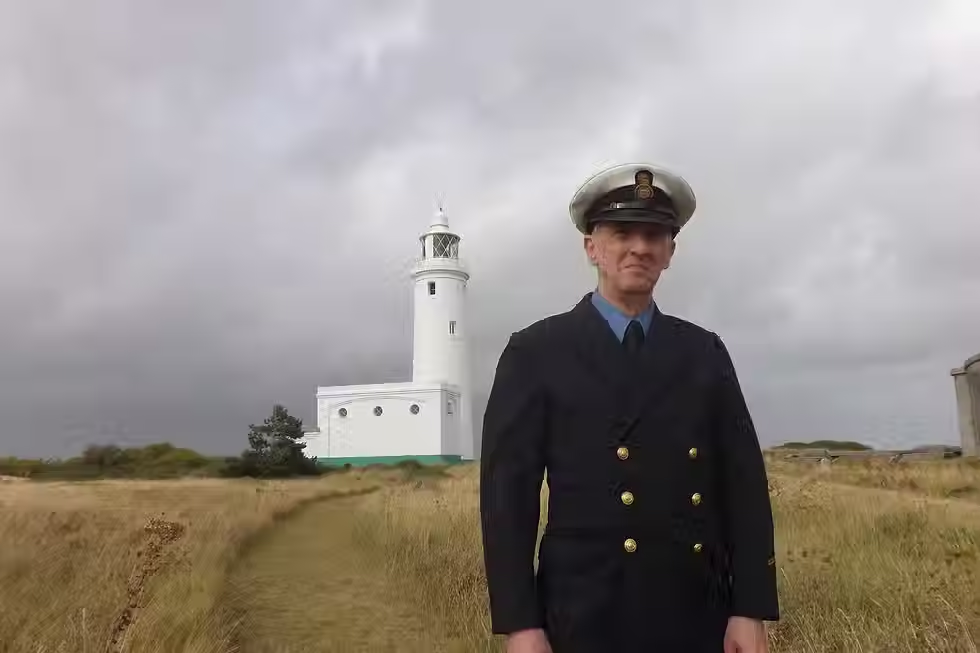
Stationed at the edge of the world, tasked with keeping ships from discovering it.
Other professions disappeared so gradually that few noticed. The bank teller, for instance, who once mediated the entire relationship between individuals and the financial system, whose steady hands legitimized the transfer of money, whose small talk softened the indignity of economic dependence. Even when tellers remain, their function has been eroded. Trust has migrated into abstraction. We are now content to conduct transactions through glass screens and scripted interfaces. The teller vanished because we began to prioritize efficiency over reassurance, autonomy over conversation. In doing so, we accepted a world in which money moves without passing through a pair of human hands.

Before ATMs counted the money, someone had to look you in the eye.
Or take the travel agent, a profession that evaporated the moment we convinced ourselves that algorithms knew more than experts. For decades, the travel agent acted as a guide through the bewildering geography of global movement. They interpreted timetables, compared routes, explained border regulations, understood which airlines were unreliable, which hotels were forgiving, which destinations required a temperament certain travelers did not possess. Their work was clerical, but also curatorial. With the loss of the travel agent, we lost the sense that a journey acquires meaning when mediated by someone who has traveled more widely than we have. In their disappearance, travel became less personal, less narrative, less anchored in human counsel.
Then consider the professions built entirely on the practice of listening—stenographers, dictation typists, transcriptionists. Their value lay not in the mechanical reproduction of speech, but in the kind of attention they cultivated. To take dictation was to inhabit another person’s thought patterns, to enter their verbal rhythms. The typist was a vessel, a witness, and sometimes an interpreter. Such roles demanded concentration of a kind that has become increasingly rare. The software that replaced them may be efficient, but it cannot listen the way a person listens: with judgment, hesitation, intuition, moral awareness. The disappearance of these listening professions marked a cultural shift in which attention itself became a scarce commodity.

Once upon a time, a stranger told you where to go—and you thanked him.
What unites all these vanished roles is not the irrelevance of the tasks they performed, but the irrelevance of the human presence that once performed them. Their disappearance reveals a world increasingly structured around the absence of mediation, the erasure of friction, the replacement of human intervals with automated continuities. A vanishing profession is a profession that contained an element of surplus—a degree of human involvement no longer considered necessary by a society obsessed with optimization. But this surplus was not waste; it was texture, it was meaning, it was the small residue of humanity that made even mundane interactions feel grounded in shared experience.
When these professions disappeared, something else disappeared alongside them: the choreography of everyday life. Elevators no longer involve the ritual of being announced or acknowledged. Phone calls no longer begin with a brief exchange mediated by a human voice. Films appear on screens without passing through the fingers of someone who understands the fragility of the image. Coastlines flash with automated lights that suggest preparedness but lack the quiet gravitas of a person who keeps watch. Money circulates without ever being counted by another human being. Journeys unfold without guidance, as if the world itself were self-navigating.
We tend to imagine that modernity progresses by subtraction: fewer steps, fewer obstacles, fewer intermediaries. But what has been subtracted from the world is not merely inefficiency. It is the human choreography that once animated the flow of experience. The vanishing professions remind us that the world used to make room for presence—not the abstract presence of data or algorithms, but the simple presence of a person who performed their task with a mixture of skill, attention, and patience.
Now, we accept that machines perform many of these roles more efficiently. But efficiency is not a value without consequence. What has been lost is the recognition that some tasks—particularly those involving movement, communication, or safety—benefit from the dignity of human attention. There is something reassuring about a person who looks you in the eye before taking your money, about a voice connecting your call, about a projectionist adjusting the frame, about a lighthouse keeper judging the color of the sky. We have gained speed, autonomy, and convenience, but we have lost the small gestures that made the world feel inhabited.
These disappearances are not tragic. Progress rarely is. But it is revealing. Certain professions served as connective tissue, binding individuals to systems through the conduit of another person’s attention. As they vanish, we glimpse the contours of our own time: a world in which we move more quickly but touch less, communicate more widely but witness less, travel more freely but trust less deeply. The world has not become empty, exactly, but its human scaffolding has grown faint.
A vanishing profession is a memory of a posture, a gesture, a tone of voice. It is a reminder that the world once depended on hands we can no longer see. And though we do not mourn them, perhaps we should occasionally look for their absence—not to summon them back, but to remember when human presence was not a redundancy but a necessity.

When every sentence arrived by keystroke and personal sacrifice.
My interest in vanishing professions is not academic. I have held several of them myself. I myself have been the anonymous intermediary, the quiet facilitator, the person whose work depended on presence rather than visibility. I have inhabited positions that required attention more than expertise, patience more than ambition, discretion more than authority. I have been the projectionist alone in the booth, the typist hired to transcribe someone else’s thoughts, the clerk whose signature once mattered and then suddenly didn’t. These jobs were not glamorous, and yet they shaped the way I see the world: as a series of fragile connections that someone must hold together, even briefly, so that meaning can pass between people.
Now I find myself in another such profession, one that has not yet fully disappeared but is already dimming at the edges. I am, quite simply, a writer—someone who arranges words for a living, someone whose task was once considered a profession rather than an eccentricity or a leftover craft. Writing was once a trade, a livelihood, a compact between the one who observes and the ones who wish to understand. I am a kind of cultural interpreter—part editor, part archivist, part witness, part custodian of other people’s stories. It is a role that once felt indispensable, and yet I can feel the floor shifting beneath it, the soft rumble that precedes disappearance.
Writing is now sliding toward the category of things the world can increasingly generate without us. And I can feel it: the slow erosion of the ground beneath my feet, the shift from necessity to novelty, from vocation to vestige. Soon this occupation, too, will join the others in the quiet museum of things the world no longer requires. I am, in truth, already halfway out the door. Not because I wish to leave, but because the profession itself is vanishing around me, dissolving like smoke into a future that no longer has a place for such work.
Which is perhaps why I have written this catalogue at all: as a way of acknowledging that professions disappear not with a crash, but with a shrug, and that sometimes the last person performing them does not realize they are the last until they themselves have nearly vanished. If there is a lesson, it is simply this: that to practice a profession on the verge of extinction is to know both the weight and the lightness of being unnecessary. I have carried both. Soon enough, I will set them down.
I do not say this with bitterness. I say it with quiet recognition. I am becoming the last occupant of a room whose walls are thinning and whose door is already half open.
Odette Marsden (b. 1979 in Winnipeg) comes from a place where winters last longer than most professions, and the wind knows more about persistence than the labor market. Schooled in whatever jobs were still standing—projection booths, switchboards, clerks’ counters, each now quietly retired—she is, for now at least, a writer of long sentences.
Cover image: Evidence from a time when vertical motion required a witness.
This was a really interesting read. The idea of jobs that no longer make sense made me think about how fast the world changes and how many skills we take for granted. Some of the examples were surprising and made me smile. It also made me wonder which professions might disappear next. Thanks for sharing these stories.
Best,
Bernard Trentin
Flower delivery France
I have to say Travel Agents have made somewhat of a comeback. After working 32 years in the printing profession, I retired from that and went back to school to become a Leisure Travel agent which I enjoyed immensely. I am now 77 and enjoying retirement, but it was really fulfilling helping clients plan their trips, some of them trips of a lifetime assisting them with all the details and extra perks I could obtain for them.
Thank you for writing one of the more interesting, insightful, philosophical and poignant articles about something I expected to be more of what you point out is happening: only a listicle and brief summary of the loss of job types. Bravo!