

BRICK BY BRICK
WINNIPEG: THE FUTURE WENT ELSEWHERE
EDGAR P. DALLOWAY
October 13, 2026
Once Canada’s third-largest city, Winnipeg built railway hotels, imposing banks, and broad streets in the expectation that its importance would endure. A winter visit reveals the distance between that confidence and the city’s present place in the world. Moving from the grandeur of Union Station to a sushi restaurant supplied daily from Vancouver, this essay considers how decisions made thousands of miles away can alter a city’s prospects—and how easily a visitor can mistake the visible remains of an earlier ambition for the whole story of a place. Between punishing cold, monumental architecture, and the practical business of keeping life going, Winnipeg repeatedly unsettles the assumptions brought to it.
The streets in Winnipeg allowed for more traffic than was using them. I was there in winter, when crossing one of those streets gave its width an immediate physical significance. On the opposite sidewalk stood another substantial building, another entrance behind which there would be heat. The city offered considerable space between these arrangements. I had never been anywhere so cold.
I had come to give a lecture at the University of Manitoba on the literature of the American Midwest. There was something geographically reasonable about the invitation, although I was less certain about its intellectual consequences. I had prepared remarks about provincial life, distance, and the peculiar authority acquired by people who leave a place and subsequently explain it. Then I boarded a plane to explain these things somewhere else.

In the middle of nowhere, at the center of everything. Depending on the century.
The cold made an early correction to my preparation. Distance ceased to be an imaginative condition when the exposed parts of my face began to hurt. I acquired a particular concern for my ears. They seemed insufficiently attached, vulnerable to a climate for which the rest of me could at least be dressed. I had packed for winter. Winnipeg appeared to regard this as a preliminary gesture.
There was a procedure for leaving buildings. The car’s heating was started via remote, and we waited inside while it warmed. Museum lobby, restaurant entrance, university doorway—these became places of suspended departure. Coats were on. Conversation continued. Outside, the car was making itself habitable. Eventually it was deemed warm enough, and we crossed the remaining distance with an urgency appropriate to the task.
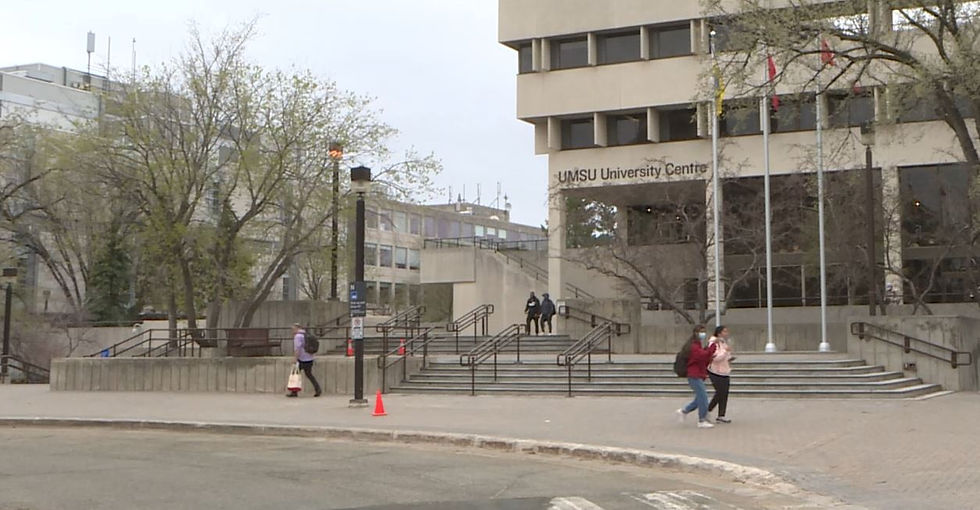
A suitable place to explain provincial life, having flown in with a return ticket.
My hosts treated this as ordinary. I found it almost ceremonious, a small collective acknowledgment that stepping outside required arrangements. The warmth of the car had to be established before we entered it. I had been accustomed to assuming that the next space would be tolerable upon arrival. I began to wonder why people had ever come here.
The question was naive, although the weather gave it some force. People already lived here long before anyone began selling the place as an opportunity. They had knowledge, routes, practices, and attachments for which my discomfort supplied no useful measure. But for the later arrivals, those drawn into the railway city and its expanding economy, the winter must also have been a factor. What prospect had made it acceptable? What were they expecting in return?

The Fort Garry Hotel: When the railway booked a room, it expected to need a château.
The Fort Garry Hotel suggested that the expectations had been substantial. Its steep roof and stone facade belong to an age when railway companies considered a château an appropriate statement of corporate purpose. Built for the Grand Trunk Pacific Railway between 1911 and 1913, it expressed confidence about who would arrive in Winnipeg and how they should be accommodated. The railway would deliver the guests. The hotel would assure them that they had reached somewhere important.
Nearby, Union Station supplied another assurance. Built between 1908 and 1911 to designs by the New York firm Warren and Wetmore, its Beaux-Arts frontage and domed central space gave arrival a public grandeur. A station of this scale made a journey appear to culminate in something. The hotel then extended the promise into an overnight stay. Together they provided an imposing answer to my question about coming here.
There was something of Detroit in the space around the buildings, although the association was imprecise. It had to do with the feeling that the streets had been prepared for a volume of activity which had subsequently diminished. But Winnipeg did not have Detroit’s appearance of physical abandonment. The resemblance was atmospheric, and therefore convenient to someone who knew very little about either city’s present circumstances.
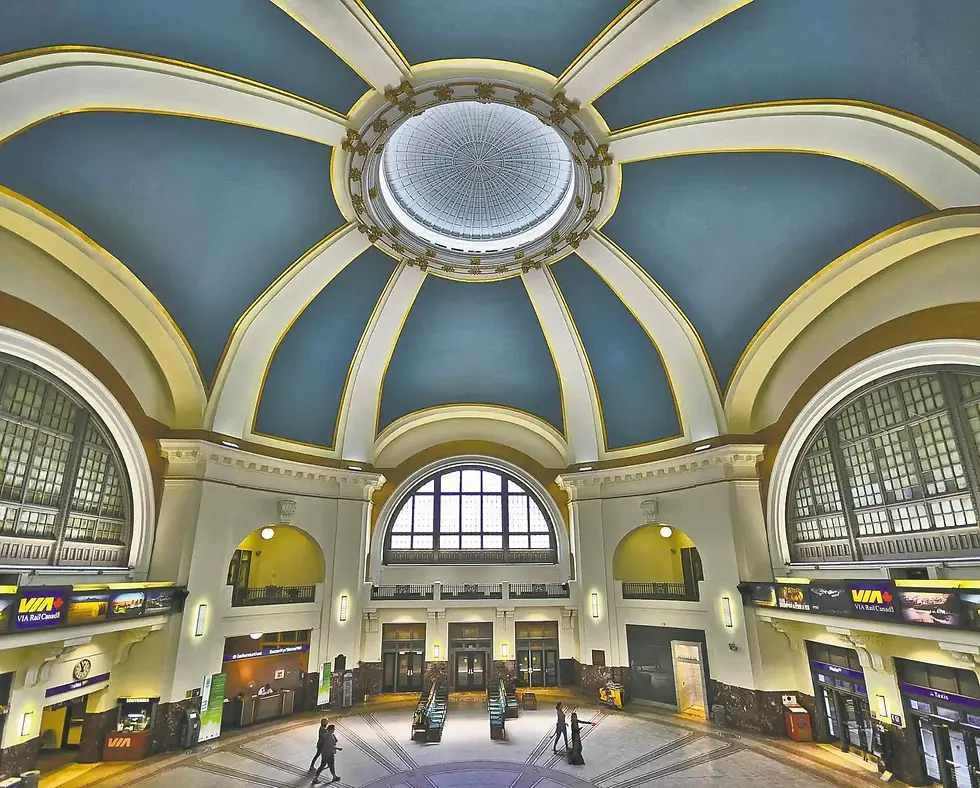
Union Station, where even a modest arrival could enjoy a very high opinion of itself.
Later, reading about Winnipeg, I learned that in 1911 it had been Canada’s third-largest city. Montreal, Toronto, Winnipeg—I returned several times to the order of those names. It made the hotel intelligible. It also made my initial indifference seem provincial. I had placed Winnipeg somewhere in the interior of my idea of Canada, away from the cities whose institutions and real estate difficulties receive international attention. Its buildings preserved another hierarchy. Their dimensions were evidence. I had imagined them as atmosphere.
The former Union Bank Building, erected in 1903–4, was an early skyscraper, its height declaring the importance of finance on Main Street. The Manitoba Legislative Building, formally opened in 1920, carried that confidence into government: classical columns, a dome, Manitoba Tyndall limestone, allegorical figures representing qualities public institutions love to announce for themselves. Winnipeg had given commerce and administration room to appear consequential.

The Union Bank Building: Money had passed through Winnipeg and decided it needed more floors.
The winter made these buildings feel particularly deliberate. Stone had been quarried, transported, carved, and assembled in a place where getting from a doorway to a car could require consultation. The climate had plainly failed to discourage ambition. From the warmth of an entrance hall, this seemed admirable. Outside, admiration became more difficult to sustain.
Occasionally a place supplies a fact that reorganizes a visit after it is over. Something seen without much attention becomes consequential. One has already left the street when one begins to understand why it looked that way. The return takes place through documents, maps, photographs. Memory now accommodates information it did not possess at the time.
Winnipeg’s importance had depended on movement. At The Forks, where the Assiniboine joins the Red River, Indigenous peoples had gathered and traded for thousands of years. Routes connected the plains and the northern forests long before the railway. The fur trade introduced further connections and rivalries. Goods and provisions traveled into the interior; pelts traveled out. What later appeared to newcomers as the promising location of a new city was a location whose possibilities had already been understood and leveraged.
The railway changed the scale and the terms. Winnipeg became a center for the western grain economy, wholesale distribution, finance, and businesses accompanying settlement. People came for work, land, trade, family connections, the possibility of improving circumstances elsewhere denied them. Climate was simply one condition among many. My question had given comfort a priority that the circumstances of migration do not always permit.

Several inhabitants inconveniently disproving the visitor’s theory that nobody goes outside.
In the Exchange District, grain was graded, bought, financed, insured. Goods waited in warehouses before traveling farther. The district took its name from the Grain and Produce Exchange, founded in 1887. Money passing through Winnipeg acquired offices, staircases, facades. Brick and stone gave temporary advantages a persuasive appearance of permanence.
Then there was the Panama Canal.
It opened in 1914, thousands of miles from Manitoba, and helped change the advantages of shipping through the Pacific. Vancouver’s position strengthened. Winnipeg’s role in the western grain and wholesale economy became less secure. Changes in freight arrangements, competing centers, and the wider economy also contributed to its relative decline. A channel was cut through Central America. Calculations were revised. Some of the buildings in Winnipeg began to belong to a different future.
I had thought of the city’s breadth as a local condition. The canal suggested a less reassuring account of place. A hotel could remain physically unchanged while the network that justified its construction altered around it. The building continued to receive guests. The winter continued to arrive. The advantages that had made both seem worth accommodating were subject to decisions elsewhere.
Winnipeg kept growing. This mattered, because I had begun assembling an explanation around decline with very little resistance from the word itself. Its metropolitan area contained more than 834,000 people in the 2021 census, ranking eighth in Canada. Historical city populations and contemporary metropolitan populations are different measures, but the loss of relative position was clear. Other places had risen faster.
My impression of emptiness could no longer stand as evidence of a population simply disappearing. It belonged to a more complicated distribution of activity, people, and investment. It also belonged to winter. I had been searching the pavements for urban life while participating in an elaborate local practice of remaining indoors.

“Open daily” offers a useful qualification to any visiting theory of decline.
Chinatown required another revision. Chinese shops helped establish the district around King Street in 1909, during Winnipeg’s commercial expansion. Laundries, restaurants, and associations supported people whose labor was needed and whose place in Canada was constrained by discrimination and restrictive immigration laws. The prosperous city and the exclusionary city occupied the same map.
A railway hotel advertised the importance of Winnipeg. A laundry sustained someone’s place in it. The hotel survives as an object through which visitors interpret the past, while much of the work supporting that past is harder to recover. I began to think about what had been required to maintain the city’s appearance of confidence, and about the lives its most imposing facades did little to announce.
I had wanted to know what was left of Chinese Winnipeg. The wording was already leading me toward an answer. Many Chinese residents and businesses had moved beyond the historic district. A comparatively quiet Chinatown could coexist with lives established elsewhere. Community-led redevelopment in the 1980s had also produced the gateway, the Chinese Heritage Garden, housing, and the Dynasty and Mandarin buildings. The Chinese Cultural and Community Centre gave institutional form to a continuing presence.

Saint-Boniface Cathedral, declining to become a convenient metaphor for the visitor.
Across the Red River, Saint-Boniface introduced a chronology that the commercial narrative could not contain. Here, French-speaking and Métis histories remained present through education, religious institutions, cultural organizations, and daily life. French belonged to the formation of the place. It had not arrived to provide Winnipeg with a picturesque quarter, although picturesque quarters are what travelers tend to request once they have exhausted the principal attractions.
I wanted to make the building explain Winnipeg: a present life within the dimensions of a larger expectation. But the cathedral had its own history, and the people using it were under no obligation to complete my metaphor. They had needed somewhere to worship. Architecture had supplied an arrangement in which the interruption remained visible.
There was also the matter of dinner. After the lecture, my host took me to a sushi restaurant. I found this surprising. An inland city, I apparently believed, should acknowledge its position by serving something that had not recently occupied an ocean. Beef would have been comprehensible. Freshwater fish would have shown geographical discipline. Sushi suggested a confidence I had previously reserved for Toronto, Vancouver, or Montreal. My host had booked a table rather than consulted my theory of Canadian sophistication. The meal was very good.

Vancouver supplied the fish. Winnipeg supplied the customers. The visitor supplied the surprise.
The owner, learning that I was visiting, explained with evident pride that the fish was FedExed every day from a fish market in Vancouver. He offered the information as a guarantee of quality. I received it as a revision of the map. Vancouver was part of the restaurant’s daily arrangements. Somewhere between the Pacific and our table, a tracking number had assumed responsibilities once assigned to geography.
I remembered a delicate plate of French cheeses served to me in Rapid City, delivered from San Francisco by a courier service. There had also been a lecture at a university in St. Louis, where I had expected a steak dinner and been taken to an Indian restaurant. My hosts had wanted to eat somewhere they liked. I was the one requiring the meal to confirm the location and satisfy my longing for local cuisine.
In Winnipeg, I felt the correction most strongly. The city’s earlier importance had depended on its ability to connect distant places. I had seen evidence of a diminished position and begun to imagine a diminished relationship with the world. But the restaurant owner was describing one such relationship in the present tense. He took pleasure in the arrangements. Fish was available in one place, customers in another, and a company was available to move the fish between them. The expense and timing were presumably less simple than the explanation. Still, he made distance sound like a manageable business matter. I had arrived prepared to treat it as a condition of the soul.
A century earlier, shifts favoring the Pacific port had helped weaken Winnipeg’s position. Now a business in Winnipeg was drawing on Vancouver to supplement what it offered locally. The transactions were incomparable in scale, but I kept returning to the connection. The city’s rank had changed. Its capacity to establish a relationship elsewhere remained an active concern.
I had come to speak about the American Midwest, prepared to discuss the interior as a place people inhabit, leave, remember, and explain. Winnipeg made me more attentive to the practical means by which people inhabit an interior: institutions, shipments, languages, buildings, the daily arrangements sustaining life in a place outsiders would find intolerable.
After dinner, we waited near the restaurant entrance while the car warmed. We would leave when it was ready. Outside lay the broad street that had first struck me as insufficiently occupied. For the moment, several of its inhabitants were standing beside me, talking, keeping warm.
Edgar P. Dalloway was born in Normal, Illinois, on February 29, 1964. He studied literature at the University of Iowa and specializes in Midwestern American fiction, particularly characters whose escape is perpetually postponed by one final obligation. He lives in Chicago, where he is completing a study of disappointment as a regional resource.
Cover image: The difficulty with reading a city through its buildings is that someone may be editing the text.
Comments